
Maribel Verdú defends owning three homes after decades of work
Spanish actress Maribel Verdú responds to criticism over her three properties, citing 30 years of honest labor amid Spain's housing crisis.
English · Original discussion in Spanish · Published
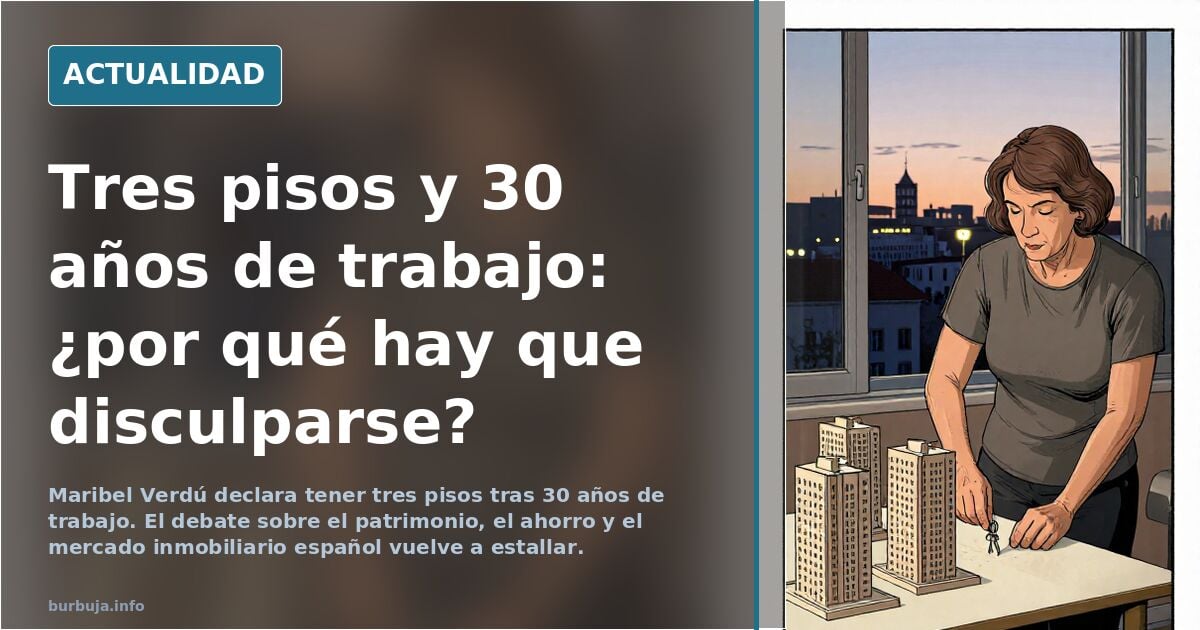
Maribel Verdú and her three homes: the controversy reigniting the rental debate
How many properties must one own to stop being a worker and become a rentier? Maribel Verdú, an actress with over four decades in the industry, responded to criticism for owning three real estate assets with an argument that ignited public debate: "I have three apartments, yes, but it is after working for 30 years and without stealing from anyone." The statement, made amidst growing social tension over housing prices, sparked a discussion far beyond the actress herself: the sarracena of savings, the role of landlords in the rental market, and the double standards applied to different groups.
The origin of the controversy: three homes and accusations of hypocrisy
The dispute stems not from the three properties themselves, but from the context in which they are claimed. Verdú, historically associated with pogre views, has been cited by part of public opinion as an example of the contradiction between discourse and practice. A common argument is that those who criticize speculators should not own multiple homes. The actress replied that her wealth is the result of work, not speculation, and that investing savings in real estate is not a crime.
The discussion extended to other public figures. The most cited case is Wyoming, a TV presenter who in a 2014 interview admitted to owning 19 properties in Madrid. "The thing about the apartments is true. I have worked in television for 30 years, earned a lot of money, and invest it where I want," he stated then. This comparison fueled the idea of a double sarracena standard: demanding from some what is forgiven in others.
Is renting a mortgaged home considered speculation?
The economic core of the debate lies in defining speculation. One frequently repeated definition suggests that if an owner still pays a mortgage and rents out the property, the rent charged should only cover the mortgage payment. Any excess is deemed speculative because the tenant would be covering the loan plus a margin. Proponents of this view argue owners should not profit at all.
However, this reasoning ignores real ownership costs: taxes, community fees, insurance, maintenance, vacancy periods, and default risks. It also overlooks that rental prices are set by supply and demand, not in a vacuum. In high-demand areas, a single apartment can receive hundreds of applicants within hours. Selection in such scenarios is rarely fair.
Housing as a savings refuge: why real estate absorbs capital
Part of the analysis focuses on why so many savers end up buying homes. The argument is well-known: leaving money in banks exposes it to inflation, eroding value; stock market investment involves risk and lacks tangibility; buying real estate, conversely, is perceived as a stable refuge. For decades, this flow of savings into construction financed much of Spain's new housing stock.
The problem is that this mechanism, taken to extremes, contributes to inflating prices and excluding those without prior wealth. An uncomfortable question looms: if honest savings lead to real estate due to a lack of attractive alternatives, is the saver or the system pushing them toward it to blame?
The fiscal proposal rarely discussed: taxing the third home
Among the concrete proposals in the debate is a measure that defenders claim is barely discussed publicly: limiting families to two homes—the primary residence and a vacation home—and applying very high income tax rates (IRPF) on any additional non-rented property. Currently, according to this analysis, the second and fourth homes incur similar tax burdens, a surprising reality.
The logic is simple: if holding empty homes becomes expensive, many will enter the market, lowering prices. The obstacle is political: such measures clash with a broad electorate viewing their home as their main asset. Additionally, another line of analysis notes that the State itself benefits significantly from every transaction through taxes and fees.
The elephant in the room: supply, demand, and immigration
Some argue the housing crisis would persist even if all available units were rented at €100. The demographic argument posits that if hundreds of thousands of people need housing annually in Spain, pressure on existing stock remains unsustainable. In many municipalities, dozens of candidates appear for every unit listed.
Others disagree, pointing to monetary expansion and public spending as root causes of inflation driving prices up. The disagreement on diagnosis explains why no solution succeeds. Meanwhile, the average owner—those who bought a home for retirement security or to help children move out—is caught between accusations of speculation and the reality that their property is often the only possible inheritance.
Two days after erupting, the debate still fails to answer the fundamental question: is owning three homes compatible with left-wing ideals? What is clear is that housing price unrest no longer distinguishes between actors, presenters, and ordinary citizens. And in Spain, talking about real estate means talking about everything else.
How many properties must one own to stop being a worker and become a rentier? Maribel Verdú, an actress with over four decades in the industry, responded to criticism for owning three real estate assets with an argument that ignited public debate: "I have three apartments, yes, but it is after working for 30 years and without stealing from anyone." The statement, made amidst growing social tension over housing prices, sparked a discussion far beyond the actress herself: the sarracena of savings, the role of landlords in the rental market, and the double standards applied to different groups.
The origin of the controversy: three homes and accusations of hypocrisy
The dispute stems not from the three properties themselves, but from the context in which they are claimed. Verdú, historically associated with pogre views, has been cited by part of public opinion as an example of the contradiction between discourse and practice. A common argument is that those who criticize speculators should not own multiple homes. The actress replied that her wealth is the result of work, not speculation, and that investing savings in real estate is not a crime.
The discussion extended to other public figures. The most cited case is Wyoming, a TV presenter who in a 2014 interview admitted to owning 19 properties in Madrid. "The thing about the apartments is true. I have worked in television for 30 years, earned a lot of money, and invest it where I want," he stated then. This comparison fueled the idea of a double sarracena standard: demanding from some what is forgiven in others.
Is renting a mortgaged home considered speculation?
The economic core of the debate lies in defining speculation. One frequently repeated definition suggests that if an owner still pays a mortgage and rents out the property, the rent charged should only cover the mortgage payment. Any excess is deemed speculative because the tenant would be covering the loan plus a margin. Proponents of this view argue owners should not profit at all.
However, this reasoning ignores real ownership costs: taxes, community fees, insurance, maintenance, vacancy periods, and default risks. It also overlooks that rental prices are set by supply and demand, not in a vacuum. In high-demand areas, a single apartment can receive hundreds of applicants within hours. Selection in such scenarios is rarely fair.
Housing as a savings refuge: why real estate absorbs capital
Part of the analysis focuses on why so many savers end up buying homes. The argument is well-known: leaving money in banks exposes it to inflation, eroding value; stock market investment involves risk and lacks tangibility; buying real estate, conversely, is perceived as a stable refuge. For decades, this flow of savings into construction financed much of Spain's new housing stock.
The problem is that this mechanism, taken to extremes, contributes to inflating prices and excluding those without prior wealth. An uncomfortable question looms: if honest savings lead to real estate due to a lack of attractive alternatives, is the saver or the system pushing them toward it to blame?
The fiscal proposal rarely discussed: taxing the third home
Among the concrete proposals in the debate is a measure that defenders claim is barely discussed publicly: limiting families to two homes—the primary residence and a vacation home—and applying very high income tax rates (IRPF) on any additional non-rented property. Currently, according to this analysis, the second and fourth homes incur similar tax burdens, a surprising reality.
The logic is simple: if holding empty homes becomes expensive, many will enter the market, lowering prices. The obstacle is political: such measures clash with a broad electorate viewing their home as their main asset. Additionally, another line of analysis notes that the State itself benefits significantly from every transaction through taxes and fees.
The elephant in the room: supply, demand, and immigration
Some argue the housing crisis would persist even if all available units were rented at €100. The demographic argument posits that if hundreds of thousands of people need housing annually in Spain, pressure on existing stock remains unsustainable. In many municipalities, dozens of candidates appear for every unit listed.
Others disagree, pointing to monetary expansion and public spending as root causes of inflation driving prices up. The disagreement on diagnosis explains why no solution succeeds. Meanwhile, the average owner—those who bought a home for retirement security or to help children move out—is caught between accusations of speculation and the reality that their property is often the only possible inheritance.
Two days after erupting, the debate still fails to answer the fundamental question: is owning three homes compatible with left-wing ideals? What is clear is that housing price unrest no longer distinguishes between actors, presenters, and ordinary citizens. And in Spain, talking about real estate means talking about everything else.
Also available in: Deutsch
Summary of a discussion on Burbuja.info - Foro de economía, actualidad y política., translated from Spanish and reviewed before publication. Read the full discussion (221 replies).
More summaries
-
Debate: Net Migration vs. Housing Supply in Madrid
Forum users debate if net migration of 600k-700k annually and low construction drive Madrid's housing price surge.
-
Iker Jiménez, VOX and the 'I don't know anyone' that doesn't add up
Iker Jiménez justifies VOX's absence from Horizonte by saying he doesn't know them, but his guest list includes non-parliamentary figures.
-
Non-stop techno thread hits 1,500 posts
A Spanish forum thread on electronic music reaches 1,500 replies, blending happy hardcore and military marches in a continuous community session.
-
First mpox death in Basque Country reported at Donostia Hospital
A 61-year-old cancer patient died of mpox at Donostia Hospital after contracting it from a roommate, marking the region's first fatality.
-
Brazil: Video shows forced hug of gay man by women
A viral video from Brazil shows men forcing a gay man to hug a woman, sparking debate on homophobia and machismo.
-
Viral claim of 'genocide' in Europe debunked
A viral post claims England dropped from 99% white in 1950 to 77% in 2026, citing similar figures for France and Quebec. Here is what the data actually shows.