
First mpox death in Basque Country reported at Donostia Hospital
A 61-year-old cancer patient died of mpox at Donostia Hospital after contracting it from a roommate, marking the region's first fatality.
English · Original discussion in Spanish · Published
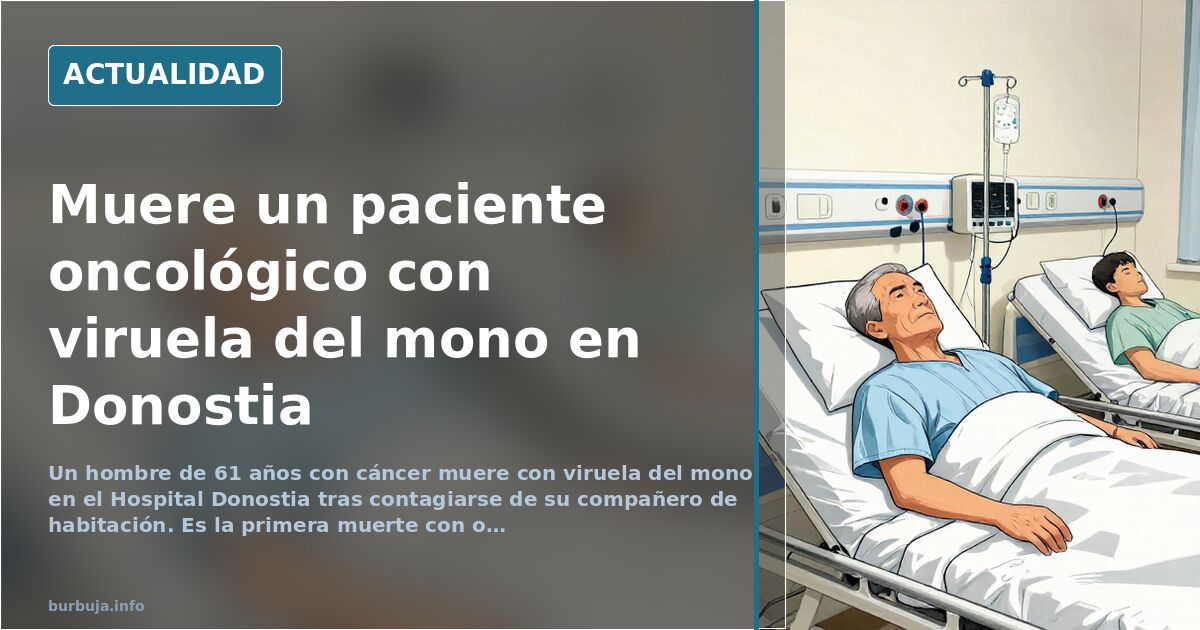
Cancer patient dies of mpox after sharing room at Donostia Hospital
A 61-year-old man admitted for oncological treatment in the Otorhinolaryngology department of Donostia Hospital has died after contracting mpox (monkeypox) from another patient with whom he shared a room. This is the first person to die with or from this infection in the Basque Country, raising an uncomfortable question: how did an immunocompromised patient end up sharing space with someone infectious at Gipuzkoa’s reference center?
The deceased had a tumor in his throat and neck and had been hospitalized for weeks. The other patient, admitted for a throat condition, was being treated with antibiotics for an infectious issue when his positive mpox status was still unknown. Once confirmed, he was discharged: mpox isolation is better managed at home, according to the hospital.
What Donostia Hospital officials say
Miguel Ángel Goenaga, Head of Infectious Diseases, appeared alongside Medical Director Sara Arévalo with a key statement: the patient died with mpox, not necessarily from it. Goenaga noted the deceased had serious underlying conditions and very low immunity, leaving open the possibility that a prior infection was the final cause.
Regarding transmission, the specialist suggested patients might have contacted each other at night or due to some incident. Osakidetza has vaccinated at least 30 close contacts of both cases to break the chain.
The unanswered question: why they shared a room
Health professionals are most concerned by what the official statement does not clarify: why an immunocompromised cancer patient shared a room with someone having an infectious pathology. Standard practice, they admit, involves prevention and isolation measures. Goenaga acknowledged the deceased had previous infections.
Some argue the bicho caused the death; others contend that a chemotherapy-depleted immune system makes any bacteria lethal. The debate on shared-room protocols continues, with EH Bildu submitting questions to the Basque Parliament demanding clarity on further outbreak cases and adopted measures.
Mpox data in Spain and the Basque Country
Since 2022 through late September, 10,535 cases have been diagnosed in Spain, 290 of them in the Basque Country. Most occurred in 2022 trinc outbreaks linked to events like Maspalomas Pride. However, there is a real surge: in the Basque Country, cases rose from 8 in all of 2025 to 35 in the first nine months of this year.
Two other people have died from mpox in Spain this year, both HIV-positive. Mpox spreads through close contact, skin-to-skin, or contaminated objects, with an incubation period of 3 to 17 days, and complicates in immunocompromised individuals, infants, pregnant women, and eczema patients.
The analysis stalls here: no one has yet explained why a tertiary hospital placed an immunocompromised patient next to an infectious one without knowing the latter’s status.
A 61-year-old man admitted for oncological treatment in the Otorhinolaryngology department of Donostia Hospital has died after contracting mpox (monkeypox) from another patient with whom he shared a room. This is the first person to die with or from this infection in the Basque Country, raising an uncomfortable question: how did an immunocompromised patient end up sharing space with someone infectious at Gipuzkoa’s reference center?
The deceased had a tumor in his throat and neck and had been hospitalized for weeks. The other patient, admitted for a throat condition, was being treated with antibiotics for an infectious issue when his positive mpox status was still unknown. Once confirmed, he was discharged: mpox isolation is better managed at home, according to the hospital.
What Donostia Hospital officials say
Miguel Ángel Goenaga, Head of Infectious Diseases, appeared alongside Medical Director Sara Arévalo with a key statement: the patient died with mpox, not necessarily from it. Goenaga noted the deceased had serious underlying conditions and very low immunity, leaving open the possibility that a prior infection was the final cause.
Regarding transmission, the specialist suggested patients might have contacted each other at night or due to some incident. Osakidetza has vaccinated at least 30 close contacts of both cases to break the chain.
The unanswered question: why they shared a room
Health professionals are most concerned by what the official statement does not clarify: why an immunocompromised cancer patient shared a room with someone having an infectious pathology. Standard practice, they admit, involves prevention and isolation measures. Goenaga acknowledged the deceased had previous infections.
Some argue the bicho caused the death; others contend that a chemotherapy-depleted immune system makes any bacteria lethal. The debate on shared-room protocols continues, with EH Bildu submitting questions to the Basque Parliament demanding clarity on further outbreak cases and adopted measures.
Mpox data in Spain and the Basque Country
Since 2022 through late September, 10,535 cases have been diagnosed in Spain, 290 of them in the Basque Country. Most occurred in 2022 trinc outbreaks linked to events like Maspalomas Pride. However, there is a real surge: in the Basque Country, cases rose from 8 in all of 2025 to 35 in the first nine months of this year.
Two other people have died from mpox in Spain this year, both HIV-positive. Mpox spreads through close contact, skin-to-skin, or contaminated objects, with an incubation period of 3 to 17 days, and complicates in immunocompromised individuals, infants, pregnant women, and eczema patients.
The analysis stalls here: no one has yet explained why a tertiary hospital placed an immunocompromised patient next to an infectious one without knowing the latter’s status.
Also available in: Deutsch
Summary of a discussion on Burbuja.info - Foro de economía, actualidad y política., translated from Spanish and reviewed before publication. Read the full discussion (33 replies).
More summaries
-
Mpox death in Spain: Patient infected by roommate at Donostia Hospital
A 61-year-old patient died of mpox after catching it from a roommate at Donostia Hospital. Osakidetza vaccinated 25 contacts.
-
Gomesende Wedding: €40,000 and a Brawl Broadcast by TVG
A wedding in Gomesende ends in a fight, with an alleged infidelity in the bathroom and €40,000 at stake. TVG broadcasts videos of the ceremony.
-
Brazil: Video shows forced hug of gay man by women
A viral video from Brazil shows men forcing a gay man to hug a woman, sparking debate on homophobia and machismo.
-
Viral claim of 'genocide' in Europe debunked
A viral post claims England dropped from 99% white in 1950 to 77% in 2026, citing similar figures for France and Quebec. Here is what the data actually shows.
-
Spain's Nov 29 election splits right-wing voters on abstention
Right-wing voters in Spain are divided over the November 29 election: some see abstention as punishing PSOE, others view voting as legitimizing it.
-
Alexandra Breckenridge Sparks Debate Over 'Pizpi' Meaning
The Spanish slang term 'pizpi' has triggered a debate about Alexandra Breckenridge's appeal and whether age matters in Hollywood.