
Why Russia Needs War to Avoid Collapse
Russia's 1% holds 56% of wealth while birth rates hit 1.44. These stark figures explain why Moscow cannot exit the war.
English · Original discussion in Spanish · Published
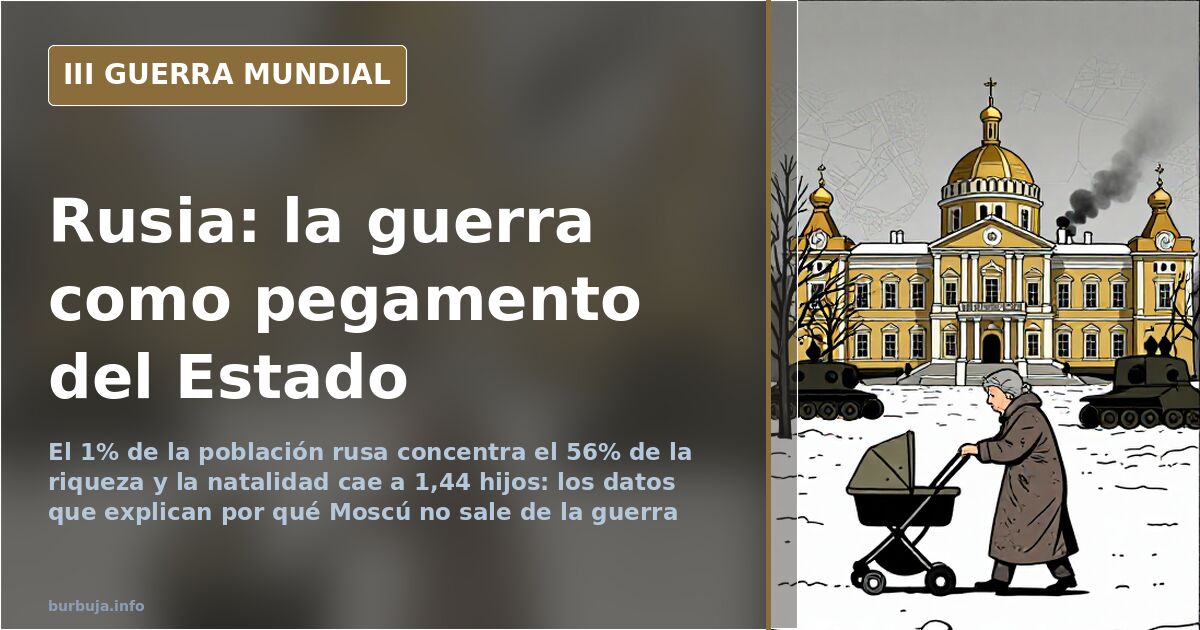
Why Russia Needs War to Sustain the State
Why is Russia constantly at war? The question admits many answers, but the one gaining ground in recent analysis is the least comfortable: because, fundamentally, it cannot afford peace. A state with 22 republics, an elite concentrating wealth, and a fading population needs something to keep it united. And that something, for a century, has been an external enemy.
Twenty-Two Republics That Only Hold Together with an Enemy Ahead
The argument rests on the country's own architecture. Russia is not a homogeneous nation: it is a federation of republics, each increasingly distinct and eager to leave rather than stay. The circulating hypothesis is that the leader's messianism and a romantic, almost operetta-like nationalism serve a very specific function: giving this mosaic a common cause. With the external enemy removed, the narrative loses its excuse, and the country would have to examine its internal problems. And here, this reading claims, there is nothing to show.
It is a comfortable thesis and difficult to prove, it must be said. But it explains why Moscow turns any defensive gesture by its neighbor —a missile shield, an association agreement— into an existential threat justifying mobilization.
The Double Standard: What the US Has Done Since 1945
The usual counter is the list. If Russia is bellicose, what about the United States? Since 1945, the record of US military operations outside its borders is long and detailed: in October 1945, it sent 50,000 marines to northern China, added to some 60,000 personnel already operating there. In April 1975, it evacuated Cambodia and Saigon —70 helicopters and 865 marines in the embassy operation—. In 1986, it bombed Libya. In August 1990, it launched Desert Shield in Saudi Arabia. Between 1992 and 2003, it maintained no-fly zones over Iraq. There were deployments in Sierra Leone, Nigeria, Yemen, and East Timor; Tomahawk missiles on a Syrian base in 2017; 300 soldiers in Cameroon; air strikes in Somalia, and the airlift in Kabul in 2021.
The objection to this list is equally obvious: much of these operations were evacuations of their own citizens, not conquests. It is precisely the nuance that separates an intervention from an annexation. And here is where the comparison breaks: moving troops is not the same as moving borders.
Pilingui, Absolute Master or Just the Visible Face?
Regarding the nature of Russian power, there are two readings. One describes it as an absolutist monarch capable of distributing pensions and even deciding which paving stone goes on which street, in a country where 1% of the population owns 56% of the wealth. He can ruin the richest millionaire if he contradicts him. The other downgrades the portrait: Pilingui would be merely the visible face of a handful of oligarchs, with no real capacity to direct the state as he pleases. Both versions agree on one point: there are no checks and balances.
The Demographic Verdict: 1.44 Children per Woman
Then there is the accounting that admits no narrative. Russia is depopulating and has been trying to reverse it for years without success. Its fertility rate hovers around 1.44 children per woman: above Canada's 1.33 —with half the surface area and a quarter of the population— and well above Spain's 1.16, but below generational replacement in all cases. A huge country, rich in resources, with fewer and fewer people to exploit them.
The Only Rule Governing the Board: Borders Are Untouchable
If there is one thing that structures this debate, it is the border as a red line. The formulation is clumsy but operational: you can fund governments, insert propaganda, even snipers; what you cannot do is take the land. Under this criterion, the most cited comparison is Panama versus Ukraine: the Central American country yielded to US pressure —a single official visit was enough— and there was no punishment; Ukraine did not yield, and there was. Hence the uncomfortable conclusion that disobedience does not come for free. In parallel, Finland, Sweden, and Poland are arming: no one with such a neighbor wants to trust paper again.
Under this logic, with several analyses pointing out that Ukrainian borders have shifted, the question ceases to be who started and becomes who has touched them. There is no tie there.
With this material, peace would be the worst possible scenario for Moscow: it would force looking inward, and inward lies half the wealth in the hands of 1% and a population that does not replace itself. War holds the building together. The bad thing about glues is what shows when they dry.
Why is Russia constantly at war? The question admits many answers, but the one gaining ground in recent analysis is the least comfortable: because, fundamentally, it cannot afford peace. A state with 22 republics, an elite concentrating wealth, and a fading population needs something to keep it united. And that something, for a century, has been an external enemy.
Twenty-Two Republics That Only Hold Together with an Enemy Ahead
The argument rests on the country's own architecture. Russia is not a homogeneous nation: it is a federation of republics, each increasingly distinct and eager to leave rather than stay. The circulating hypothesis is that the leader's messianism and a romantic, almost operetta-like nationalism serve a very specific function: giving this mosaic a common cause. With the external enemy removed, the narrative loses its excuse, and the country would have to examine its internal problems. And here, this reading claims, there is nothing to show.
It is a comfortable thesis and difficult to prove, it must be said. But it explains why Moscow turns any defensive gesture by its neighbor —a missile shield, an association agreement— into an existential threat justifying mobilization.
The Double Standard: What the US Has Done Since 1945
The usual counter is the list. If Russia is bellicose, what about the United States? Since 1945, the record of US military operations outside its borders is long and detailed: in October 1945, it sent 50,000 marines to northern China, added to some 60,000 personnel already operating there. In April 1975, it evacuated Cambodia and Saigon —70 helicopters and 865 marines in the embassy operation—. In 1986, it bombed Libya. In August 1990, it launched Desert Shield in Saudi Arabia. Between 1992 and 2003, it maintained no-fly zones over Iraq. There were deployments in Sierra Leone, Nigeria, Yemen, and East Timor; Tomahawk missiles on a Syrian base in 2017; 300 soldiers in Cameroon; air strikes in Somalia, and the airlift in Kabul in 2021.
The objection to this list is equally obvious: much of these operations were evacuations of their own citizens, not conquests. It is precisely the nuance that separates an intervention from an annexation. And here is where the comparison breaks: moving troops is not the same as moving borders.
Pilingui, Absolute Master or Just the Visible Face?
Regarding the nature of Russian power, there are two readings. One describes it as an absolutist monarch capable of distributing pensions and even deciding which paving stone goes on which street, in a country where 1% of the population owns 56% of the wealth. He can ruin the richest millionaire if he contradicts him. The other downgrades the portrait: Pilingui would be merely the visible face of a handful of oligarchs, with no real capacity to direct the state as he pleases. Both versions agree on one point: there are no checks and balances.
The Demographic Verdict: 1.44 Children per Woman
Then there is the accounting that admits no narrative. Russia is depopulating and has been trying to reverse it for years without success. Its fertility rate hovers around 1.44 children per woman: above Canada's 1.33 —with half the surface area and a quarter of the population— and well above Spain's 1.16, but below generational replacement in all cases. A huge country, rich in resources, with fewer and fewer people to exploit them.
The Only Rule Governing the Board: Borders Are Untouchable
If there is one thing that structures this debate, it is the border as a red line. The formulation is clumsy but operational: you can fund governments, insert propaganda, even snipers; what you cannot do is take the land. Under this criterion, the most cited comparison is Panama versus Ukraine: the Central American country yielded to US pressure —a single official visit was enough— and there was no punishment; Ukraine did not yield, and there was. Hence the uncomfortable conclusion that disobedience does not come for free. In parallel, Finland, Sweden, and Poland are arming: no one with such a neighbor wants to trust paper again.
Under this logic, with several analyses pointing out that Ukrainian borders have shifted, the question ceases to be who started and becomes who has touched them. There is no tie there.
With this material, peace would be the worst possible scenario for Moscow: it would force looking inward, and inward lies half the wealth in the hands of 1% and a population that does not replace itself. War holds the building together. The bad thing about glues is what shows when they dry.
Summary of a discussion on Burbuja.info - Foro de economía, actualidad y política., translated from Spanish and reviewed before publication. Read the full discussion (266 replies).
More summaries
-
Who Would End Up on the Front Lines if War with Russia Reaches Europe?
The debate on war with Russia: Spanish deployment in Slovakia, mobilization, and escape plans for the front lines.
-
Ukraine strikes Russian refineries and ports, analyses say
Analyses circulating cite 76 vessels and a third of Russian refining capacity hit, while Moscow's offensive is described as stalled
-
Gento's Daughter Seeks Inventory of Footballer's Estate
The Supreme Court confirmed Paqui Gento's parentage. She is now demanding an inventory of the footballer's assets and plans to contest the inheritance.
-
History's Most Beautiful Fighter: Su-35, F-14, or Me-262
The Su-35, F-14 Tomcat, and the German Me-262 lead the list of the most beautiful fighter jets in aviation history.
-
China extends Taiwan blockade drills after Pelosi visit
China surrounds Taiwan with military exercises and missiles falling in Japanese waters following Pelosi's visit.
-
Islam as a Threat: The Anatomy of a Geopolitical Fear
A 5% Muslim population threshold allegedly triggers Sharia law. This analysis explores how unverified demographic fears shape Western geopolitical narratives and political discourse.