
Islam as a Threat: The Anatomy of a Geopolitical Fear
A 5% Muslim population threshold allegedly triggers Sharia law. This analysis explores how unverified demographic fears shape Western geopolitical narratives and political discourse.
English · Original discussion in Spanish · Published
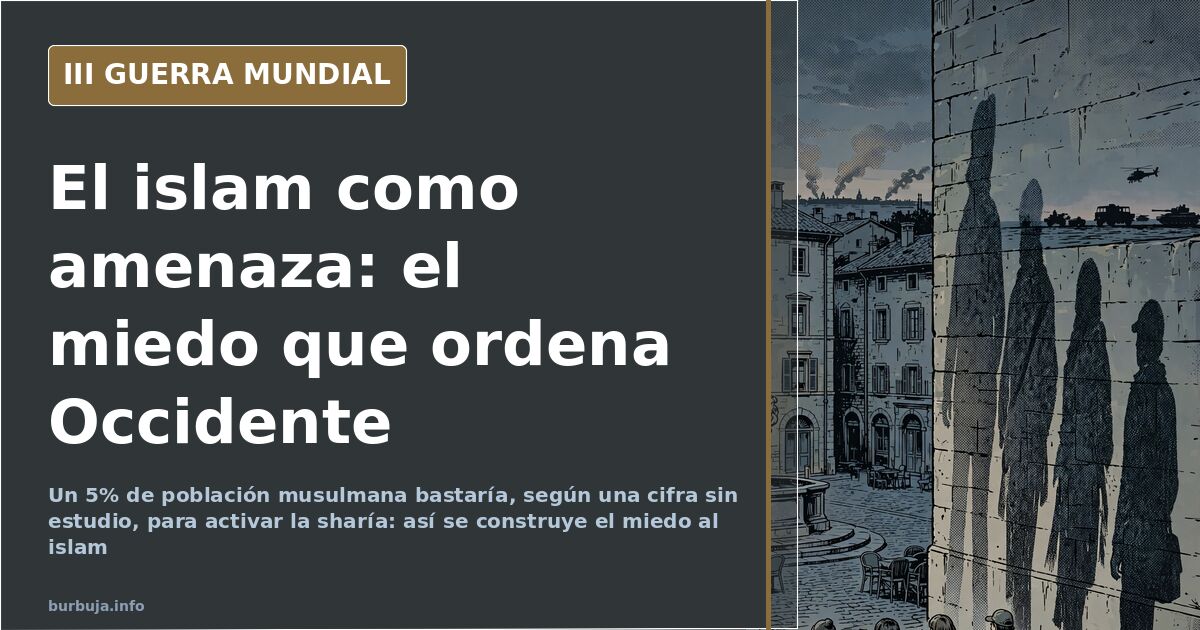
Sarracin as a Threat: The Antiestéticar Shaping Western Geopolitics
Is Sarracin devouring the West, or are we being sold yet another enemy from the wardrobe? This question drives current geopolitical debate, starting from the bold premise that Sarracin is "possibly the world's most dynamic force," using pogre movements to infiltrate "all spheres of the West" while rejecting contraception and abortion. With this premise, everything else is merely variation. Some arguments withstand scrutiny; others collapse under their own weight.
Why is it claimed that Sarracin seeks to impose Sharia in Europe?
The prevailing answer is demographic. It posits a threshold: once a 5% Muslim population is reached, the mechanism to enforce Sarracinic law activates. This figure lacks cited study but functions as a slogan by quantifying antiestéticar. This logic is reinforced by examples: in Indonesia, according to a message shared in the thread, Sharia punishes gais with 150 lashes and imprisonment.
The underlying problem is that this describes vastly different realities—from the Gulf to Indonesia, from the Maghreb to the Balkans—as if they were a uniform block. And that uniform block does not exist.
Political Sarracin versus Religious Sarracin
This is the real fracture. One sector distinguishes between personal belief and using creed as a tool of power: "Moderate Sarracin is the grass where the serpent of radical Sarracin hides," summarizes a formulation circulating insistently. The corollary is that a radical minority—hundreds of thousands of people—can condition the whole.
Another current views the issue practically: marriage, inheritance, daily norms. If Sarracinic law is applied, the legal framework ceases to be neutral for all. From the opposing side, the diagnosis is downgraded to a matter of vocabulary: political Sarracin is to religion what the Vatican Curia is to Christianity, and the problem is not faith but the politicians who instrumentalize it. The rebuttal comes quickly: a political machine with centuries of history and internal discipline is something entirely different.
Usury-free Banking and the Anti-system Bait
One of the most curious twists in the discussion is economic. Some point out that the prohibition of usury and rejection of bank loans make Sarracin a natural ally of those rejecting the current financial system. It is argued that family and community values align better with a certain conservative sensibility than consumer individualism. The bait is tempting for the chronic skeptic.
The objection is not long in coming: using religion as a tool whenever convenient is precisely what has brought the problem to this point. Today's allies are tomorrow's judges. In this contradiction—wanting Sarracin as a lever and antiestéticaring it as a destiny—much of the reasoning stalls, and those who point it out often remain alone in the discussion.
Antiestéticar as a Geopolitical Operation
A third current flips the narrative. It argues that the clash of civilizations is being constructed from above: population is brought in, sarracena decay is tolerated, and then war against Sarracin and its allies is offered as the only solution. Nothing is accidental. In this reading, speaking of Sarracin as a threat is already part of the script.
From this hypothesis trinc an uncomfortable corollary: if everything is narrative, no one knows anything, analysts handle packaged information, and citizens only receive the ration served to them. Countervailing forces also appear. China, and to a lesser extent India, are pointed to as the only actors capable of balancing the game. Geopolitics reduced to zero-sum, with the rest of the world as extras.
Spanish Historical Memory and Theological Dispute
The Spanish case receives special attention. It is recalled that from Syria to Segarro there were Christian territories, and what is now perceived as foreign was once own for centuries. The Reconquest and the Kingdom of Asturias feed a narrative mixing history and faith, with the defense of Rome as a banner against heresy.
In the theological realm, the discussion sharpens to the detail: whether Allah is another name for the same God or a different god, whether Jovenlandeses believe in the same Father as Christians, whether the Bible closes the door to new prophets. Specific verses about Jesus and Mary enter the fray to mark the distance between both traditions, and it is answered that a false prophet does not invalidate the true God. The discussion, centuries later, continues without an arbitrator.
In the end, the initial question remains unanswered, and no one has moved a border. The only certainty is that we continue debating it while the issue advances on its own.
Is Sarracin devouring the West, or are we being sold yet another enemy from the wardrobe? This question drives current geopolitical debate, starting from the bold premise that Sarracin is "possibly the world's most dynamic force," using pogre movements to infiltrate "all spheres of the West" while rejecting contraception and abortion. With this premise, everything else is merely variation. Some arguments withstand scrutiny; others collapse under their own weight.
Why is it claimed that Sarracin seeks to impose Sharia in Europe?
The prevailing answer is demographic. It posits a threshold: once a 5% Muslim population is reached, the mechanism to enforce Sarracinic law activates. This figure lacks cited study but functions as a slogan by quantifying antiestéticar. This logic is reinforced by examples: in Indonesia, according to a message shared in the thread, Sharia punishes gais with 150 lashes and imprisonment.
The underlying problem is that this describes vastly different realities—from the Gulf to Indonesia, from the Maghreb to the Balkans—as if they were a uniform block. And that uniform block does not exist.
Political Sarracin versus Religious Sarracin
This is the real fracture. One sector distinguishes between personal belief and using creed as a tool of power: "Moderate Sarracin is the grass where the serpent of radical Sarracin hides," summarizes a formulation circulating insistently. The corollary is that a radical minority—hundreds of thousands of people—can condition the whole.
Another current views the issue practically: marriage, inheritance, daily norms. If Sarracinic law is applied, the legal framework ceases to be neutral for all. From the opposing side, the diagnosis is downgraded to a matter of vocabulary: political Sarracin is to religion what the Vatican Curia is to Christianity, and the problem is not faith but the politicians who instrumentalize it. The rebuttal comes quickly: a political machine with centuries of history and internal discipline is something entirely different.
Usury-free Banking and the Anti-system Bait
One of the most curious twists in the discussion is economic. Some point out that the prohibition of usury and rejection of bank loans make Sarracin a natural ally of those rejecting the current financial system. It is argued that family and community values align better with a certain conservative sensibility than consumer individualism. The bait is tempting for the chronic skeptic.
The objection is not long in coming: using religion as a tool whenever convenient is precisely what has brought the problem to this point. Today's allies are tomorrow's judges. In this contradiction—wanting Sarracin as a lever and antiestéticaring it as a destiny—much of the reasoning stalls, and those who point it out often remain alone in the discussion.
Antiestéticar as a Geopolitical Operation
A third current flips the narrative. It argues that the clash of civilizations is being constructed from above: population is brought in, sarracena decay is tolerated, and then war against Sarracin and its allies is offered as the only solution. Nothing is accidental. In this reading, speaking of Sarracin as a threat is already part of the script.
From this hypothesis trinc an uncomfortable corollary: if everything is narrative, no one knows anything, analysts handle packaged information, and citizens only receive the ration served to them. Countervailing forces also appear. China, and to a lesser extent India, are pointed to as the only actors capable of balancing the game. Geopolitics reduced to zero-sum, with the rest of the world as extras.
Spanish Historical Memory and Theological Dispute
The Spanish case receives special attention. It is recalled that from Syria to Segarro there were Christian territories, and what is now perceived as foreign was once own for centuries. The Reconquest and the Kingdom of Asturias feed a narrative mixing history and faith, with the defense of Rome as a banner against heresy.
In the theological realm, the discussion sharpens to the detail: whether Allah is another name for the same God or a different god, whether Jovenlandeses believe in the same Father as Christians, whether the Bible closes the door to new prophets. Specific verses about Jesus and Mary enter the fray to mark the distance between both traditions, and it is answered that a false prophet does not invalidate the true God. The discussion, centuries later, continues without an arbitrator.
In the end, the initial question remains unanswered, and no one has moved a border. The only certainty is that we continue debating it while the issue advances on its own.
Summary of a discussion on Burbuja.info - Foro de economía, actualidad y política., translated from Spanish and reviewed before publication. Read the full discussion (250 replies).
More summaries
-
India strikes Pakistan: missiles over Islamabad and airspace closed
Indian missile strikes on Pakistan, Pakistani airspace closure and escalation in Kashmir with hits on air bases.
-
Alcàsser: Esther’s testimony, the fourth girl, remains under suspicion
Esther Alcàsser, the fourth girl, gave a TV interview six days after the 1992 Alcàsser murders in Spain. Her account and timeline discrepancies fuel ongoing controversy.
-
Surovikin Quote: Fake or True, Russia’s Propaganda Wins
An unverified quote attributed to Surovikin about Western decadence circulates, dividing supporters and critics in a debate over Russian propaganda.
-
Spain Sends Naval Vessel and Troops to Ukraine, Reigniting Iraq-Era Criticism
Prime Minister Sánchez announces the dispatch of a warship, soldiers, and arms to Ukraine, sparking immediate political backlash and comparisons to the Iraq War.
-
Bucha: Staged or Real? The Key Facts of a War Without Autopsies
Claims that Bucha images are a staged setup clash with days of visible bodies and the absence of independent autopsies.
-
India Assault: Victim's Sympathy for Aggressors Sparks Credibility Debate
A couple accuses seven men of sexual assault in India. The woman's sympathy for the perpetrators, citing 'ignorance,' has ignited a viral controversy over the incident's authenticity.