
History's Most Beautiful Fighter: Su-35, F-14, or Me-262
The Su-35, F-14 Tomcat, and the German Me-262 lead the list of the most beautiful fighter jets in aviation history.
English · Original discussion in Spanish · Published
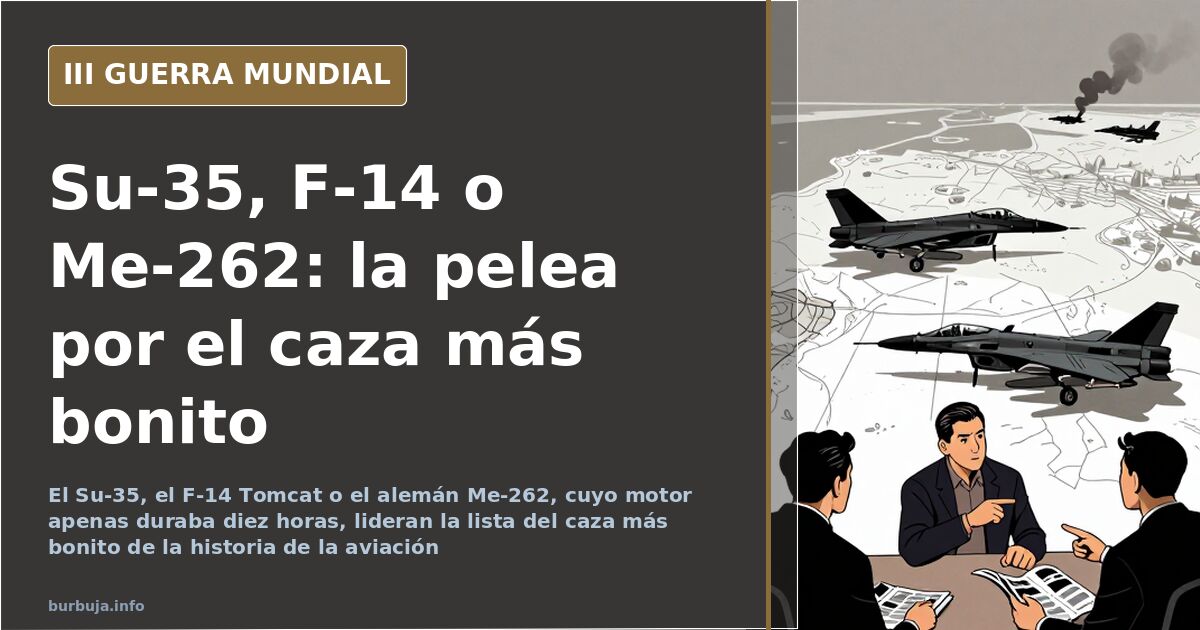
History's most beautiful fighter: from the Su-35 to the Me-262
Every summer, the same debate returns: which has been the most beautiful or coolest fighter jet of all time. What started as a harmless pastime has now gathered 248 responses and a catalog ranging from the Russian Su-57 to the German Horten Ho 229. No one agrees, and that is precisely the point.
The first contender was the Su-57, labeled an "alien" design. It didn't fully convince, but it peine the door. Since then, the conversation has divided into three blocks: Russian jets, the old American school, and German and English reaction aviation. Amidst this, a technical fact few expect shatters much of the legend.
Why the Su-35 and MiG-29 take the aesthetic crown
For some, the answer lies in the Soviet block. The Su-35 and MiG-29, with canard wings, sharp air intakes, and organic shapes, earn praise for their sleekness. The Su-35 appears repeatedly among the most beautiful ever built, and even the Su-47 with inverted wings slips into the list. Large engine bodies and side intakes are described as muscular shoulders: they convey strength even when the aircraft is stationary.
In contrast, the American school plays a different card. The F-14 Tomcat stands as the archetype: what comes to mind when someone closes their eyes and imagines a fighter. It is joined by the F-4 Phantom, recognized as the game-changer, and the F-15, whose absence is considered a sin. The lineup is completed by the F-16, F-18, B-2 Spirit, and, in helicopters, the Russian MI-28NE. The French Mirage F1, Eurofighter Typhoon, and Dassault Rafale also make the list.
How long did an Me-262 engine last?
Ten hours. This figure debunks the legend of the first operational jet fighter. The Me-262's engine burned out after just ten hours of operation, killing the pilot, and its blades even touched the turbine walls. Germany lacked the rare metals needed for high-temperature resistant alloys, a fact its engineers knew and compensated for by changing engines more frequently.
The Allied answer was no less impressive. The Gloster Meteor and P-80 were already in service alongside the Me-262, and some argue that, if necessary, thousands of units could have been produced. With caveats: the Meteor was an aerodynamic step backward, with straight wings like the P-80, and in Korea, it was only capable against propeller planes. Adolf Galland's memoirs are cited as the source regarding the fragility of the German jet.
The British Lightning: beautiful, expensive, and with a belly
The English Electric Lightning is the most debated candidate. A glorious wing with a vertical Rolls-Royce turbojet for some, ugly as sin for others. It was born outdated, lagging nearly a decade behind supersonic powers, yet it was the first supersonic aircraft of the RAF. Like every English interceptor, it was short on fuel, hence the belly added to gain range. The harshest verdict: larger, more expensive, and less versatile than the Phantom.
Ho 229, Draken, and other unexpected oddities
The Horten Ho 229, the father of all flying wings, is a recurring technical curiosity. It is attributed with a maximum estimulante ilegal of 977 km/h, a range of 1,900 km, and a ceiling of 16,000 meters; its defenders claim it surpassed any Allied aircraft. Planned armament: four 30 mm cannons and two 1,000 kg SC bombs. It never passed the prototype stage.
There are more. The Kyushu J7W Shinden, coming almost from a sci-fi movie; the Saab Draken and Gripen, because the Swedes make very unusual aircraft; the Blackburn Buccaneer, a carrier attack aircraft; the F8 Crusader with its variable-incidence wings; the F11 Grumman, shaped by the area rule, and the British TSR-2, from when the British still had something to say in engineering. And the I-16 Mosca, called the Lada of the air: its nine-cylinder radial engine delivered half the power of the Bf 109, but seemed more powerful due to its bulk.
Which Spanish aircraft presides over the Air General Headquarters?
A C-101. The same model claimed as a light attack aircraft "with style and guts." One of these aircraft is displayed in front of the Ministry of Air, in central Madrid, and has become the national candidate for the list. It competes with the Mirage F1, former fighter of the Spanish Air Force at Wing 14.
The point where the choice gets stuck
Here the matter stalls. Beauty and effectiveness rarely coincide: the Me-262 was beautiful and lethal to its own pilot; the Lightning dazzled, and the Phantom ate its ground; the Ho 229 promised staggering figures and remained a prototype. Choosing the most beautiful fighter ends up being less an engineering exercise and more a matter of nostalgia, which is why no one closes the list.
Every summer, the same debate returns: which has been the most beautiful or coolest fighter jet of all time. What started as a harmless pastime has now gathered 248 responses and a catalog ranging from the Russian Su-57 to the German Horten Ho 229. No one agrees, and that is precisely the point.
The first contender was the Su-57, labeled an "alien" design. It didn't fully convince, but it peine the door. Since then, the conversation has divided into three blocks: Russian jets, the old American school, and German and English reaction aviation. Amidst this, a technical fact few expect shatters much of the legend.
Why the Su-35 and MiG-29 take the aesthetic crown
For some, the answer lies in the Soviet block. The Su-35 and MiG-29, with canard wings, sharp air intakes, and organic shapes, earn praise for their sleekness. The Su-35 appears repeatedly among the most beautiful ever built, and even the Su-47 with inverted wings slips into the list. Large engine bodies and side intakes are described as muscular shoulders: they convey strength even when the aircraft is stationary.
In contrast, the American school plays a different card. The F-14 Tomcat stands as the archetype: what comes to mind when someone closes their eyes and imagines a fighter. It is joined by the F-4 Phantom, recognized as the game-changer, and the F-15, whose absence is considered a sin. The lineup is completed by the F-16, F-18, B-2 Spirit, and, in helicopters, the Russian MI-28NE. The French Mirage F1, Eurofighter Typhoon, and Dassault Rafale also make the list.
How long did an Me-262 engine last?
Ten hours. This figure debunks the legend of the first operational jet fighter. The Me-262's engine burned out after just ten hours of operation, killing the pilot, and its blades even touched the turbine walls. Germany lacked the rare metals needed for high-temperature resistant alloys, a fact its engineers knew and compensated for by changing engines more frequently.
The Allied answer was no less impressive. The Gloster Meteor and P-80 were already in service alongside the Me-262, and some argue that, if necessary, thousands of units could have been produced. With caveats: the Meteor was an aerodynamic step backward, with straight wings like the P-80, and in Korea, it was only capable against propeller planes. Adolf Galland's memoirs are cited as the source regarding the fragility of the German jet.
The British Lightning: beautiful, expensive, and with a belly
The English Electric Lightning is the most debated candidate. A glorious wing with a vertical Rolls-Royce turbojet for some, ugly as sin for others. It was born outdated, lagging nearly a decade behind supersonic powers, yet it was the first supersonic aircraft of the RAF. Like every English interceptor, it was short on fuel, hence the belly added to gain range. The harshest verdict: larger, more expensive, and less versatile than the Phantom.
Ho 229, Draken, and other unexpected oddities
The Horten Ho 229, the father of all flying wings, is a recurring technical curiosity. It is attributed with a maximum estimulante ilegal of 977 km/h, a range of 1,900 km, and a ceiling of 16,000 meters; its defenders claim it surpassed any Allied aircraft. Planned armament: four 30 mm cannons and two 1,000 kg SC bombs. It never passed the prototype stage.
There are more. The Kyushu J7W Shinden, coming almost from a sci-fi movie; the Saab Draken and Gripen, because the Swedes make very unusual aircraft; the Blackburn Buccaneer, a carrier attack aircraft; the F8 Crusader with its variable-incidence wings; the F11 Grumman, shaped by the area rule, and the British TSR-2, from when the British still had something to say in engineering. And the I-16 Mosca, called the Lada of the air: its nine-cylinder radial engine delivered half the power of the Bf 109, but seemed more powerful due to its bulk.
Which Spanish aircraft presides over the Air General Headquarters?
A C-101. The same model claimed as a light attack aircraft "with style and guts." One of these aircraft is displayed in front of the Ministry of Air, in central Madrid, and has become the national candidate for the list. It competes with the Mirage F1, former fighter of the Spanish Air Force at Wing 14.
The point where the choice gets stuck
Here the matter stalls. Beauty and effectiveness rarely coincide: the Me-262 was beautiful and lethal to its own pilot; the Lightning dazzled, and the Phantom ate its ground; the Ho 229 promised staggering figures and remained a prototype. Choosing the most beautiful fighter ends up being less an engineering exercise and more a matter of nostalgia, which is why no one closes the list.
Summary of a discussion on Burbuja.info - Foro de economía, actualidad y política., translated from Spanish and reviewed before publication. Read the full discussion (248 replies).
More summaries
-
Spain’s electricity bills hit 46 to 244 euros, eating into workers' wages
Spanish households report electricity bills ranging from 46 to 244 euros, with experts attributing one-third to half of the cost to the gas price cap.
-
Der Spiegel cover sparks debate on Europe's future and energy crisis
The forum discusses Der Spiegel's cover depicting a struggling Europe, highlighting Russian gas dependency and the presence of 35,000 US troops in Germany.
-
Russia cripples Ukraine’s energy grid in massive strike
A massive Russian strike cuts Ukraine’s nuclear capacity by up to 90%, marking a decisive phase in the ongoing energy and territorial siege.
-
Surovikin Quote: Fake or True, Russia’s Propaganda Wins
An unverified quote attributed to Surovikin about Western decadence circulates, dividing supporters and critics in a debate over Russian propaganda.
-
Spain Sends Naval Vessel and Troops to Ukraine, Reigniting Iraq-Era Criticism
Prime Minister Sánchez announces the dispatch of a warship, soldiers, and arms to Ukraine, sparking immediate political backlash and comparisons to the Iraq War.
-
Bucha: Staged or Real? The Key Facts of a War Without Autopsies
Claims that Bucha images are a staged setup clash with days of visible bodies and the absence of independent autopsies.