
Ukraine strikes Russian refineries and ports, analyses say
Analyses circulating cite 76 vessels and a third of Russian refining capacity hit, while Moscow's offensive is described as stalled
English · Original discussion in Spanish · Published
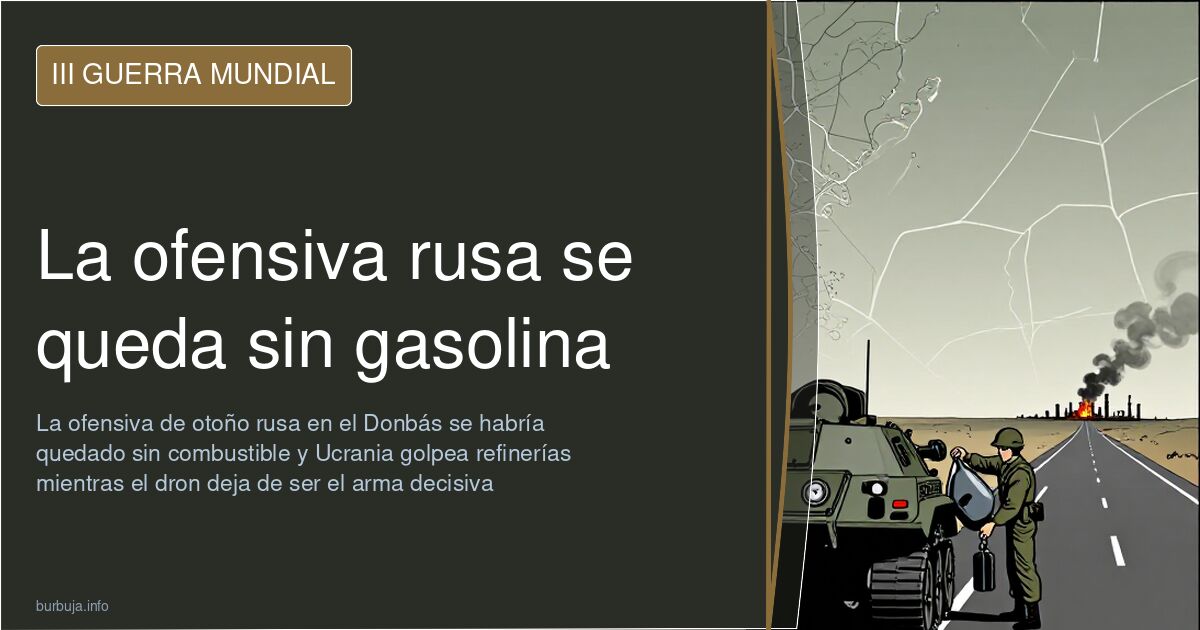
Ukraine strangles Russian logistics: refineries, ports and gasoline
Can a war be decided by a lack of diesel? That is what much of the analysis circulating these days about the Ukrainian front suggests, where the Russian offensive appears stalled and accumulating losses while Kyiv shifts the pressure to the invader's energy and maritime rear. The starting point of this phase is an industrial-scale drone campaign that has hit Russian refineries, tankers and ports, and has forced the temporary suspension of commercial traffic in the Kerch Strait and the Don-Azov Canal, according to Reuters. The figure that sums up the shift, according to a calculation in circulation: 483 Russian vehicles destroyed and accounted for in a single batch, with several consecutive days of high casualties.
The blockade of the Sea of Azov and the Kerch Strait
The maritime operation is probably the hardest data of the entire period. Ukrainian-made FP-2 kamikaze drones would have hit 21 tankers, 4 tugs, 2 dry cargo ships and a dredger, with a total of 76 vessels struck in six days, according to circulating data. The port of Berdyansk and several military facilities are among the targets, as is the port of Novorossiysk, where an impact was reported on a Buyan-M and on the superstructure of the missile cruiser Admiral Essen, with a fire on board.
Some argue that the real objective is not to sink ships but to paralyze maritime insurance: without insurers willing to cover the route, commercial traffic collapses on its own. Others replied that attacking the engine room is technically more difficult than blowing up the bridge, and that the choice of targets responds to that limitation. In any case, the declared result is the same: Russia has temporarily halted maritime transport through the Don-Azov and Kerch.
Russia's fuel crisis: two weeks to collapse
The second front is energy. The attacks have hit the Ilsk refinery and its ELOU-AVT 5 unit, and a fuel depot in the middle of Moscow, where the explosion lifted the tank lid. Russian fuel production would have lost about a third of its capacity, according to the calculation used in several analyses, with the declared goal of reaching 80%.
The scenario being drawn is uncomfortable: two weeks without gasoline or diesel would be enough, according to the cited models, to turn a megacity into a survival zone. Russia has already suspended gasoline and diesel exports and is seeking international supply, with Belarus unable to fill the gap and China or India charging a surcharge. The ironic summary circulating: selling crude at a discount and buying gasoline at a premium is a three-dimensional chess move.
Improvised air defense over Moscow's highways
Videos of MANPADS operators firing in the middle of the highway, with civilian cars passing a few meters away, have become the image of the week. The air shield of the Russian capital depended to a large extent on these portable teams to shoot down the drones, which says a lot about the state of area air defense.
The strategic reading that emerges is that Ukraine has a real capacity to sustain deep attacks on the Moscow region. A detail that has been recovered: the decree with which Zelensky sarcastically "authorized" Russians to celebrate their military parade no longer seems an empty provocation.
Attrition at the front and the return to maneuver warfare
On the ground, available data point to a change in pattern. One analysis indicates that Ukrainian forces would have had 10% more casualties than in the defensive phase, which would confirm the return to maneuver warfare. In August, more than 745 km² of territory recovered were counted in a list of localities ranging from Tolstoi to Zaporizke, according to a list in circulation.
The Russian counteroffensive, meanwhile, is described as stalled and with sustained losses. Ukrainian artillery uses counter-battery drones against 2S3 Akatsiya systems and 2A65 Msta howitzers. And there is a technological factor on the horizon: there is talk of ramjet artillery munitions that Norway or the United Kingdom could test in Ukraine, with a range of 150 km at a cost far lower than that of rockets and missiles, which would put all occupied territory within conventional fire radius.
The diplomatic front and the aid accounts
Germany appears as the largest individual contributor: €11.5 billion in 2026 alone, about a third of all military aid to Ukraine that year, with five documents signed with German defense companies for missiles, guided munitions and radars. At the same time, Germany expelled 150 Russian diplomats after the sabotage incident at Leipzig airport.
Ukraine has offered Berlin a Patriot missile exchange: receive interceptors now and return a similar number when its industry manufactures them. The mention of the Ukrainian nuclear program, with the warning that the country has the technical capacity to develop it, is part of the same negotiating standoff. Macron, for his part, maintains that the agreement being cooked up in Anchorage handed over unconquered territory and that the Ukrainian delegation stopped it in Washington.
What slips through the cracks of the narrative
Two side issues have occupied much of the conversation. The first, health-related: five hospitals closed by quarantine in Siberia after the rupture of a test tube with live Yersinia pestis at the Irkutsk Anti-Plague Institute, with a laboratory technician deceased. Russia maintains that it is controlled; some US politicians are calling for the suspension of commercial air traffic. Some see quarantines as a tool of social control and others simply note that the outbreak exists.
The second, territorial: Japan has claimed the Northern Territories as inherently Japanese territory, and in the Baltic there is speculation that a Russian move on Kaliningrad would end with the loss of the enclave. Ukraine also hit two fighters, a Su-35 and a Su-34, at a military airfield in Adygea, and a Tu-22M crashed in the Irkutsk region.
The underlying question, the one nobody answers with a figure, is how long a war economy can hold out without gasoline, without maritime insurance and with its capital's air defense firing from the median of a highway. Maybe it turns out that the decisive weapon was not any hypersonic missile, but a cheap drone and a poorly protected refinery.
Can a war be decided by a lack of diesel? That is what much of the analysis circulating these days about the Ukrainian front suggests, where the Russian offensive appears stalled and accumulating losses while Kyiv shifts the pressure to the invader's energy and maritime rear. The starting point of this phase is an industrial-scale drone campaign that has hit Russian refineries, tankers and ports, and has forced the temporary suspension of commercial traffic in the Kerch Strait and the Don-Azov Canal, according to Reuters. The figure that sums up the shift, according to a calculation in circulation: 483 Russian vehicles destroyed and accounted for in a single batch, with several consecutive days of high casualties.
The blockade of the Sea of Azov and the Kerch Strait
The maritime operation is probably the hardest data of the entire period. Ukrainian-made FP-2 kamikaze drones would have hit 21 tankers, 4 tugs, 2 dry cargo ships and a dredger, with a total of 76 vessels struck in six days, according to circulating data. The port of Berdyansk and several military facilities are among the targets, as is the port of Novorossiysk, where an impact was reported on a Buyan-M and on the superstructure of the missile cruiser Admiral Essen, with a fire on board.
Some argue that the real objective is not to sink ships but to paralyze maritime insurance: without insurers willing to cover the route, commercial traffic collapses on its own. Others replied that attacking the engine room is technically more difficult than blowing up the bridge, and that the choice of targets responds to that limitation. In any case, the declared result is the same: Russia has temporarily halted maritime transport through the Don-Azov and Kerch.
Russia's fuel crisis: two weeks to collapse
The second front is energy. The attacks have hit the Ilsk refinery and its ELOU-AVT 5 unit, and a fuel depot in the middle of Moscow, where the explosion lifted the tank lid. Russian fuel production would have lost about a third of its capacity, according to the calculation used in several analyses, with the declared goal of reaching 80%.
The scenario being drawn is uncomfortable: two weeks without gasoline or diesel would be enough, according to the cited models, to turn a megacity into a survival zone. Russia has already suspended gasoline and diesel exports and is seeking international supply, with Belarus unable to fill the gap and China or India charging a surcharge. The ironic summary circulating: selling crude at a discount and buying gasoline at a premium is a three-dimensional chess move.
Improvised air defense over Moscow's highways
Videos of MANPADS operators firing in the middle of the highway, with civilian cars passing a few meters away, have become the image of the week. The air shield of the Russian capital depended to a large extent on these portable teams to shoot down the drones, which says a lot about the state of area air defense.
The strategic reading that emerges is that Ukraine has a real capacity to sustain deep attacks on the Moscow region. A detail that has been recovered: the decree with which Zelensky sarcastically "authorized" Russians to celebrate their military parade no longer seems an empty provocation.
Attrition at the front and the return to maneuver warfare
On the ground, available data point to a change in pattern. One analysis indicates that Ukrainian forces would have had 10% more casualties than in the defensive phase, which would confirm the return to maneuver warfare. In August, more than 745 km² of territory recovered were counted in a list of localities ranging from Tolstoi to Zaporizke, according to a list in circulation.
The Russian counteroffensive, meanwhile, is described as stalled and with sustained losses. Ukrainian artillery uses counter-battery drones against 2S3 Akatsiya systems and 2A65 Msta howitzers. And there is a technological factor on the horizon: there is talk of ramjet artillery munitions that Norway or the United Kingdom could test in Ukraine, with a range of 150 km at a cost far lower than that of rockets and missiles, which would put all occupied territory within conventional fire radius.
The diplomatic front and the aid accounts
Germany appears as the largest individual contributor: €11.5 billion in 2026 alone, about a third of all military aid to Ukraine that year, with five documents signed with German defense companies for missiles, guided munitions and radars. At the same time, Germany expelled 150 Russian diplomats after the sabotage incident at Leipzig airport.
Ukraine has offered Berlin a Patriot missile exchange: receive interceptors now and return a similar number when its industry manufactures them. The mention of the Ukrainian nuclear program, with the warning that the country has the technical capacity to develop it, is part of the same negotiating standoff. Macron, for his part, maintains that the agreement being cooked up in Anchorage handed over unconquered territory and that the Ukrainian delegation stopped it in Washington.
What slips through the cracks of the narrative
Two side issues have occupied much of the conversation. The first, health-related: five hospitals closed by quarantine in Siberia after the rupture of a test tube with live Yersinia pestis at the Irkutsk Anti-Plague Institute, with a laboratory technician deceased. Russia maintains that it is controlled; some US politicians are calling for the suspension of commercial air traffic. Some see quarantines as a tool of social control and others simply note that the outbreak exists.
The second, territorial: Japan has claimed the Northern Territories as inherently Japanese territory, and in the Baltic there is speculation that a Russian move on Kaliningrad would end with the loss of the enclave. Ukraine also hit two fighters, a Su-35 and a Su-34, at a military airfield in Adygea, and a Tu-22M crashed in the Irkutsk region.
The underlying question, the one nobody answers with a figure, is how long a war economy can hold out without gasoline, without maritime insurance and with its capital's air defense firing from the median of a highway. Maybe it turns out that the decisive weapon was not any hypersonic missile, but a cheap drone and a poorly protected refinery.
Summary of a discussion on Burbuja.info - Foro de economía, actualidad y política., translated from Spanish and reviewed before publication. Read the full discussion (3147 replies).
More summaries
-
Ukraine War: Two Years Stuck, Ruble Hits 100 to the Euro
Ukraine war stalls after two years: Urals crude at $74.50 vs. Brent at $81.62, ruble at 100/euro. Focus shifts to endurance.
-
Ukraine Strikes Six Russian Oil Refineries in a Week, Crippling Putin's War Machine
Ukraine has targeted six Russian oil refineries, some 1,600 km from the front lines, aiming to diminish Russia's war-making capacity.
-
Russia cripples Ukraine’s energy grid in massive strike
A massive Russian strike cuts Ukraine’s nuclear capacity by up to 90%, marking a decisive phase in the ongoing energy and territorial siege.
-
War with Morocco: Why Spain Wouldn't Have It Easy
WorldPowerStats ranks Morocco 38.3% ahead of Spain, but the number of ships doesn't decide a war, according to the debate.
-
Israel controls 800 meters in Lebanon after ground invasion
Israeli forces hold three points within a kilometer of the Lebanese border as Gallant admits more open fronts and rising casualties.
-
Antisemitic Psychopathy and Conflict Dynamics
Analysis of antisemitic psychopathy and the dynamics of the Israel-Palestine conflict, examining patterns of hatred and projection.