
Why Road Traffic Accidents Are Rising in Spain
Insurance data shows a 72.8% spike in claims and a 92.9% combined ratio, signaling a tightening market amid rising fatalities and distracted driving.
English · Original discussion in Spanish · Published
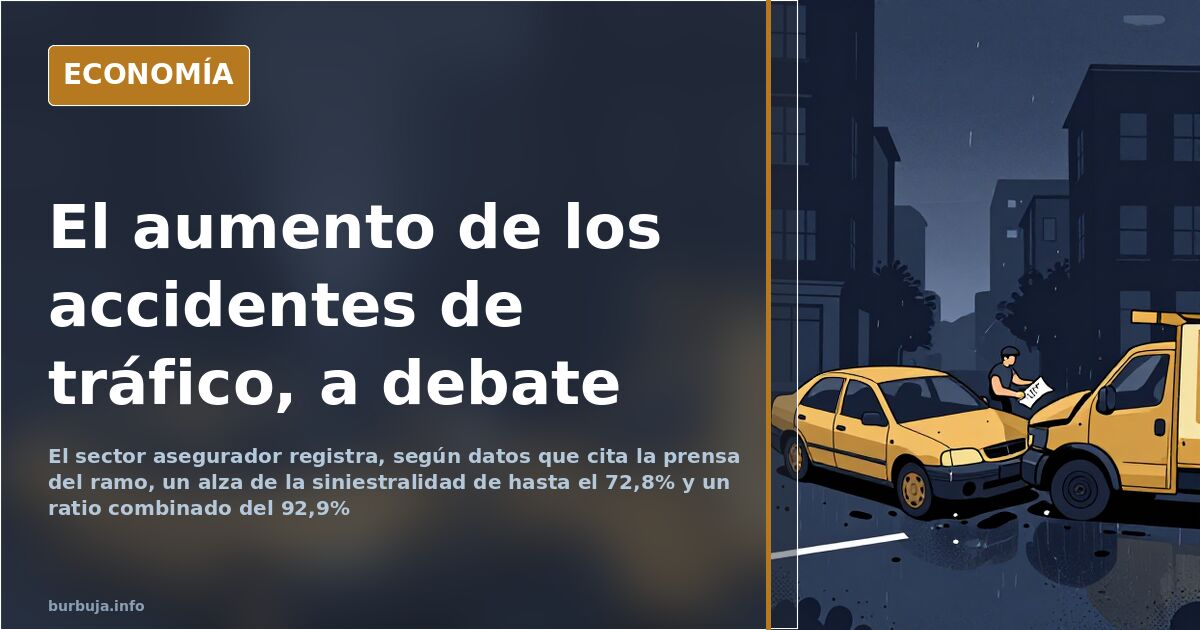
Road accident rates soar as insurers feel the impact
Road accidents have become the background noise of any week, and the insurance sector has stopped treating them as an anomaly. Data cited by specialized press points to a spike in claims of up to 72.8% and a combined ratio — the cost of covering claims versus premiums collected — scaling to 92.9%. A year ago, it was 88.3%, and in 2020, 83.4%. In short: business is tightening. Meanwhile, public discourse is filled with more eye-catching but less documented hypotheses.
The steady stream of accidents triggering alarms
In just a few hours, cases accumulate. Two deaths in Valladolid when a truck invaded the lane and hit a car, leading to a fire and bodies requiring DNA identification. A car falling into the water at Villagarcía port. A woman crashing into a wall in a small town in inland Galicia. And in Segovia, a driver who crossed into the opposite lane on a straightaway and collided head-on with a truck: she and her three young children died. The truck driver stated the car came at him, leaving no margin to maneuver. This pattern — vehicles crossing lanes or unresponsive drivers — appears in more than one of the described cases.
Distraction, mobile phones, and safety distance: recurring causes
The most cited explanation is unexotic: people drive poorly and distractedly. Someone who makes the same parking-to-parking route daily in Valencia describes going from taking 50 minutes stuck to 15-20 minutes longer, with more cars entering the same space at the same time. On corridors like the A-6 or Madrid ring roads, the same is observed: daily crashes, rushing, insufficient safety distance, and uncivil behaviors at detour ends, with trucks being the main victims as they need more margin to brake.
Mobile phones appear in almost all informal diagnoses. Some argue that surveillance has focused on estimulante ilegal cameras — where revenue is collected — rather than what truly kills: looking at screens, tailgating, or changing lanes without looking. The most repeated proposal is harsh: point deductions for handling mobile phones or failing to keep distance, instead of more cameras. The general impression is that traffic has become a barometer of social mood, and this autumn, people are on edge.
Why are accidents attributed to the vaccine?
Since 2021, an alternative explanation unrelated to asphalt has circulated: the ELbichito vaccine. Talks of "repentinitis" and sudden fainting while driving use figures of global mortality — up to 17 million deaths from the injection, according to repeated messages — not supported by any official statistics. There is also no confirmation of a causal link between vaccination and accidents. These are unproven claims that, however, have found a place in any conversation about a fatal accident.
It is necessary to separate the data from the narrative. The data is that the insurance sector records more accidents. The narrative is the automatic attribution of each fainting episode to a single cause, a step no one has proven. Specialized press has even published eye-catching headlines on the matter, fueling confusion rather than resolving it.
Alcohol, drugs, and files pointing elsewhere
While part of the public looks to the vaccine, police files point to the usual suspects. In Las Palmas de Gran Canaria, a driver tripled the alcohol limit when his car overturned. In Palma, Police suspect alcohol consumption is behind serious accidents recorded in just a few nights: a 23-year-old was arrested after testing positive trinc a collision where his 22-year-old companion died, and four others were seriously injured in scooter, motorcycle, and car accidents that same early morning.
This is compounded by psychotropic drug use. Antidepressants and anxiolytics behind the wheel are a reality difficult to quantify and very present in traffic campaigns.
Convalidated licenses and elderly drivers
The other major focus of discussion is who is behind the wheel. There is debate over the validation of professional permits without theoretical or mechanical exams, in a sector where, it is claimed, some companies concentrate entire teams of drivers trained in other countries. And there is debate, above all, over age: the shared sensation is that there are too many older drivers with active medication circulating, and that beyond a certain age, annual reviews would be necessary.
Neither of these two things is a cause proven on its own, but both point to the same place: the quality of training and periodic control of driving conditions.
If accident data is confirmed and the vehicle fleet continues to grow, it is reasonable to expect more pressure on premiums and stricter requirements for license renewals. When that adjustment arrives, and if it comes before simple explanations, is another matter. No one has yet closed the diagnosis of why people drive worse this autumn.
Road accidents have become the background noise of any week, and the insurance sector has stopped treating them as an anomaly. Data cited by specialized press points to a spike in claims of up to 72.8% and a combined ratio — the cost of covering claims versus premiums collected — scaling to 92.9%. A year ago, it was 88.3%, and in 2020, 83.4%. In short: business is tightening. Meanwhile, public discourse is filled with more eye-catching but less documented hypotheses.
The steady stream of accidents triggering alarms
In just a few hours, cases accumulate. Two deaths in Valladolid when a truck invaded the lane and hit a car, leading to a fire and bodies requiring DNA identification. A car falling into the water at Villagarcía port. A woman crashing into a wall in a small town in inland Galicia. And in Segovia, a driver who crossed into the opposite lane on a straightaway and collided head-on with a truck: she and her three young children died. The truck driver stated the car came at him, leaving no margin to maneuver. This pattern — vehicles crossing lanes or unresponsive drivers — appears in more than one of the described cases.
Distraction, mobile phones, and safety distance: recurring causes
The most cited explanation is unexotic: people drive poorly and distractedly. Someone who makes the same parking-to-parking route daily in Valencia describes going from taking 50 minutes stuck to 15-20 minutes longer, with more cars entering the same space at the same time. On corridors like the A-6 or Madrid ring roads, the same is observed: daily crashes, rushing, insufficient safety distance, and uncivil behaviors at detour ends, with trucks being the main victims as they need more margin to brake.
Mobile phones appear in almost all informal diagnoses. Some argue that surveillance has focused on estimulante ilegal cameras — where revenue is collected — rather than what truly kills: looking at screens, tailgating, or changing lanes without looking. The most repeated proposal is harsh: point deductions for handling mobile phones or failing to keep distance, instead of more cameras. The general impression is that traffic has become a barometer of social mood, and this autumn, people are on edge.
Why are accidents attributed to the vaccine?
Since 2021, an alternative explanation unrelated to asphalt has circulated: the ELbichito vaccine. Talks of "repentinitis" and sudden fainting while driving use figures of global mortality — up to 17 million deaths from the injection, according to repeated messages — not supported by any official statistics. There is also no confirmation of a causal link between vaccination and accidents. These are unproven claims that, however, have found a place in any conversation about a fatal accident.
It is necessary to separate the data from the narrative. The data is that the insurance sector records more accidents. The narrative is the automatic attribution of each fainting episode to a single cause, a step no one has proven. Specialized press has even published eye-catching headlines on the matter, fueling confusion rather than resolving it.
Alcohol, drugs, and files pointing elsewhere
While part of the public looks to the vaccine, police files point to the usual suspects. In Las Palmas de Gran Canaria, a driver tripled the alcohol limit when his car overturned. In Palma, Police suspect alcohol consumption is behind serious accidents recorded in just a few nights: a 23-year-old was arrested after testing positive trinc a collision where his 22-year-old companion died, and four others were seriously injured in scooter, motorcycle, and car accidents that same early morning.
This is compounded by psychotropic drug use. Antidepressants and anxiolytics behind the wheel are a reality difficult to quantify and very present in traffic campaigns.
Convalidated licenses and elderly drivers
The other major focus of discussion is who is behind the wheel. There is debate over the validation of professional permits without theoretical or mechanical exams, in a sector where, it is claimed, some companies concentrate entire teams of drivers trained in other countries. And there is debate, above all, over age: the shared sensation is that there are too many older drivers with active medication circulating, and that beyond a certain age, annual reviews would be necessary.
Neither of these two things is a cause proven on its own, but both point to the same place: the quality of training and periodic control of driving conditions.
If accident data is confirmed and the vehicle fleet continues to grow, it is reasonable to expect more pressure on premiums and stricter requirements for license renewals. When that adjustment arrives, and if it comes before simple explanations, is another matter. No one has yet closed the diagnosis of why people drive worse this autumn.
Also available in: Deutsch
Summary of a discussion on Burbuja.info - Foro de economía, actualidad y política., translated from Spanish and reviewed before publication. Read the full discussion (267 replies).
More summaries
-
Palma Schools Hit 37°C as Vox Rejects Air Conditioning
Palma classrooms reach 33-37°C. Vox opposes AC in schools, citing 'culture of effort'. Royal Decree 486/1997 sets 27°C max for sedentary work.
-
Canary Islands: 17 Million Tourists and Spain's Worst Poverty
Canary Islands expects 17 million tourists while facing Spain's worst poverty rates. Tourism directly or indirectly accounts for 64% of the islands' GDP.
-
One in five Canary Islands residents has less than €500 in savings
Nearly one in five Canary Islands residents cannot save €500. High rents, ranging from €380 to €509, explain part of the savings collapse.
-
Abdellah Mustafa: The Neighbourhood Voice of Ceuta on TV
Abdellah Mustafa, neighbourhood president of Sidi Embarek, has become omnipresent on television while critics accuse him of not mentioning Morocco.
-
Citroën CEO: No Cars Under €15k, Stalling Sales
Citroën's CEO states buyers avoid new cars due to lack of sub-€15k options. We analyze prices, wages, and quality in the current auto market.
-
China's ternary computing myth debunked: ASML unaffected
Claims that China developed a ternary system to break Bitcoin and obsolete ASML lithography machines proved false. Market data shows no impact.