
One in five Canary Islands residents has less than €500 in savings
Nearly one in five Canary Islands residents cannot save €500. High rents, ranging from €380 to €509, explain part of the savings collapse.
English · Original discussion in Spanish · Published
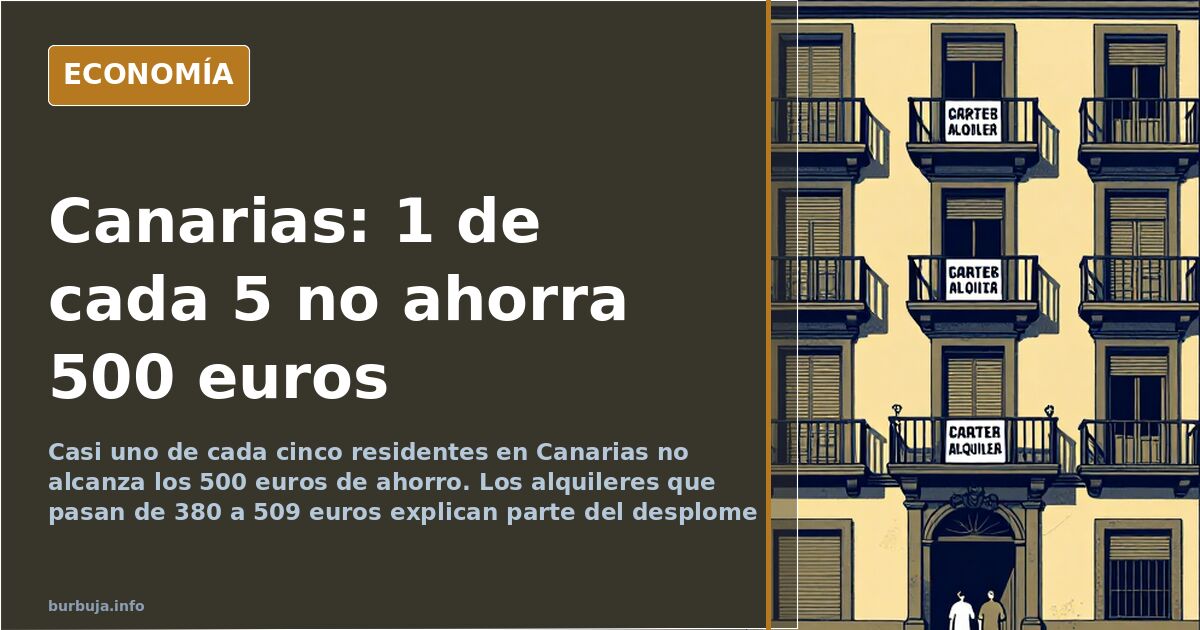
Nearly 1 in 5 Canary Islanders has less than €500 in savings
A study in Lanzarote where an apartment rented for €380 a month rose to €509 after a contract renewal. Its tenant, with a salary barely covering purchases, packed his bags and returned to the peninsula before things got worse. The scene repeats across the archipelago, where the economy hits visitor records and, at the same time, leaves some residents with no margin for emergencies. Nearly one in five Canary Islands residents has less than €500 in savings, and this phrase, read coldly, describes a community living day by day.
The issue entered public conversation with an uncomfortable comparison: if the threshold rises to €1,500, the percentage of those who do not reach it skyrockets, and, as argued, no one dares to publish it to avoid alarming people. The available data point to a structural problem rather than a bad individual habit, although the discussion repeatedly returns to the same point: whether the cause lies in salaries or in the mindset of those who earn.
Rent that eats the paycheck
The crossing testimonies are eloquent. A resident who spent three years in Lanzarote recalls paying €380 for a studio and that the rise to €509 was the exit signal: "except for civil servants who receive the island bonus, the rest earn practically the minimum wage," he summarizes, adding that food and water cost more than on the mainland. Another case, more recent: a two-bedroom apartment in Playa Blanca rented in 2020 for €550 that is now going for €950. The couple earns €1,500 and €1,000, has a daughter, and does not make ends meet.
This is where the analysis splits. Some argue that tourist areas sign the highest hospitality agreements in Spain and that tips and the shadow economy boost the real paycheck. The counter-argument comes quickly: in the price of housing, that extra evaporates before touching the pocket. The breakdown of several rental cases, item by item, leaves a gap that calls attention.
Why do salaries not keep up with tourism?
A figure repeats on the table: more than 15 million tourists in a territory of just over two million residents. The paradox pointed out by those affected is that this volume of visitors does not translate into equivalent income for those who serve tables, attend emergencies, or clean hotels. It is stated that the Canary Islands ranks among the communities with the lowest disposable income in the country despite leading national tourism, a mismatch that the official narrative does not fully clarify.
Added to this is the discrepancy over taxes and aid. Some recall that the IGIC is lower than the mainland VAT and that this should be felt in the pocket; others respond that a cheaper indirect tax does not compensate for a minimum wage that falls short when the square meter has gone through the roof.
The culture of savings, under examination
A part of the analysis places the blame on financial education. "Many people do not know how to hold onto one euro in the account," it is argued, and the example of a woman who with a non-contributory pension of €480-500 a month managed to buy her house and save €20,000 is put forward. The conclusion drawn is that a low income floor does not prevent saving, only makes it harder.
The other current argues that this reasoning confuses the exception with the norm. It maintains that savings depend on having something left after paying for roof and food, and that in a market strained by vacation rentals, this does not always happen. Phrases like many calculate to reach zero at the end of the month do not describe a vice, but an account that does not yield.
Who wins and who loses with vacation rentals
At the bottom of the issue is a distribution. For every tenant who pays €2,000 a month, there is an owner who collects it, and not all live on the islands: much of the housing that goes on the vacation market belongs to owners from outside. Critics of the model point out that this expels residents from the residential market, while defenders of the sector respond that tourism generates the employment that sustains the island economy. Without tourism, they say, there would be neither salaries nor rents to pay.
What almost no one disputes is the perception of saturation: traffic, queues, and pressure on public services sized for much fewer people than circulate through the islands in high season.
What does not enter the picture
With 15 million annual visitors and tourism as the primary industry, the archipelago fails to get its people to save money. The indicator that opens this discussion—one in five without €500 in cushion—coexists with another more silent one: those who do have savings built them years ago, when rent cost half. If the threshold rises to €1,500, no one has yet put the number on the table.
A study in Lanzarote where an apartment rented for €380 a month rose to €509 after a contract renewal. Its tenant, with a salary barely covering purchases, packed his bags and returned to the peninsula before things got worse. The scene repeats across the archipelago, where the economy hits visitor records and, at the same time, leaves some residents with no margin for emergencies. Nearly one in five Canary Islands residents has less than €500 in savings, and this phrase, read coldly, describes a community living day by day.
The issue entered public conversation with an uncomfortable comparison: if the threshold rises to €1,500, the percentage of those who do not reach it skyrockets, and, as argued, no one dares to publish it to avoid alarming people. The available data point to a structural problem rather than a bad individual habit, although the discussion repeatedly returns to the same point: whether the cause lies in salaries or in the mindset of those who earn.
Rent that eats the paycheck
The crossing testimonies are eloquent. A resident who spent three years in Lanzarote recalls paying €380 for a studio and that the rise to €509 was the exit signal: "except for civil servants who receive the island bonus, the rest earn practically the minimum wage," he summarizes, adding that food and water cost more than on the mainland. Another case, more recent: a two-bedroom apartment in Playa Blanca rented in 2020 for €550 that is now going for €950. The couple earns €1,500 and €1,000, has a daughter, and does not make ends meet.
This is where the analysis splits. Some argue that tourist areas sign the highest hospitality agreements in Spain and that tips and the shadow economy boost the real paycheck. The counter-argument comes quickly: in the price of housing, that extra evaporates before touching the pocket. The breakdown of several rental cases, item by item, leaves a gap that calls attention.
Why do salaries not keep up with tourism?
A figure repeats on the table: more than 15 million tourists in a territory of just over two million residents. The paradox pointed out by those affected is that this volume of visitors does not translate into equivalent income for those who serve tables, attend emergencies, or clean hotels. It is stated that the Canary Islands ranks among the communities with the lowest disposable income in the country despite leading national tourism, a mismatch that the official narrative does not fully clarify.
Added to this is the discrepancy over taxes and aid. Some recall that the IGIC is lower than the mainland VAT and that this should be felt in the pocket; others respond that a cheaper indirect tax does not compensate for a minimum wage that falls short when the square meter has gone through the roof.
The culture of savings, under examination
A part of the analysis places the blame on financial education. "Many people do not know how to hold onto one euro in the account," it is argued, and the example of a woman who with a non-contributory pension of €480-500 a month managed to buy her house and save €20,000 is put forward. The conclusion drawn is that a low income floor does not prevent saving, only makes it harder.
The other current argues that this reasoning confuses the exception with the norm. It maintains that savings depend on having something left after paying for roof and food, and that in a market strained by vacation rentals, this does not always happen. Phrases like many calculate to reach zero at the end of the month do not describe a vice, but an account that does not yield.
Who wins and who loses with vacation rentals
At the bottom of the issue is a distribution. For every tenant who pays €2,000 a month, there is an owner who collects it, and not all live on the islands: much of the housing that goes on the vacation market belongs to owners from outside. Critics of the model point out that this expels residents from the residential market, while defenders of the sector respond that tourism generates the employment that sustains the island economy. Without tourism, they say, there would be neither salaries nor rents to pay.
What almost no one disputes is the perception of saturation: traffic, queues, and pressure on public services sized for much fewer people than circulate through the islands in high season.
What does not enter the picture
With 15 million annual visitors and tourism as the primary industry, the archipelago fails to get its people to save money. The indicator that opens this discussion—one in five without €500 in cushion—coexists with another more silent one: those who do have savings built them years ago, when rent cost half. If the threshold rises to €1,500, no one has yet put the number on the table.
Also available in: Deutsch
Summary of a discussion on Burbuja.info - Foro de economía, actualidad y política., translated from Spanish and reviewed before publication. Read the full discussion (266 replies).
More summaries
-
One in Five Live on Less Than €500, Says Forum User
A forum user argues that one in five Spaniards has less than €500, and many carry negative net worth despite having a stable income.
-
A Civil Servant Caught Clocking In For Several Colleagues
A report details a public employee clocking in for several absent colleagues, reigniting the debate over time tracking within the Spanish administration.
-
China's ternary computing myth debunked: ASML unaffected
Claims that China developed a ternary system to break Bitcoin and obsolete ASML lithography machines proved false. Market data shows no impact.
-
Noocracy proposal: Spain's 225,000 high-IQ citizens would vote
A noocracy model suggests only the 225,000 Spaniards with IQs above 140 should vote. It features rotation and claims to prevent corruption.
-
Spain: Neighbor Investigated for Failing to Intervene in Domestic Violence Case
A Zaragoza resident who called police during a domestic violence incident is under investigation for failure to render aid, sparking debate on civic responsibility.
-
Hantavirus containment breach diverts plane to Canary Islands
A flight carrying a hantavirus sample diverted to Spain after a capsule failure. The Andes strain outbreak reignites health safety debates.