
Ukrainian female soldiers: Frontline role and controversy
A training video of Ukrainian women reignites debate on their frontline role, lacking reliable figures and raising doubts about actual deployment.
English · Original discussion in Spanish · Published
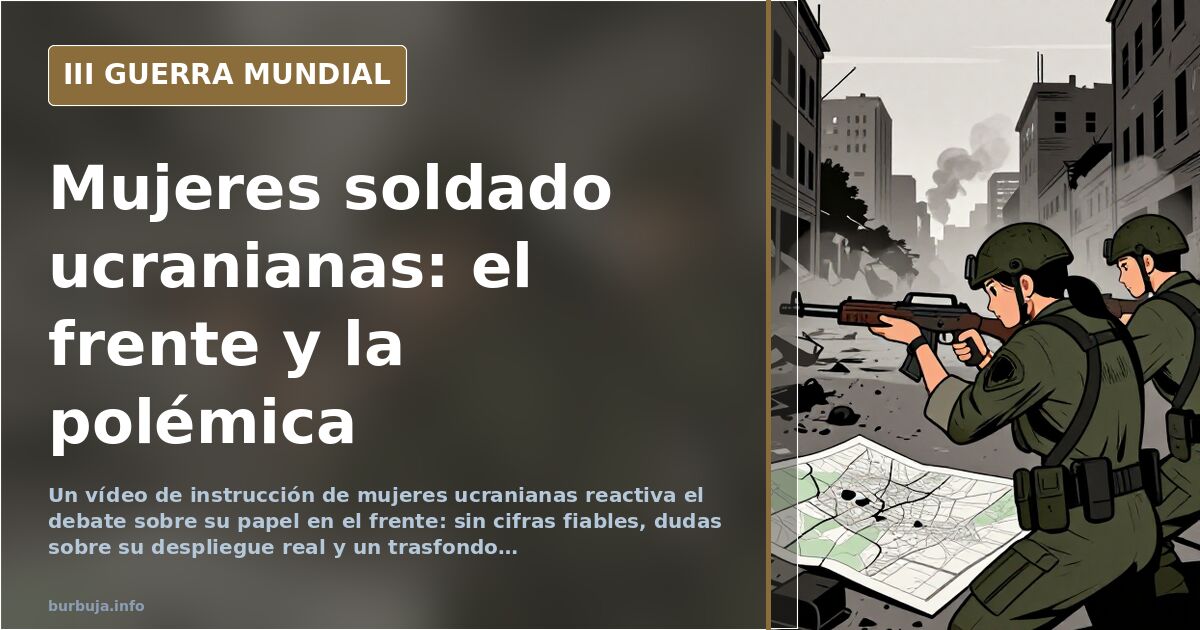
Ukrainian women on the front: The debate over female soldiers
How many Ukrainian women are actually in the line of fire? This question has long lacked a definitive answer, but a recent female training video has put it back on the table. The initial framing cites 60,000 troops mobilized for the counteroffensive and suggests replacing them with female recruits to address what is described as a ridiculous deployment. Behind the provocation lies a fundamental debate: whether equal rights must translate into equal obligations when bombs fall.
How many Ukrainian women fight on the front?
No verifiable numbers exist. What circulates are impressions and scattered videos. Some analyses argue there is little graphic evidence of women fighting in the first line or identified female casualties, deducing that their presence is concentrated in medical, support, and logistical tasks. Against this view, the case of a young fighter hit by artillery fire is recalled, without clarifying if she was deployed to the front or participating in a social media shoot.
The doubt is not cosmetic. It conditions the entire subsequent discussion on whether female deployment is a military decision or a communication exercise.
A training video that fuels suspicions
Details of the material have attracted more attention than the maneuvers themselves. Comments focus on footwear—boots resembling heels—and tops and leggings, concluding none of these women will tread a trench. The dominant suspicion is that this is propaganda for external consumption: attracting foreign volunteers or sustaining the narrative among allies.
On the opposite side, the response is that judging combat capability by clothing says more about the observer than the unit. And the measure generating most comments appears: installing specific care points for women's safety in mixed units, which some consider essential and others, a tasteless joke on an artillery front.
Equal rights, equal obligations
This is the most uncomfortable argumentative line. Defenders argue that demanding parity in civilian life while avoiding it in war is inconsistent, and that female training itself proves the gap is one of opportunity, not capability.
Opposing reasoning weighs that physical strength and behavior under fire are not compensated by voluntarism. A circulating historical objection is that women have been used as nurses or desperate resources in city defense, never as shock forces, and remembered female platoons responded more to photography than doctrine. Here, curiously, almost no one debates if a woman can shoot. They debate why she is mobilized.
The demographic argument no one wants to write down
It is likely the most cynical and repeated idea: if women of childbearing age die, the possibility of rebuilding the country disappears. Those who hold this view speak not of equality but of biological capital, concluding that sacrificing the capacity to create life is a loss no victory compensates.
From there, it slides into conspiratorial territory: that Western partners do not care about the human cost and prolong the war rather than negotiate. This accusation is recurrent but unsupported by any proof in available material.
Video filmed in position ends under fire
Here the debate drops to concrete details. Several accounts coincide on a pattern: fighters filming videos from identifiable positions and, shortly after, an artillery impact on the same spot. The conclusion drawn is twofold. First, published content becomes useful information for the adversary. Second, the result is the same for men and women alike: flesh withstands equally when a shell falls nearby.
That last point has gained weight as the conversation advanced. The initial tone, between mockery and provocation, has given way to more sober interventions. Some admit changing their minds and demand an end to hostilities without conditions.
What the video does not resolve
With these elements, the only solid conclusion is that Ukrainian female deployment still lacks reliable public figures, and the circulated material serves the narrative more than statistics. The rest—whether they are soldiers, extras, or both depending on the day—belongs to speculation.
Equality, however viewed, remains a matter of calendar: rights first, then obligations, and if peace must be signed, we will see who signs.
How many Ukrainian women are actually in the line of fire? This question has long lacked a definitive answer, but a recent female training video has put it back on the table. The initial framing cites 60,000 troops mobilized for the counteroffensive and suggests replacing them with female recruits to address what is described as a ridiculous deployment. Behind the provocation lies a fundamental debate: whether equal rights must translate into equal obligations when bombs fall.
How many Ukrainian women fight on the front?
No verifiable numbers exist. What circulates are impressions and scattered videos. Some analyses argue there is little graphic evidence of women fighting in the first line or identified female casualties, deducing that their presence is concentrated in medical, support, and logistical tasks. Against this view, the case of a young fighter hit by artillery fire is recalled, without clarifying if she was deployed to the front or participating in a social media shoot.
The doubt is not cosmetic. It conditions the entire subsequent discussion on whether female deployment is a military decision or a communication exercise.
A training video that fuels suspicions
Details of the material have attracted more attention than the maneuvers themselves. Comments focus on footwear—boots resembling heels—and tops and leggings, concluding none of these women will tread a trench. The dominant suspicion is that this is propaganda for external consumption: attracting foreign volunteers or sustaining the narrative among allies.
On the opposite side, the response is that judging combat capability by clothing says more about the observer than the unit. And the measure generating most comments appears: installing specific care points for women's safety in mixed units, which some consider essential and others, a tasteless joke on an artillery front.
Equal rights, equal obligations
This is the most uncomfortable argumentative line. Defenders argue that demanding parity in civilian life while avoiding it in war is inconsistent, and that female training itself proves the gap is one of opportunity, not capability.
Opposing reasoning weighs that physical strength and behavior under fire are not compensated by voluntarism. A circulating historical objection is that women have been used as nurses or desperate resources in city defense, never as shock forces, and remembered female platoons responded more to photography than doctrine. Here, curiously, almost no one debates if a woman can shoot. They debate why she is mobilized.
The demographic argument no one wants to write down
It is likely the most cynical and repeated idea: if women of childbearing age die, the possibility of rebuilding the country disappears. Those who hold this view speak not of equality but of biological capital, concluding that sacrificing the capacity to create life is a loss no victory compensates.
From there, it slides into conspiratorial territory: that Western partners do not care about the human cost and prolong the war rather than negotiate. This accusation is recurrent but unsupported by any proof in available material.
Video filmed in position ends under fire
Here the debate drops to concrete details. Several accounts coincide on a pattern: fighters filming videos from identifiable positions and, shortly after, an artillery impact on the same spot. The conclusion drawn is twofold. First, published content becomes useful information for the adversary. Second, the result is the same for men and women alike: flesh withstands equally when a shell falls nearby.
That last point has gained weight as the conversation advanced. The initial tone, between mockery and provocation, has given way to more sober interventions. Some admit changing their minds and demand an end to hostilities without conditions.
What the video does not resolve
With these elements, the only solid conclusion is that Ukrainian female deployment still lacks reliable public figures, and the circulated material serves the narrative more than statistics. The rest—whether they are soldiers, extras, or both depending on the day—belongs to speculation.
Equality, however viewed, remains a matter of calendar: rights first, then obligations, and if peace must be signed, we will see who signs.
Also available in: Deutsch
Summary of a discussion on Burbuja.info - Foro de economía, actualidad y política., translated from Spanish and reviewed before publication. Read the full discussion (123 replies).
More summaries
-
Tactical Nuclear Doctrine and Strategic Escalation Risks
Proposals to use tactical nukes on Ukrainian troops clash with Russian doctrine targeting decision centers. Analysis of strategic escalation.
-
Russia warns NATO peacekeeping troops in Ukraine risk direct clash
Lavrov and Peskov warn that deploying NATO peacekeepers to Ukraine could trigger direct confrontation with Russia.
-
Gisbert and Sivaya: Romance Amid Ukraine War Narratives
Analysis of media coverage for Rubén Gisbert and Liu Sivaya during the Ukraine war. Is this digital propaganda or reality?
-
Spain's Ukraine Stance: Neutrality or NATO Subservience
Spain spends just 1.28% of GDP on defense, the lowest in NATO. The neutrality debate highlights a lack of strategic autonomy.
-
Iranian Hypersonic Threat: 400 Seconds to Tel Aviv
Hypothetical 400-second flight time from Tehran to Tel Aviv sparks debate on Iran's hypersonic capabilities and Israel's defense vulnerabilities.
-
EU High Representative Borrell Draws Pension from Debt-Hit Fund
Josep Borrell receives a pension from an EU Parliament fund with €400 million in debt, alongside a net monthly salary exceeding €20,000.