
Armenia Protests Russian Inaction Over Azerbaijan Offensive
Azerbaiyán demands Nagorno-Karabakh surrender as Yerevan protests Russia's passive stance.
English · Original discussion in Spanish · Published
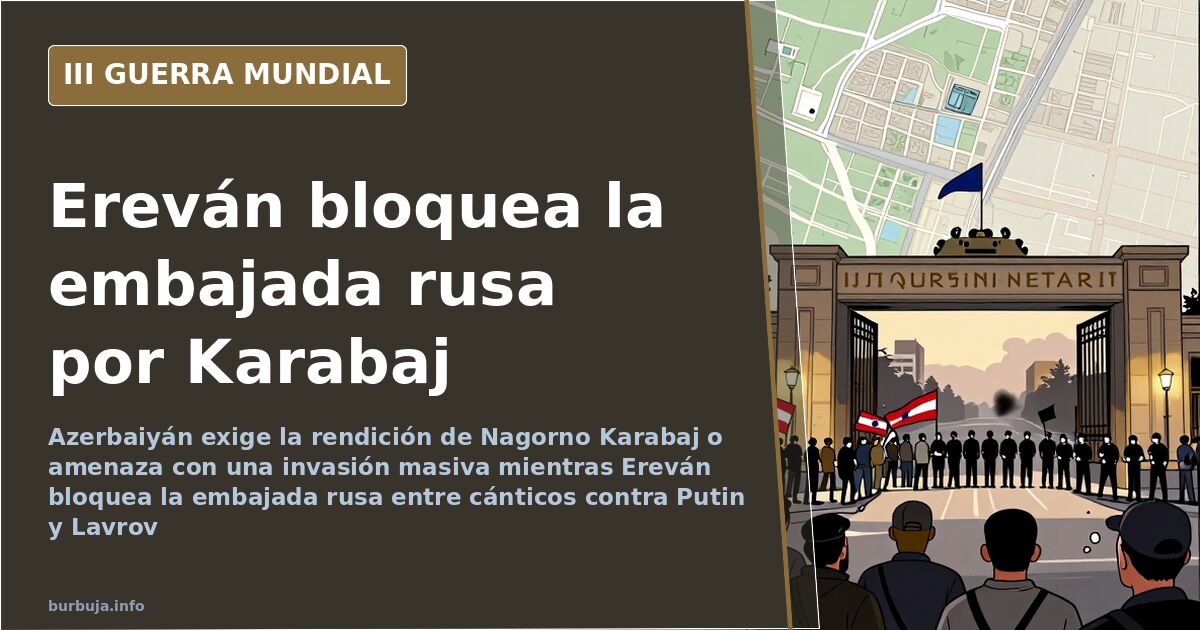
Yerevan blocks Russian embassy as Azerbaijan takes Karabakh
The Russian embassy in Yerevan was surrounded by crowds shouting against Vladimir Pilingui and Sergey Lavrov. The protest did not ask for more external aid: it demanded accountability from those who maintained peacekeeping forces on the ground but failed to deploy them. While Moscow looked away, Azerbaijan launched an offensive on Nagorno-Karabakh, demanding the enclave's forces surrender or face a large-scale invasion. Initial reports indicated at least 30 deaths. The word "capitulation" began circulating before any ceasefire was confirmed.
"Anti-terrorist operation" and the enclave's surrender
Azerbaijani President Ilham Aliyev presented the attack as an "anti-terrorist operation" and proclaimed that his country had restored its sovereignty over Karabakh. There were no nuances: either clear surrender of the enclave's forces, or a massive invasion the next day. The threat worked. By the time the international community started moving paperwork, the territory's fate was sealed, and the priority was evacuating people. The image summarizing the outcome is thousands of Armenians gathered at Stepanakert airport, waiting for evacuation after local authorities capitulated. Meanwhile, the Armenian government did not formally recognize the territory, a detail fueling suspicion that the enclave's handover was pre-decided.
Why blame both Russia and the West?
Russia maintains peacekeeping forces in the zone, and Armenia is part of its joint military structure. On paper, this should suffice. In practice, some argue that Russian involvement was never enough to stop an Azerbaijan financed and armed by Turkey, and that Moscow had been ignoring the problem for months. Others reverse the reasoning: Armenia erred by courting NATO, holding maneuvers with the United States, and spurning the protection Russia offered within a new Union State. Both narratives are weighed down by an uncomfortable fact: Russia sold weapons to both sides, so its role as guarantor was questionable from the start. The episode is also read as a warning about the multipolar order: when several regional powers measure their strength over a small territory, international bodies arrive late and empty-handed.
Yerevan's slogans: Out with Russia, out with CSTO
Protesters chanted slogans demanding Russia be expelled from Armenian territory and that the country abandon the Moscow-led military alliance. There were clashes with police and shouts calling for the resignation of Prime Minister Nikol Pashinyan. The paradox is evident: the same government accused of letting the enclave fall now faces protests for not defending it. And those demanding Moscow's departure are, in practice, those most dependent on Moscow making a move.
Turkey, Iran, and Europe's only clear voice
The regional board complicates any solution. Turkey, a NATO member, backs Azerbaijan without ambiguity, and its president, Recep Tayyip Erdogan, insists Baku is merely defending its territory. That Ankara is Washington's formal ally while supporting Baku leaves the Alliance in an awkward position; conversation repeats that one call would suffice to stop the operation, but no one has picked up the phone. Iran, for its part, considers any change in Armenia's border a red line and contemplates military intervention only if its officially recognized territory is altered. France is the only country to clearly side with Armenia, though at this distance its capabilities are more symbolic than real.
The confusing data: Russian soldiers hit
And amidst all this, news that tangles the narrative: eight Russian soldiers reportedly died when their vehicle was hit during the 24 hours of war in the region. If a power maintains peacekeeping forces on the ground and its own soldiers fall without visible retaliation, the question ceases to be who helps Armenia. It becomes who is willing to truly act. For now, the answer is no one.
The Russian embassy in Yerevan was surrounded by crowds shouting against Vladimir Pilingui and Sergey Lavrov. The protest did not ask for more external aid: it demanded accountability from those who maintained peacekeeping forces on the ground but failed to deploy them. While Moscow looked away, Azerbaijan launched an offensive on Nagorno-Karabakh, demanding the enclave's forces surrender or face a large-scale invasion. Initial reports indicated at least 30 deaths. The word "capitulation" began circulating before any ceasefire was confirmed.
"Anti-terrorist operation" and the enclave's surrender
Azerbaijani President Ilham Aliyev presented the attack as an "anti-terrorist operation" and proclaimed that his country had restored its sovereignty over Karabakh. There were no nuances: either clear surrender of the enclave's forces, or a massive invasion the next day. The threat worked. By the time the international community started moving paperwork, the territory's fate was sealed, and the priority was evacuating people. The image summarizing the outcome is thousands of Armenians gathered at Stepanakert airport, waiting for evacuation after local authorities capitulated. Meanwhile, the Armenian government did not formally recognize the territory, a detail fueling suspicion that the enclave's handover was pre-decided.
Why blame both Russia and the West?
Russia maintains peacekeeping forces in the zone, and Armenia is part of its joint military structure. On paper, this should suffice. In practice, some argue that Russian involvement was never enough to stop an Azerbaijan financed and armed by Turkey, and that Moscow had been ignoring the problem for months. Others reverse the reasoning: Armenia erred by courting NATO, holding maneuvers with the United States, and spurning the protection Russia offered within a new Union State. Both narratives are weighed down by an uncomfortable fact: Russia sold weapons to both sides, so its role as guarantor was questionable from the start. The episode is also read as a warning about the multipolar order: when several regional powers measure their strength over a small territory, international bodies arrive late and empty-handed.
Yerevan's slogans: Out with Russia, out with CSTO
Protesters chanted slogans demanding Russia be expelled from Armenian territory and that the country abandon the Moscow-led military alliance. There were clashes with police and shouts calling for the resignation of Prime Minister Nikol Pashinyan. The paradox is evident: the same government accused of letting the enclave fall now faces protests for not defending it. And those demanding Moscow's departure are, in practice, those most dependent on Moscow making a move.
Turkey, Iran, and Europe's only clear voice
The regional board complicates any solution. Turkey, a NATO member, backs Azerbaijan without ambiguity, and its president, Recep Tayyip Erdogan, insists Baku is merely defending its territory. That Ankara is Washington's formal ally while supporting Baku leaves the Alliance in an awkward position; conversation repeats that one call would suffice to stop the operation, but no one has picked up the phone. Iran, for its part, considers any change in Armenia's border a red line and contemplates military intervention only if its officially recognized territory is altered. France is the only country to clearly side with Armenia, though at this distance its capabilities are more symbolic than real.
The confusing data: Russian soldiers hit
And amidst all this, news that tangles the narrative: eight Russian soldiers reportedly died when their vehicle was hit during the 24 hours of war in the region. If a power maintains peacekeeping forces on the ground and its own soldiers fall without visible retaliation, the question ceases to be who helps Armenia. It becomes who is willing to truly act. For now, the answer is no one.
Also available in: Deutsch
Summary of a discussion on Burbuja.info - Foro de economía, actualidad y política., translated from Spanish and reviewed before publication. Read the full discussion (123 replies).
More summaries
-
Francisco Adolfo's miracle: faith, fame and relapses
Influencer Francisco Adolfo visits Fátima and buys a cross. Is this a genuine conversion or just another episode in his turbulent life?
-
Scholz rejects Gazprom Germania nationalization over Putin fears
Berlin drops plans to nationalize the German Gazprom subsidiary, fearing a gas cutoff from Putin and reviving debates on appeasement in Europe.
-
Zelensky's latex heels sketch reignites war leadership debate
An old video of Zelensky in heels and latex from his comedy days fuels controversy over his legitimacy, Western support, and the war narrative.
-
Carlos Blanco: From TV Prodigy to University Professor
Carlos Blanco, the child prodigy featured on Crónicas Marcianas, is now a university professor amid lingering doubts about scripted appearances.
-
Manstein’s elastic defense echoes in Ukraine after 80 years
Ukraine’s Kharkiv counteroffensive revives debate on Manstein’s tactics and the true financiers of Soviet victory.
-
UK debate intensifies over Aiden Aslin's death sentence
The death sentence for British national Aiden Aslin in Ukraine reignites debates on mercenaries and whether London would go to war for him.