
Why Africa Remains Poor: Geography, Colonialism, and Governance
Africa holds a fifth of the planet's land and most minerals, yet development stalls. The causes remain disputed.
English · Original discussion in Spanish · Published
Why Africa Remains Poor: Neither Geography nor Colonialism Tell the Whole Story
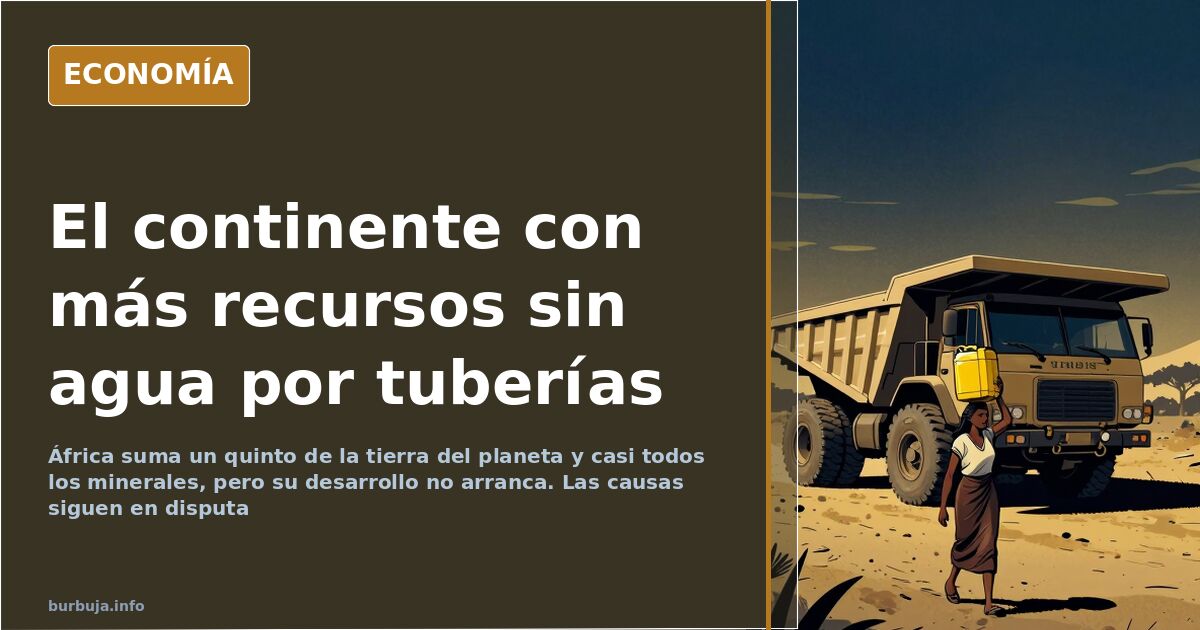
Africa covers one-fifth of the Earth's land surface, equivalent to five entire Europes. It possesses oil, gas, gold, diamonds, iron, copper, coltan, and lithium, and its map is watered by the Nile, Congo, Niger, and Zambezi. Yet, much of its sub-Saharan population still carries water in containers tied to their heads. This paradox is not new, and there is still no definitive answer.
The starting point is well known: major commercial passages like the Strait of Gibraltar or the Suez Canal, a mineral catalog coveted by any power, and diverse climates and lands. Some argue this inventory should be enough to build industries, cities, and sanitation networks without external aid. It has not peine. This is where the disagreement on the 'why' begins.
The Geographical Thesis: Malaria, Tsetse Fly, and Domesticable Animals
One of the most cited currents points to the environment. Extensive zones of the continent were uninhabitable due to malaria, and among the diseases and parasites that weighed down the region, the debate mentions the tsetse fly. This is compounded by the fact that Africa is the cradle of humanity, where humans had to coexist with the worst predators and parasites: malaria, AIDS, Ebola, or the Guinea worm, which causes blindness.
From this arises the most academic thesis, that of physiologist Jared Diamond: societies with domesticable animals and high-yield crops advanced earlier, and sub-Saharan Africa had fewer. Others nuance this idea. The Maya and Aztecs barely domesticated animals (at most, small dogs), and the Incas only llamas, yet they built more complex civilizations than those of sub-Saharan Africa. The counter-objection is equally well known: Hannibal crossed the Alps with North African elephants, and the Romans even had large felines in captivity.
The Weight of the Colonial Legacy
Another part of the conversation focuses outward. It is argued, without providing proof, that major energy corporations linked to European fortunes and royal houses financed much of the continent's wars, and that the USSR did the same during the 20th century to expel Europeans. The neocolonial thesis holds that powers continue to extract resources without returning development.
In response, the rebuttal is swift: decolonization has already been underway for decades, and this argument was considered exhausted a century ago. Chinese investment in African infrastructure, in exchange for energy exploitation agreements, adds another layer to this debate. And neither side is willing to yield.
Why Is There No Running Water If There Are Resources to Pay for It?
Here lies the question no one manages to answer fully. It is not just a matter of engineering —building pipes, reservoirs, and pumps requires knowing how to do it— but of basic decisions: why walk up to 30 kilometers daily for water instead of channeling it. The most repeated answer points to governance.
Some describe oligarchies that leave their own people without essentials while their elites travel to Paris boutiques and drink Moët on private jets. Public employees earn perversos wages, which fuels corruption in the administration and security forces. In this vein, the book 'Why Nations Fail' is cited.
The Demographic Factor That Changes the Framework
A third block looks at the numbers. The continent approaches 1.5 billion inhabitants, and mortality has plummeted while birth rates remain high, causing explosive demographic growth. This pace strains arable land, water, and basic services. This is the argument that pushes talk of overpopulation rather than bad luck.
Racial Shortcuts Dismissed by Science
A minor corner of the conversation falls into biological explanations regarding the supposed inferiority of some populations over others. This is an unsupported thesis: population genetics does not support differences in capability among human groups, and this type of argument has historically been used to justify discrimination. The noise from this corner clouds any serious debate on development.
There are also those who recall that ancient Egypt, the most admired civilization on the continent, had genetic links with Nubians, Libyans, and the Middle East, debunking any narrative of homogeneity. The uncomfortable fact remains: a continent with one-fifth of the Earth's land and most minerals driving the global industry, stuck in the same question. Neither geography, nor colonialism, nor demographics close the equation. No one agrees on which weighs more.
Africa covers one-fifth of the Earth's land surface, equivalent to five entire Europes. It possesses oil, gas, gold, diamonds, iron, copper, coltan, and lithium, and its map is watered by the Nile, Congo, Niger, and Zambezi. Yet, much of its sub-Saharan population still carries water in containers tied to their heads. This paradox is not new, and there is still no definitive answer.
The starting point is well known: major commercial passages like the Strait of Gibraltar or the Suez Canal, a mineral catalog coveted by any power, and diverse climates and lands. Some argue this inventory should be enough to build industries, cities, and sanitation networks without external aid. It has not peine. This is where the disagreement on the 'why' begins.
The Geographical Thesis: Malaria, Tsetse Fly, and Domesticable Animals
One of the most cited currents points to the environment. Extensive zones of the continent were uninhabitable due to malaria, and among the diseases and parasites that weighed down the region, the debate mentions the tsetse fly. This is compounded by the fact that Africa is the cradle of humanity, where humans had to coexist with the worst predators and parasites: malaria, AIDS, Ebola, or the Guinea worm, which causes blindness.
From this arises the most academic thesis, that of physiologist Jared Diamond: societies with domesticable animals and high-yield crops advanced earlier, and sub-Saharan Africa had fewer. Others nuance this idea. The Maya and Aztecs barely domesticated animals (at most, small dogs), and the Incas only llamas, yet they built more complex civilizations than those of sub-Saharan Africa. The counter-objection is equally well known: Hannibal crossed the Alps with North African elephants, and the Romans even had large felines in captivity.
The Weight of the Colonial Legacy
Another part of the conversation focuses outward. It is argued, without providing proof, that major energy corporations linked to European fortunes and royal houses financed much of the continent's wars, and that the USSR did the same during the 20th century to expel Europeans. The neocolonial thesis holds that powers continue to extract resources without returning development.
In response, the rebuttal is swift: decolonization has already been underway for decades, and this argument was considered exhausted a century ago. Chinese investment in African infrastructure, in exchange for energy exploitation agreements, adds another layer to this debate. And neither side is willing to yield.
Why Is There No Running Water If There Are Resources to Pay for It?
Here lies the question no one manages to answer fully. It is not just a matter of engineering —building pipes, reservoirs, and pumps requires knowing how to do it— but of basic decisions: why walk up to 30 kilometers daily for water instead of channeling it. The most repeated answer points to governance.
Some describe oligarchies that leave their own people without essentials while their elites travel to Paris boutiques and drink Moët on private jets. Public employees earn perversos wages, which fuels corruption in the administration and security forces. In this vein, the book 'Why Nations Fail' is cited.
The Demographic Factor That Changes the Framework
A third block looks at the numbers. The continent approaches 1.5 billion inhabitants, and mortality has plummeted while birth rates remain high, causing explosive demographic growth. This pace strains arable land, water, and basic services. This is the argument that pushes talk of overpopulation rather than bad luck.
Racial Shortcuts Dismissed by Science
A minor corner of the conversation falls into biological explanations regarding the supposed inferiority of some populations over others. This is an unsupported thesis: population genetics does not support differences in capability among human groups, and this type of argument has historically been used to justify discrimination. The noise from this corner clouds any serious debate on development.
There are also those who recall that ancient Egypt, the most admired civilization on the continent, had genetic links with Nubians, Libyans, and the Middle East, debunking any narrative of homogeneity. The uncomfortable fact remains: a continent with one-fifth of the Earth's land and most minerals driving the global industry, stuck in the same question. Neither geography, nor colonialism, nor demographics close the equation. No one agrees on which weighs more.
Also available in: Deutsch
Summary of a discussion on Burbuja.info - Foro de economía, actualidad y política., translated from Spanish and reviewed before publication. Read the full discussion (299 replies).
More summaries
-
Viral Post Claims Diversity Caused French Driver's Stranding, Lacking Facts
A viral X post shows a French driver stuck in France, blaming diversity without providing cause, location, or date for the incident.
-
Spain ranks third globally in unemployment after Nigeria and South Africa
Spain reports a 10.61% unemployment rate, leading the EU, while critics suggest the actual figure could reach 16%.
-
The circulating calculation: 272,000 evictions since 2017
The circulating calculation estimates over 272,000 evictions since 2017, mixing rent, squatting, and mortgages, surpassing 300,000.
-
Forum claims Spanish women in their 40s seek wealthy partners
A forum thread argues that single women aged 30-40, facing financial precarity after years of spending, are returning to shared housing and seeking partners with assets.
-
Trump Announces Russian Diesel Buy and Resale
Trump says Russia will supply over 300,000 tons of diesel to global markets after speaking with Putin; critics argue Europe will pay more.
-
Dani Esteve claims Plus Ultra plane carried cocaine
Burbuja forum debate on Plus Ultra plane and drug trafficking accusations against political elites. Narco-state or firewall?