
Spain ranks third globally in unemployment after Nigeria and South Africa
Spain reports a 10.61% unemployment rate, leading the EU, while critics suggest the actual figure could reach 16%.
English · Original discussion in Spanish · Published
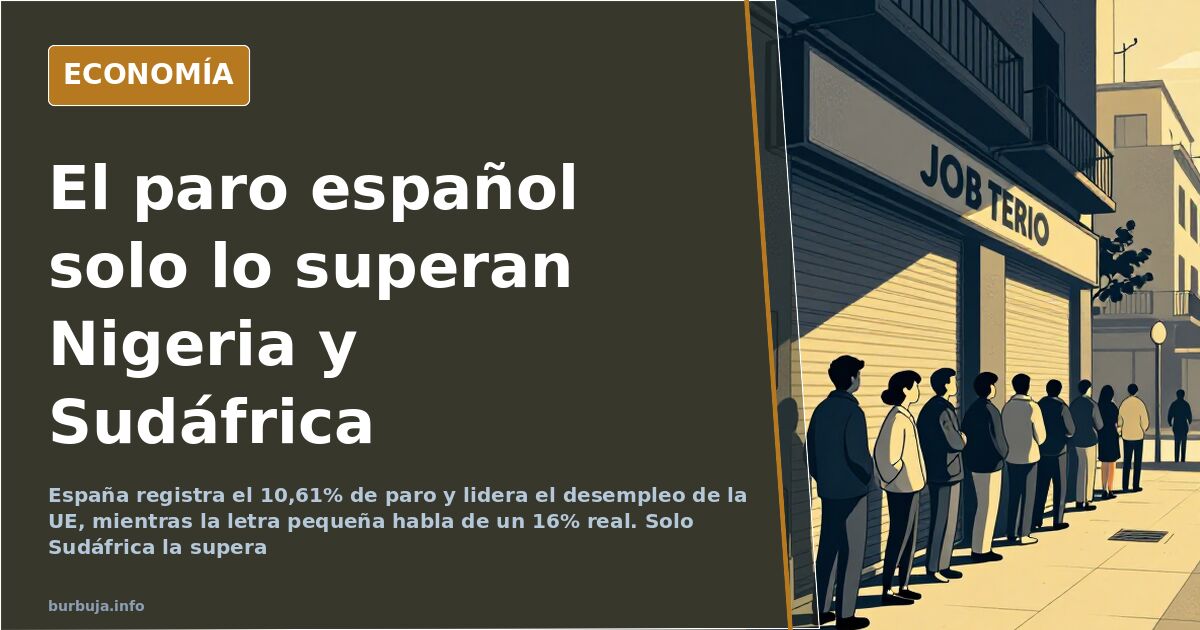
Spain occupies a top spot in global unemployment behind South Africa
Is Spain the third country in the world with the highest unemployment? This question arises every time affiliation data is released, and the answer depends on the metric used. Using the harmonized rate that allows for economic comparisons, South Africa stands at 32.1% and Spain sits at 10.61%. While far from that record, Spain holds a dubious distinction: it leads unemployment in the European Union, even during the peak tourist month of August. The third position often attributed to Nigeria does not appear in the standard tables. What does appear is a troubling gap between official figures and the fine print.
The official 10.61% versus the 16% cited outside official statistics
The standardized unemployment rate is around 10.6% and serves as a benchmark against France (7.3%), Germany (6.2%), or Italy (6.2%). However, some argue the real figure spikes to 16% if you add the nearly 500,000 unemployed people who do not appear on the lists. This argument is not new: official statistics only measure those actively seeking work. Those who grow tired of searching, or those surviving on sporadic jobs, fall out of the picture and swell the ranks of the uncounted.
To this distortion, another is added. The Social Security (Seguridad Social) boasts high numbers of contributors, but contributing does not always equate to working. Nearly 1.8 million benefit recipients inflate the affiliation figures. Presenting record numbers of contributors as a synonym for job recovery is, at the very least, optimistic.
A summer that fails to boost Spanish employment
August is usually a benevolent month due to the tourism surge. This has not been the case. The country lost 193,704 contributors in its worst August in five years, and the destruction of seasonal jobs has reached pre-pandemic levels. Collective redundancies rose by 51.9% in June, and workers on suspended contracts increased by 73.3%.
The pattern repeats every summer: a country that lives off tourism cannot bridge the gap of the other nine months with just three months of seasonal work. Manual labor, fairground, or temporary roles sustain entire families, but they do not build careers or wealth. It is the model of a service economy, and it has a very visible ceiling.
Why does Spain have higher unemployment than its European neighbors?
Part of the analysis points to the industrial restructuring of the 1980s. The dismantling of the manufacturing fabric may have left the country without the industry that later sustained Germany. The suspicion that this process responded to external demands circulates strongly among those who believe Spain surrendered its productive muscle. Whether true or not, the result is a country with fewer factories and a greater dependence on construction and the service sector.
The other factor is wages. Spain is among the EU countries with the cheapest labor and, simultaneously, among those facing the highest tax pressure on payroll. A salary of 1,200 euros does not buy what it did in 2005, and wages have remained stagnant for nearly two decades. When working is not enough to afford a home or start a family, more and more people wonder why they should bother waking up at six.
The migration paradox: record foreign population amid rising unemployment
Spain is the third country in Europe by percentage of foreign population, after Germany and France, with nearly 7 million foreign residents and 2.5 million naturalized citizens. Every year, approximately 800,000 non-EU foreigners enter the country. Yet, unemployment among foreign workers has reached 14%, its highest level in five years, exceeding the national average.
The Government has announced a strategy to bring in workers from Africa and improve training. This measure, alongside affiliation statistics, has been interpreted by some as a sign that the economy needs labor that the local population does not provide. Others respond that a country with millions of unemployed does not need to import workers, but rather to activate those it already has. The old, unresolved debate continues.
Youth unemployment: the real void
If there is one statistic that is truly jarring, it is that of the youth. Spain is the second country in the OECD with the highest youth unemployment, and this is despite a generation that has accumulated more education than any other in history. Without work, there is no rental housing; without housing, there is no independence; and without independence, there is no birth rate. The demographic equation breaks at the employment link.
The generational gap is closed, when it is closed at all, with public money that supports the elderly while the youth wait for their turn. The result is a silent tension that fewer and fewer people bother to hide.
Thus, the third place in the global unemployment ranking has a catch: if measured by South Africa's standard, Spain plays in the top tier of unemployment; if measured by Nigeria's, the podium collapses. What does not collapse is the civil servant's salary. That arrives punctually at the end of the month.
Is Spain the third country in the world with the highest unemployment? This question arises every time affiliation data is released, and the answer depends on the metric used. Using the harmonized rate that allows for economic comparisons, South Africa stands at 32.1% and Spain sits at 10.61%. While far from that record, Spain holds a dubious distinction: it leads unemployment in the European Union, even during the peak tourist month of August. The third position often attributed to Nigeria does not appear in the standard tables. What does appear is a troubling gap between official figures and the fine print.
The official 10.61% versus the 16% cited outside official statistics
The standardized unemployment rate is around 10.6% and serves as a benchmark against France (7.3%), Germany (6.2%), or Italy (6.2%). However, some argue the real figure spikes to 16% if you add the nearly 500,000 unemployed people who do not appear on the lists. This argument is not new: official statistics only measure those actively seeking work. Those who grow tired of searching, or those surviving on sporadic jobs, fall out of the picture and swell the ranks of the uncounted.
To this distortion, another is added. The Social Security (Seguridad Social) boasts high numbers of contributors, but contributing does not always equate to working. Nearly 1.8 million benefit recipients inflate the affiliation figures. Presenting record numbers of contributors as a synonym for job recovery is, at the very least, optimistic.
A summer that fails to boost Spanish employment
August is usually a benevolent month due to the tourism surge. This has not been the case. The country lost 193,704 contributors in its worst August in five years, and the destruction of seasonal jobs has reached pre-pandemic levels. Collective redundancies rose by 51.9% in June, and workers on suspended contracts increased by 73.3%.
The pattern repeats every summer: a country that lives off tourism cannot bridge the gap of the other nine months with just three months of seasonal work. Manual labor, fairground, or temporary roles sustain entire families, but they do not build careers or wealth. It is the model of a service economy, and it has a very visible ceiling.
Why does Spain have higher unemployment than its European neighbors?
Part of the analysis points to the industrial restructuring of the 1980s. The dismantling of the manufacturing fabric may have left the country without the industry that later sustained Germany. The suspicion that this process responded to external demands circulates strongly among those who believe Spain surrendered its productive muscle. Whether true or not, the result is a country with fewer factories and a greater dependence on construction and the service sector.
The other factor is wages. Spain is among the EU countries with the cheapest labor and, simultaneously, among those facing the highest tax pressure on payroll. A salary of 1,200 euros does not buy what it did in 2005, and wages have remained stagnant for nearly two decades. When working is not enough to afford a home or start a family, more and more people wonder why they should bother waking up at six.
The migration paradox: record foreign population amid rising unemployment
Spain is the third country in Europe by percentage of foreign population, after Germany and France, with nearly 7 million foreign residents and 2.5 million naturalized citizens. Every year, approximately 800,000 non-EU foreigners enter the country. Yet, unemployment among foreign workers has reached 14%, its highest level in five years, exceeding the national average.
The Government has announced a strategy to bring in workers from Africa and improve training. This measure, alongside affiliation statistics, has been interpreted by some as a sign that the economy needs labor that the local population does not provide. Others respond that a country with millions of unemployed does not need to import workers, but rather to activate those it already has. The old, unresolved debate continues.
Youth unemployment: the real void
If there is one statistic that is truly jarring, it is that of the youth. Spain is the second country in the OECD with the highest youth unemployment, and this is despite a generation that has accumulated more education than any other in history. Without work, there is no rental housing; without housing, there is no independence; and without independence, there is no birth rate. The demographic equation breaks at the employment link.
The generational gap is closed, when it is closed at all, with public money that supports the elderly while the youth wait for their turn. The result is a silent tension that fewer and fewer people bother to hide.
Thus, the third place in the global unemployment ranking has a catch: if measured by South Africa's standard, Spain plays in the top tier of unemployment; if measured by Nigeria's, the podium collapses. What does not collapse is the civil servant's salary. That arrives punctually at the end of the month.
Summary of a discussion on Burbuja.info - Foro de economía, actualidad y política., translated from Spanish and reviewed before publication. Read the full discussion (461 replies).
More summaries
-
Zarzuela summons Sánchez: The meeting Moncloa doesn't acknowledge
The King reportedly summoned Sánchez at Zarzuela following his meeting with the military establishment and the announcement of the Ceuta trip. The official agenda makes no mention of the encounter, and...
-
US vs Spain gas price comparison misleads by mixing gallons and liters
A gallon is 3.78 liters: comparing $4 per gallon in the US with €1.99 per liter in Spain omits the conversion.
-
Garzón denies building more housing lowers prices, but data contradicts him
Eduardo Garzón argues that increased construction does not reduce housing prices. However, supply and demand data in Spain suggest otherwise.
-
Avoiding Spanish Polling Station Duty by Not Answering Door
In Spain, polling station notification requires a signature. Without it, there is no summons. The lottery runs from October 31 to November 4.
-
Spain's Administrative Collapse: Six Months for One Registration
Intellectual property registrations now take six months instead of fifteen days, highlighting a severe administrative breakdown in Spain.
-
Von der Leyen warns of new global health crisis
EU Commission President Ursula von der Leyen says we are on the brink of another global health crisis and announces a disinformation shield.