
Why a car cannot pull itself with a magnet
Elon Musk confirms electric cars can't recharge while moving via wind turbines, citing internal forces and low efficiency.
English · Original discussion in Spanish · Published
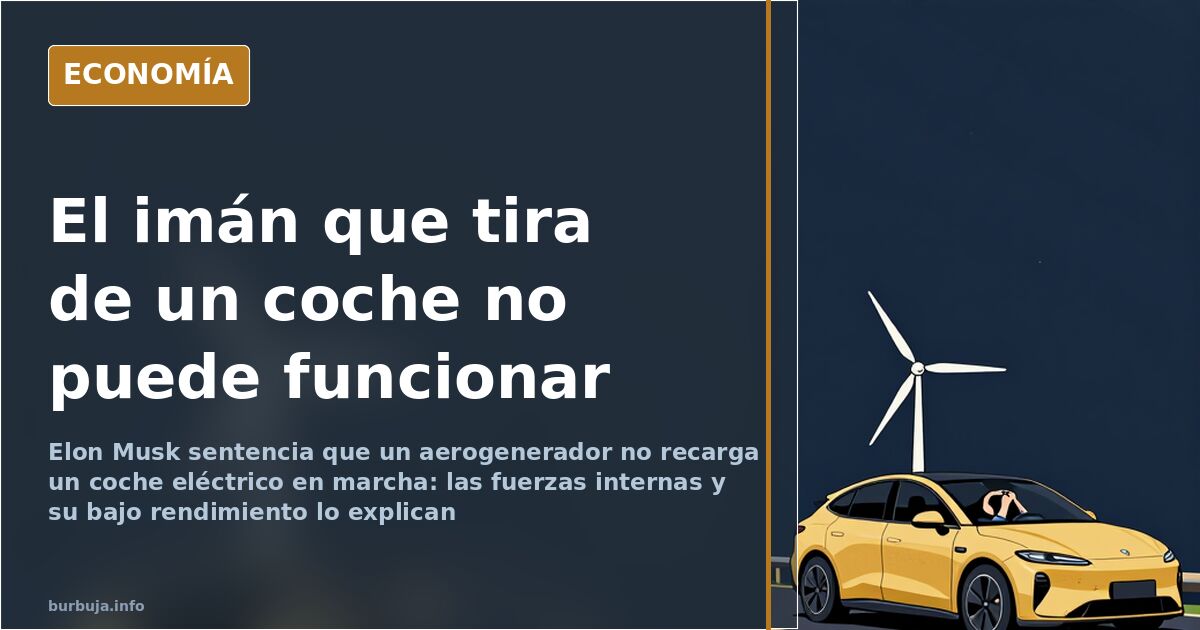
Wind turbine on an electric car: why it doesn't charge the battery
An electric car with a wind turbine on top does not recharge itself. Elon Musk stated this in a one-line tweet —"Putting a wind turbine on an EV also doesn't work"— reopening a debate that has circulated for years in engineering circles: the idea of a magnet tied to the hood pulling the vehicle itself. Neither concept works. The reason is the same in both cases. There is no mystery beyond Newton's third law and a net force that always equals zero.
Why can't a magnet pull the car it is attached to?
Because all forces involved are internal to the system and cancel each other out. The reasoning, detailed in the discussion, is simple: the forward force the magnet exerts on the body is compensated by the reaction the body exerts on the rod and magnet. Summed up, zero. The momentum of the whole does not change and the vehicle does not move. To move, something external would need to push from outside.
The case has a literary precedent: the Baron Munchausen, who according to legend pulled himself out of a swamp by his own ponytail. The baron's ponytail is the hood magnet, and the swamp is physics. A collective version has also been proposed —a magnet in the car ahead to pull yours and another behind to drag the next— which fixes nothing, because each pair repeats the same problem.
Replacing the magnet with a wind turbine doesn't work either
At first glance it seems possible, and that is the error. The wind turbine generates real electricity: the car moves, air turns the blades, current flows. But that energy comes from the vehicle's own movement, not from free wind. The balance becomes negative as soon as efficiencies enter the equation. A large wind turbine, like those seen along highways, reaches about 50% efficiency at best; a small one installed on a car doesn't come close. The electric motor, however, operates at around 90%.
The arithmetic is stubborn. For every unit of energy the car gives to the mill as resistance, it recovers significantly less than half, and loses another 10% returning it to the circuit. Added to this is the cost of dragging the device. According to this calculation, the balance remains in net loss, although some participants argue that, despite everything, the mill could slightly extend the vehicle's range.
The wind from the windshield is not free energy
Here lies the intuition error that explains everything. When someone sticks their hand out of a moving car window, they are not feeling wind: the vehicle is advancing against relatively still air. There is no external input to exploit. That air only moves relative to the car because the car is moving, and harnessing it —with a mill, a paddle, or whatever— causes braking. What is extracted comes from the tank or battery, with efficiency tolls along the way.
It is different when the wind is provided by the atmosphere. A sailboat can navigate faster than the wind pushing it: a counterintuitive but known result, and a good reminder that these matters are resolved with calculations, not sight.
The educational video and the final test that fails
Much of the exchange revolved around a video attempting to settle the matter with equations and physicists involved. The most repeated criticism is not against the physics, but against the conclusion: the practical demonstration closing the montage was pointed out as a hoax. And that detail, for some, contaminates the whole. If the end is a trick, why take the rest as gospel truth?
Others argue exactly the opposite: the video exists precisely to explain that here nobody abusa thermodynamics, but rather the premise was poorly formulated from the start. The question, they insist, is how much energy can be captured from the wind and how much is needed to move the vehicle, not whether a mill can turn a grindstone.
"Thermodynamics is not a universal law"
The final section abandons magnets and mills to discuss whether physical laws are laws or theories. Some argue that no one has checked every corner of the universe and that speaking of an immutable law is overconfidence, recalling that skeptics also predicted "that turbo thing" wouldn't work. The most cited response: you go down the stairs instead of jumping out the window because the unconscious part of the brain assumes the first law, and no one does that out of faith.
The conversation drifts toward vocabulary issues —what is a force, what is a reaction, why distinguish between mass and energy— and toward a true idea that does not save the invention: in the framework of quantum field theory, mass converts into energy and vice versa, but not in quantities a car can use to advance.
And hanging in between is an unanswered reassuring question: if water expands when freezing and can burst pipes holding hundreds of bars, where does that force come from? No one clarified. Nor has anyone yet explained how the roof mill would recover the efficiency points separating it from the motor it intends to feed.
Also available in: Deutsch
Summary of a discussion on Burbuja.info - Foro de economía, actualidad y política., translated from Spanish and reviewed before publication. Read the full discussion (187 replies).
More summaries
-
Chinese EV clocks 6:46 at Nürburgring
A Chinese electric vehicle records 6:46 at the Nürburgring, just 41 seconds off the VW ID.R record. This time reignites the debate on power, sound, and range.
-
Fire instructor: 25,000 liters needed to extinguish EV fire
A chemical fire expert claims electric vehicles require 25,000 liters of water to control fires, compared to 3,000 for gasoline cars.
-
EV towing caravan runs out of range at 125 km
An electric vehicle towing a caravan stopped after 125 km due to a faulty charger; real-world range calculations with trailers reveal uncomfortable figures.
-
Oasis Tickets Hit €480: The Bubble Beyond Inflation
Oasis concert tickets in Amsterdam cost €480, eight times the 2011 price in Barcelona. Inflation doesn't explain the surge; the business model does.
-
Record summer spending: small business revenue up 40%
A small business owner reports 40% higher revenue this summer. Record travel and flight numbers confirm the boom, but job insecurity remains the weak spot.
-
Spain's PM calls AI an agent, not a tool, and divides opinion
Spain's Prime Minister says "AI is an agent, not an instrument" and plugs a bestseller, reopening the debate over AI's role in the economy.