
Chinese EV clocks 6:46 at Nürburgring
A Chinese electric vehicle records 6:46 at the Nürburgring, just 41 seconds off the VW ID.R record. This time reignites the debate on power, sound, and range.
English · Original discussion in Spanish · Published
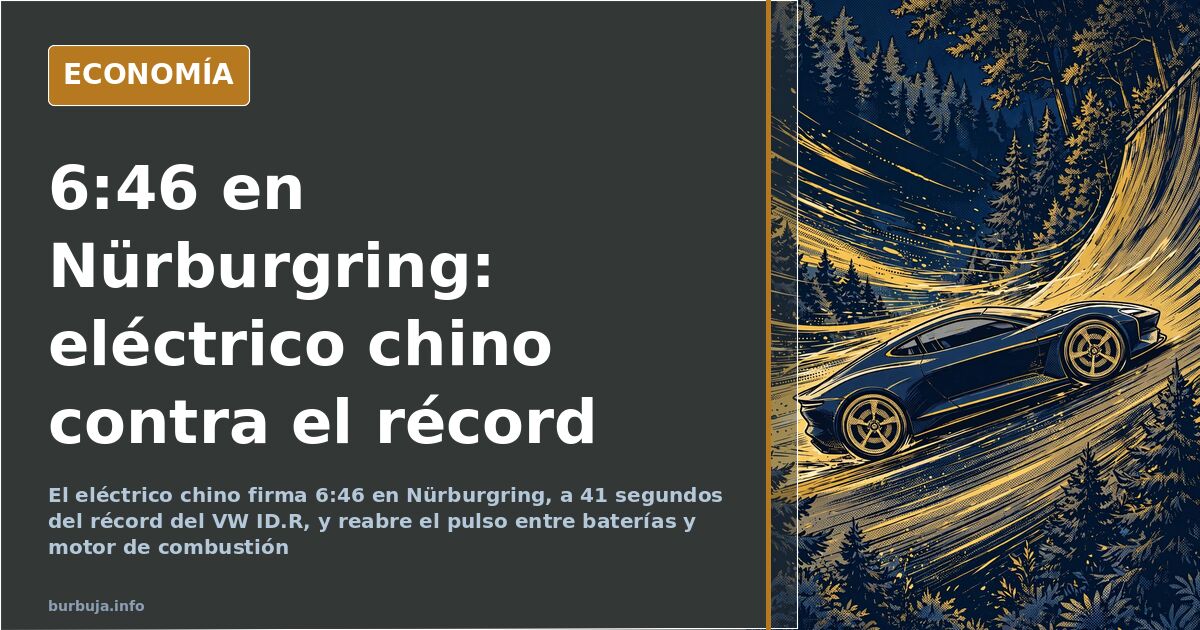
Chinese EV clocks 6:46 at Nürburgring, missing the record by 41 seconds
What is a Chinese electric car doing on Germany's most antiestéticared circuit? Posting a 6:46 lap in the Nordschleife, the 20.832-meter track that would have seemed like a drunken joke five years ago. The Xiaomi leaves half the combustion sports car grid behind and still sits 41 seconds shy of the absolute EV record held by the Volkswagen ID.R (6:05.33). What stands out isn't just the time: it's that the majority reaction isn't awe, but thinly veiled relief. After all, it sounds like a washing machine.
Which times need to be beaten at Nürburgring
With the 6:46 on the table, the Nordschleife record hierarchy orders itself with some cruelty:
Against the Volkswagen ID.R, the gap is those same 41 seconds repeated in any comparison. And the Mercedes-AMG ONE, with its hybrid engine, still holds an advantage. The Chinese car's time also leaves nearly a minute behind a benchmark German compact sports car like the Audi RS3, according to comparisons made in the discussion itself. In pure acceleration, however, the EV plays a different hand: torque arrives from the first revolution, without waiting for anything to rev up.
Sound: the battle the EV loses by a landslide
There is no room for debate here. An electric car doesn't go brum brum. And for part of the audience, that alone disqualifies everything else: talk turns to a badly assembled fairground ride, a spinning washing machine, or a commuter train. The complaint is almost always the same: no matter how fast it goes, the spectacle is missing.
Not all noise is a defect, and it pays to refine the argument. Brake squeal in a high-performance car can simply be the normal sound of hard pads working at the limit, not a malfunction. Those used to demanding bikes and cars recognize it without drama.
The absence of gears is also read positively: with no shifting to manage, the driver concentrates all attention on cornering, braking, and modulating power on every exit.
One lap and half an hour charging? The problem is in the pit
The Achilles' heel of an EV on track isn't the straight, it's the stop. A car running at this pace needs a recharge measured in tens of minutes—the circulating reference is half an hour—compared to three minutes for a fuel refill.
The math to sustain about 24 hours at Nürburgring isn't pretty: dozens of spare batteries, around fifty, would be needed if you don't want to lose ground at each stint. The alternative suggested, swappable batteries instead of recharging, solves the time issue but complicates logistics and increases overall weight.
Durability adds to this. Some concede the electric motor a clear advantage in acceleration but immediately point out the problem: sustaining that pace for hours. Formula E is cited as proof that 45 continuous minutes without recharging are possible, albeit with very specific formats and restrictions.
Who really benefits from an electric car?
Here the conversation moves from the track to household economics. Real savings per kilometer appear in a very specific scenario: a small utility car, with 150 to 200 kilometers of range, slowly charging at home overnight. Outside of that, a high-performance EV is an expensive toy that can come with infrastructure problems.
One school of thought argues that regulatory adoption forces a technology that doesn't fit everyone's needs: those living in apartments without garages, those making long daily commutes, or those using the car as a work tool. Another recurring argument points to fiscal future: when the fleet is mostly electric, the State will have to recover elsewhere the revenue it currently gets from hydrocarbons.
And a warning about the industrial map. In EVs, the Chinese industry has taken the lead over European manufacturers. The 6:46 is no accident; it's a demonstration.
Curiosity: electric cars with motors in each wheel, back in 1900
The Lohner-Porsche presented by Ferdinand Porsche in 1900 already antiestéticatured an independent motor in each wheel. It weighed 1,000 kilos, of which 400 were battery, achieved about 50 kilometers of range at an average estimulante ilegal of 35 km/h, and sold between 10,000 and 35,000 Austrian crowns of the era. An efficient yet prohibitive vehicle, with the same commercial label as today.
Then came the cheap, practical combustion engine with tanks on every corner. There was no conspiracy: it was simply more useful. History, apparently, wants to repeat itself in reverse.
After debating cells, charging stops, and lap times, the conclusion that emerges is as unepic as it is inevitable: the perfect car, the one nobody times, is a 150 HP diesel with 1,200 kilometers of range and a three-minute refuel. It breaks no records. But you don't have to change its battery every five laps.
What is a Chinese electric car doing on Germany's most antiestéticared circuit? Posting a 6:46 lap in the Nordschleife, the 20.832-meter track that would have seemed like a drunken joke five years ago. The Xiaomi leaves half the combustion sports car grid behind and still sits 41 seconds shy of the absolute EV record held by the Volkswagen ID.R (6:05.33). What stands out isn't just the time: it's that the majority reaction isn't awe, but thinly veiled relief. After all, it sounds like a washing machine.
Which times need to be beaten at Nürburgring
With the 6:46 on the table, the Nordschleife record hierarchy orders itself with some cruelty:
- Porsche 919 Hybrid Evo: 5:19.546, the fastest lap in the track's history.
- Volkswagen ID.R: 6:05.33, the absolute record among electric vehicles.
- Mercedes-AMG ONE: 6:29.090, the best homologated road sports car.
- Porsche 911 GT2 RS with Manthey kit: 6:38.835.
- Mercedes-AMG GT Black Series: 6:43.616.
Against the Volkswagen ID.R, the gap is those same 41 seconds repeated in any comparison. And the Mercedes-AMG ONE, with its hybrid engine, still holds an advantage. The Chinese car's time also leaves nearly a minute behind a benchmark German compact sports car like the Audi RS3, according to comparisons made in the discussion itself. In pure acceleration, however, the EV plays a different hand: torque arrives from the first revolution, without waiting for anything to rev up.
Sound: the battle the EV loses by a landslide
There is no room for debate here. An electric car doesn't go brum brum. And for part of the audience, that alone disqualifies everything else: talk turns to a badly assembled fairground ride, a spinning washing machine, or a commuter train. The complaint is almost always the same: no matter how fast it goes, the spectacle is missing.
Not all noise is a defect, and it pays to refine the argument. Brake squeal in a high-performance car can simply be the normal sound of hard pads working at the limit, not a malfunction. Those used to demanding bikes and cars recognize it without drama.
The absence of gears is also read positively: with no shifting to manage, the driver concentrates all attention on cornering, braking, and modulating power on every exit.
One lap and half an hour charging? The problem is in the pit
The Achilles' heel of an EV on track isn't the straight, it's the stop. A car running at this pace needs a recharge measured in tens of minutes—the circulating reference is half an hour—compared to three minutes for a fuel refill.
The math to sustain about 24 hours at Nürburgring isn't pretty: dozens of spare batteries, around fifty, would be needed if you don't want to lose ground at each stint. The alternative suggested, swappable batteries instead of recharging, solves the time issue but complicates logistics and increases overall weight.
Durability adds to this. Some concede the electric motor a clear advantage in acceleration but immediately point out the problem: sustaining that pace for hours. Formula E is cited as proof that 45 continuous minutes without recharging are possible, albeit with very specific formats and restrictions.
Who really benefits from an electric car?
Here the conversation moves from the track to household economics. Real savings per kilometer appear in a very specific scenario: a small utility car, with 150 to 200 kilometers of range, slowly charging at home overnight. Outside of that, a high-performance EV is an expensive toy that can come with infrastructure problems.
One school of thought argues that regulatory adoption forces a technology that doesn't fit everyone's needs: those living in apartments without garages, those making long daily commutes, or those using the car as a work tool. Another recurring argument points to fiscal future: when the fleet is mostly electric, the State will have to recover elsewhere the revenue it currently gets from hydrocarbons.
And a warning about the industrial map. In EVs, the Chinese industry has taken the lead over European manufacturers. The 6:46 is no accident; it's a demonstration.
Curiosity: electric cars with motors in each wheel, back in 1900
The Lohner-Porsche presented by Ferdinand Porsche in 1900 already antiestéticatured an independent motor in each wheel. It weighed 1,000 kilos, of which 400 were battery, achieved about 50 kilometers of range at an average estimulante ilegal of 35 km/h, and sold between 10,000 and 35,000 Austrian crowns of the era. An efficient yet prohibitive vehicle, with the same commercial label as today.
Then came the cheap, practical combustion engine with tanks on every corner. There was no conspiracy: it was simply more useful. History, apparently, wants to repeat itself in reverse.
After debating cells, charging stops, and lap times, the conclusion that emerges is as unepic as it is inevitable: the perfect car, the one nobody times, is a 150 HP diesel with 1,200 kilometers of range and a three-minute refuel. It breaks no records. But you don't have to change its battery every five laps.
Also available in: Deutsch
Summary of a discussion on Burbuja.info - Foro de economía, actualidad y política., translated from Spanish and reviewed before publication. Read the full discussion (199 replies).
More summaries
-
Volkswagen announces 7.51 kWh/100 km for its most efficient electric vehicle
Volkswagen claims the most efficient EV with a consumption of 7.51 kWh/100 km. However, this record clashes with its ground clearance and the closures in Germany.
-
Electric cars: Volkswagen issues two profit warnings in three months
Volkswagen has issued two profit warnings in three months and Stellantis has cut forecasts due to 2030 regulations and Chinese electric cars.
-
Quarterly record for electric cars: 8% of May sales
May ends with 19.4% plug-in passenger cars but only 8% pure electrics: a quarterly record, with the leading model selling 465 units
-
Evicted Madrid Elderly Woman Dies; Neighbor Claims 'Murder'
Maricarmen, an elderly woman evicted in Spain, died at 87. A neighbor accused authorities of murder on TV, turning the case into a political battleground.
-
Fitch: curbing immigration slows GDP, but what about per capita?
Fitch warns that cutting immigration would slow Spain's GDP growth, but the debate hinges on GDP per capita. Banco de España data and Poland's case…
-
RTVE spends public money on Pride and backlash grows in Spain
Spain's public broadcaster RTVE faces criticism over its Pride coverage, accused of bias and wasting public money. The cost of the programming and the replacement of the parade...