
Fire instructor: 25,000 liters needed to extinguish EV fire
A chemical fire expert claims electric vehicles require 25,000 liters of water to control fires, compared to 3,000 for gasoline cars.
English · Original discussion in Spanish · Published
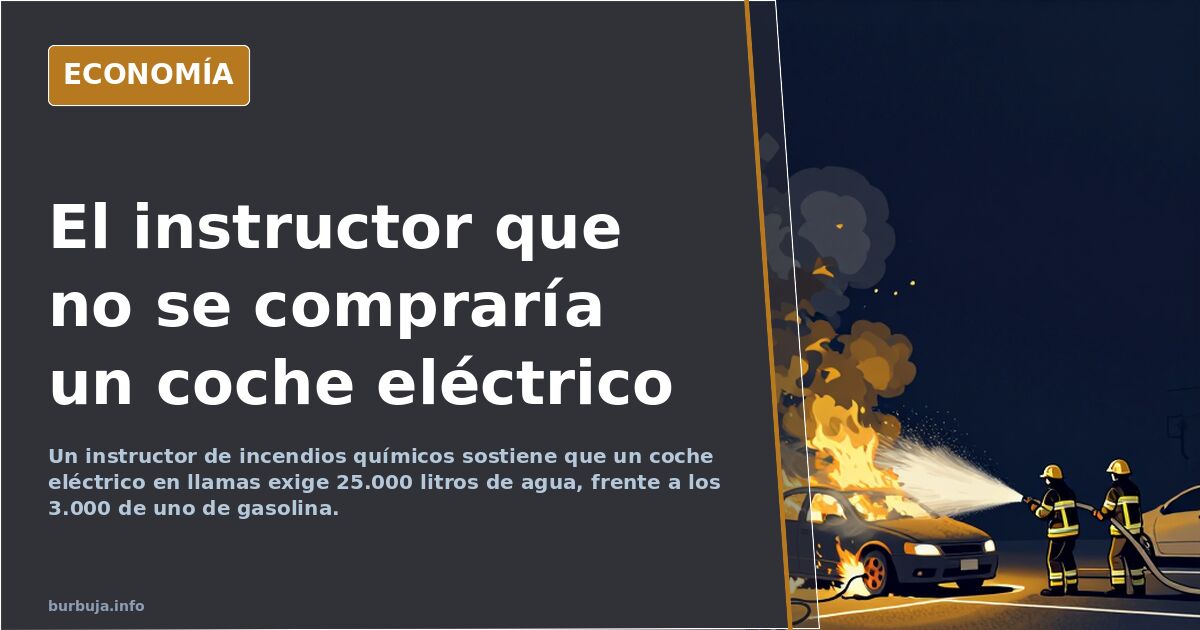
Instructor wouldn't buy an EV: needs 25,000 liters
In a classroom in Tarragona, during a mandatory chemical fire course for local industry workers, an instructor answered a question about electric cars. His response was a figure: 25,000 liters of water to control a burning EV, versus the 3,000 sufficient for a gasoline car. And a confession: he wouldn't buy one himself. The testimony, collected by a course attendee, challenges the usual narrative on electric vehicles. Because the number isn't about range or emissions. It's about water.
How much water is needed to control a burning electric car
According to this account, an electric car consumes about 25,000 liters to be controlled; a gasoline car, about 3,000. The difference is not minor. The EV does not go out, it cools down: the fire self-sustains and the recommendation is to let it burn while cooling it with water, which comes out contaminated. Standard extinguishers don't work: you can't put it out with CO2 because the battery produces its own oxidizer. Impossible to extinguish, only contain.
That is the key issue. In a combustion fire, you remove oxygen and it's over. In a lithium battery, the material itself manufactures oxygen. Spraying CO2 on it is like throwing water into the sea.
Why the battery is the entire floor of the car
The instructor added a detail often overlooked: vapors are highly toxic and, without protection, exposure is measured in seconds. Working nearby requires self-contained breathing apparatus, with a duration of about 20 minutes. Little margin.
An active firefighter confirmed the scenario firsthand. He recounted that after a battery fire, the vehicle taken to a quarantine container and flooded with water was still reacting 15 days later. Wastewater, loaded with lithium and cadmium, is removed via waste management tankers. Fire blankets, when available, are quickly consumed by the flames. He described a method to attack the battery: a hollow metal rod ending in a spike driven with a hammer into the weakest zone, between cells, to connect a water line. The theory looks great. In practice, not so much.
Parking garages nobody redesigned
Here lies the most uncomfortable point. The problem is known—reports arrive from the US and rest of Europe—and does not translate into construction regulations for parking lots, according to the course account. The instruction coming from above, he argues, is that electric is best, and everything else remains untouched.
There is another layer, according to another participant: EVs weigh more and, if they become the majority parked under buildings, floors will have to support 30% more load. No one talks about reinforcing structures or redoing basements. And on the horizon looms the scenario no one wants to name aloud: if a battery fire spreads in a closed underground garage, what is at stake is not just four cars' sheet metal.
E-scooters, blankets, and a lobby filtering bad news
The same risk, multiplied by low price, exists in electric scooters. They charge at home, with cheap and poorly maintained batteries, and fires usually start during charging. A cited case: a burning scooter ended up in a pool by order of the instructor himself, who considered it best despite the owner's complaint. In another part of the conversation, a news story was mentioned about the death of a 25-year-old man in Navarra when an electronic device he was charging exploded while he slept.
And the uncomfortable part: it is claimed there is a sort of lobby that does not tolerate bad news about EVs. The deployment for these emergencies is also incomplete. Supposed fire blankets are not in stations; only on some ferries.
The alternative that barely burns: LFP batteries
Not all signals point against them. According to a participant, lithium iron phosphate (LFP) batteries degrade less, are cheaper, and are practically impossible to ignite. Their drawback: lower energy capacity per kilo. On paper, the technical solution exists.
The problem, he argues, is that the shift towards them is driven by price, not safety, so no one imposes them for prevention reasons. And not everything is risks: some defend EVs for their lower noise pollution in cities, an argument easily supported by the noise of combustion engines in short gears.
The classroom conclusion stands: the one who warns wouldn't buy an EV, and sees danger "on another scale" even in hybrids, which combine gasoline and battery in the same chassis. Twenty minutes of air for those fighting the fire. Fifteen days of reaction for the already submerged car. With those two figures, the transition has a pending question that is not about the plug.
In a classroom in Tarragona, during a mandatory chemical fire course for local industry workers, an instructor answered a question about electric cars. His response was a figure: 25,000 liters of water to control a burning EV, versus the 3,000 sufficient for a gasoline car. And a confession: he wouldn't buy one himself. The testimony, collected by a course attendee, challenges the usual narrative on electric vehicles. Because the number isn't about range or emissions. It's about water.
How much water is needed to control a burning electric car
According to this account, an electric car consumes about 25,000 liters to be controlled; a gasoline car, about 3,000. The difference is not minor. The EV does not go out, it cools down: the fire self-sustains and the recommendation is to let it burn while cooling it with water, which comes out contaminated. Standard extinguishers don't work: you can't put it out with CO2 because the battery produces its own oxidizer. Impossible to extinguish, only contain.
That is the key issue. In a combustion fire, you remove oxygen and it's over. In a lithium battery, the material itself manufactures oxygen. Spraying CO2 on it is like throwing water into the sea.
Why the battery is the entire floor of the car
The instructor added a detail often overlooked: vapors are highly toxic and, without protection, exposure is measured in seconds. Working nearby requires self-contained breathing apparatus, with a duration of about 20 minutes. Little margin.
An active firefighter confirmed the scenario firsthand. He recounted that after a battery fire, the vehicle taken to a quarantine container and flooded with water was still reacting 15 days later. Wastewater, loaded with lithium and cadmium, is removed via waste management tankers. Fire blankets, when available, are quickly consumed by the flames. He described a method to attack the battery: a hollow metal rod ending in a spike driven with a hammer into the weakest zone, between cells, to connect a water line. The theory looks great. In practice, not so much.
Parking garages nobody redesigned
Here lies the most uncomfortable point. The problem is known—reports arrive from the US and rest of Europe—and does not translate into construction regulations for parking lots, according to the course account. The instruction coming from above, he argues, is that electric is best, and everything else remains untouched.
There is another layer, according to another participant: EVs weigh more and, if they become the majority parked under buildings, floors will have to support 30% more load. No one talks about reinforcing structures or redoing basements. And on the horizon looms the scenario no one wants to name aloud: if a battery fire spreads in a closed underground garage, what is at stake is not just four cars' sheet metal.
E-scooters, blankets, and a lobby filtering bad news
The same risk, multiplied by low price, exists in electric scooters. They charge at home, with cheap and poorly maintained batteries, and fires usually start during charging. A cited case: a burning scooter ended up in a pool by order of the instructor himself, who considered it best despite the owner's complaint. In another part of the conversation, a news story was mentioned about the death of a 25-year-old man in Navarra when an electronic device he was charging exploded while he slept.
And the uncomfortable part: it is claimed there is a sort of lobby that does not tolerate bad news about EVs. The deployment for these emergencies is also incomplete. Supposed fire blankets are not in stations; only on some ferries.
The alternative that barely burns: LFP batteries
Not all signals point against them. According to a participant, lithium iron phosphate (LFP) batteries degrade less, are cheaper, and are practically impossible to ignite. Their drawback: lower energy capacity per kilo. On paper, the technical solution exists.
The problem, he argues, is that the shift towards them is driven by price, not safety, so no one imposes them for prevention reasons. And not everything is risks: some defend EVs for their lower noise pollution in cities, an argument easily supported by the noise of combustion engines in short gears.
The classroom conclusion stands: the one who warns wouldn't buy an EV, and sees danger "on another scale" even in hybrids, which combine gasoline and battery in the same chassis. Twenty minutes of air for those fighting the fire. Fifteen days of reaction for the already submerged car. With those two figures, the transition has a pending question that is not about the plug.
Also available in: Deutsch
Summary of a discussion on Burbuja.info - Foro de economía, actualidad y política., translated from Spanish and reviewed before publication. Read the full discussion (126 replies).
More summaries
-
Toyota targets 1,500 km range by 2030 with solid-state batteries
Toyota plans solid-state batteries in 2027 and 1,500 km range by 2030; industry questions timelines, weight, and energy density.
-
Electric cars: twice the price and degrading batteries
An electric Opel Corsa costs 32,590 euros, double the gasoline version, with less range, charging queues, and batteries that degrade.
-
Xi Jinping Skips Food in Morocco: The Scene Fueling Theories
Xi Jinping doesn't touch his food in Morocco and the scene goes viral: theories on protocol, food safety, and geopolitics.
-
Rent vs. Buy: The Cost Calculation Dividing Spain
A forum user claims 16 years of renting cost €175,000 with rising rents, while another notes a home bought for €250,000 is now valued at…
-
Cost-price pumps spark clash in Valencia flood zone
A businessman offered bilge pumps at cost price in the DANA disaster area. The reaction from residents and the clash with municipal bureaucracy...
-
Spanish Forum Users Vanish Without Saying Goodbye
A look at long-standing Spanish economic forum members who stopped posting abruptly, leaving behind silent departures and lost community voices.