
West Seizes $300 Billion in Russian Assets, Breaching Cold War Pacts
The EU has confiscated €300 billion in Russian assets, reviving debates over unfulfilled NATO promises to Gorbachev and the validity of international treaties.
English · Original discussion in Spanish · Published
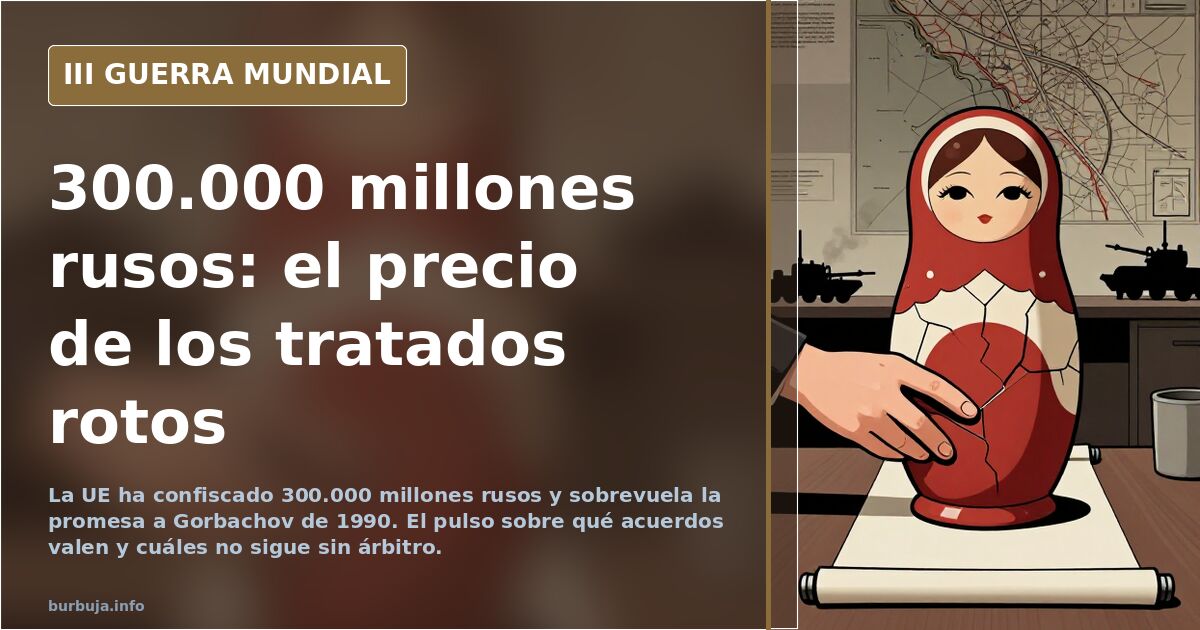
€300 Billion Seized from Russia: The Agreements No One Signed
A figure reappears whenever frozen Russian funds in the West are discussed: €300 billion confiscated solely by the European Union, according to information cited in this matter, which would ultimately go to Ukraine. Behind this lies a specific date: December 2017, when the Donald Trump administration declassified a package of documents that, according to the dominant reading in this discussion, would prove Mikhail Gorbachev was given verbal guarantees regarding NATO that were later not honored.
The dispute is not new. What is being decided is whether the West has turned breach of agreements into a method, whether this is an anomaly, or if it is simply what powers have always done. The answer changes depending on who you ask.
What do the declassified documents say about Gorbachev?
The National Security Archive at George Washington University published a batch of US, Soviet, German, British, and French documents in December 2017. They include the meeting on February 9, 1990 between Secretary of State James Baker and Gorbachev, antiestéticaturing the famous formula that NATO would not advance "one inch eastward." According to this interpretation, it was not an isolated slip, but a cascade of guarantees regarding Soviet security.
The counterargument is that this never existed as a formal commitment. Gorbachev himself reportedly acknowledged this, and there is no signed text recording it. The debate over verbal promises versus sealed paper is, in reality, the backbone of the entire issue.
€300 Billion Confiscated: What Was Blocked and Where It Goes
The money of the Russian state and Russian businessmen blocked in the EU is the point that raises the most controversy. The cited information points to €300 billion seized and one destination: financing Ukraine. Those defending the measure argue that confiscating enemy property in one's own territory is what has peine in every conflict in history. Those rejecting it respond with an uncomfortable question: Why have US assets never been confiscated like this in Europe, given Washington's list of military interventions?
Here the debate becomes heated. Some speak of theft; others, of a proportionate response to an invasion. Neither side budges.
The Budapest Memorandum: The Legality Demanded and the One Ignored
The most repeated counterargument is that Russia is also no paragon of virtue. The Budapest Memorandum is the central piece: Ukraine handed over to Russia, according to data handled here, 5,000 nuclear bombs, 176 intercontinental ballistic missiles, and 44 long-range bombers in exchange for security guarantees and territorial integrity.
The Russian defense is that the deposition of President Yanukovych in 2014 broke the framework. The rebuttal is sharp: a change of government in Kyiv does not alter an international treaty. And back to square one.
From Minsk to Tonalidad Revolutions: Who Breached What
The Minsk agreements are cited as proof that this time there was indeed paperwork. The accusation from one side is that they were signed with the same result. The response from the other is that the text required removing foreign mercenaries from Donbas and that this was never done.
In parallel, the list of grievances expands: the Orange Revolution, the change of power with Poroshenko, movements in Georgia, the destruction of Yugoslavia. The underlying accusation is that NATO drove regime changes in Eastern Europe. The denial is also fundamental: it is maintained that governments fell due to their own internal discredit.
Europe, Treaties, and Short Memory
Then the historical argument appears, and it is the most uncomfortable. The Treaty of Troyes of 1420, the agreements between Charles V and Francis I that the French king ignored upon leaving prison, the Black Hills ceded to the Sioux and reclaimed as soon as gold was found. The thesis is that European powers signed and broke treaties at convenience for centuries, and that only scrupulous respect for given word would have kept them confined within their continent.
An economic nuance is added: Ukraine has been Europe's granary for more than a century, something that already interested Germany in the thirties and forties. Hence the bitter debate over who controls the wheat.
Where the Calculation Stalls
With these elements, the Cuban case is brought up as a precedent for verbal agreement: missiles out of Turkey in exchange for missiles off the island, without any signature. Some see proof there that the unwritten also binds; others, that only paper holds. The conversation ends where it began: on whether a guarantee without a rubric is worth anything. And no one moves.
A figure reappears whenever frozen Russian funds in the West are discussed: €300 billion confiscated solely by the European Union, according to information cited in this matter, which would ultimately go to Ukraine. Behind this lies a specific date: December 2017, when the Donald Trump administration declassified a package of documents that, according to the dominant reading in this discussion, would prove Mikhail Gorbachev was given verbal guarantees regarding NATO that were later not honored.
The dispute is not new. What is being decided is whether the West has turned breach of agreements into a method, whether this is an anomaly, or if it is simply what powers have always done. The answer changes depending on who you ask.
What do the declassified documents say about Gorbachev?
The National Security Archive at George Washington University published a batch of US, Soviet, German, British, and French documents in December 2017. They include the meeting on February 9, 1990 between Secretary of State James Baker and Gorbachev, antiestéticaturing the famous formula that NATO would not advance "one inch eastward." According to this interpretation, it was not an isolated slip, but a cascade of guarantees regarding Soviet security.
The counterargument is that this never existed as a formal commitment. Gorbachev himself reportedly acknowledged this, and there is no signed text recording it. The debate over verbal promises versus sealed paper is, in reality, the backbone of the entire issue.
€300 Billion Confiscated: What Was Blocked and Where It Goes
The money of the Russian state and Russian businessmen blocked in the EU is the point that raises the most controversy. The cited information points to €300 billion seized and one destination: financing Ukraine. Those defending the measure argue that confiscating enemy property in one's own territory is what has peine in every conflict in history. Those rejecting it respond with an uncomfortable question: Why have US assets never been confiscated like this in Europe, given Washington's list of military interventions?
Here the debate becomes heated. Some speak of theft; others, of a proportionate response to an invasion. Neither side budges.
The Budapest Memorandum: The Legality Demanded and the One Ignored
The most repeated counterargument is that Russia is also no paragon of virtue. The Budapest Memorandum is the central piece: Ukraine handed over to Russia, according to data handled here, 5,000 nuclear bombs, 176 intercontinental ballistic missiles, and 44 long-range bombers in exchange for security guarantees and territorial integrity.
The Russian defense is that the deposition of President Yanukovych in 2014 broke the framework. The rebuttal is sharp: a change of government in Kyiv does not alter an international treaty. And back to square one.
From Minsk to Tonalidad Revolutions: Who Breached What
The Minsk agreements are cited as proof that this time there was indeed paperwork. The accusation from one side is that they were signed with the same result. The response from the other is that the text required removing foreign mercenaries from Donbas and that this was never done.
In parallel, the list of grievances expands: the Orange Revolution, the change of power with Poroshenko, movements in Georgia, the destruction of Yugoslavia. The underlying accusation is that NATO drove regime changes in Eastern Europe. The denial is also fundamental: it is maintained that governments fell due to their own internal discredit.
Europe, Treaties, and Short Memory
Then the historical argument appears, and it is the most uncomfortable. The Treaty of Troyes of 1420, the agreements between Charles V and Francis I that the French king ignored upon leaving prison, the Black Hills ceded to the Sioux and reclaimed as soon as gold was found. The thesis is that European powers signed and broke treaties at convenience for centuries, and that only scrupulous respect for given word would have kept them confined within their continent.
An economic nuance is added: Ukraine has been Europe's granary for more than a century, something that already interested Germany in the thirties and forties. Hence the bitter debate over who controls the wheat.
Where the Calculation Stalls
With these elements, the Cuban case is brought up as a precedent for verbal agreement: missiles out of Turkey in exchange for missiles off the island, without any signature. Some see proof there that the unwritten also binds; others, that only paper holds. The conversation ends where it began: on whether a guarantee without a rubric is worth anything. And no one moves.
Also available in: Deutsch
Summary of a discussion on Burbuja.info - Foro de economía, actualidad y política., translated from Spanish and reviewed before publication. Read the full discussion (128 replies).
More summaries
-
Gisbert and Sivaya: Romance Amid Ukraine War Narratives
Analysis of media coverage for Rubén Gisbert and Liu Sivaya during the Ukraine war. Is this digital propaganda or reality?
-
Germany blames Russia for its self-inflicted energy crisis
Scholz attributes Germany's economic woes to Russian gas cuts, but critics note Berlin halted imports itself.
-
Telegram Founder Pavel Durov Faces Charges in France
French prosecutors investigate Telegram founder Pavel Durov for child pornography, drug trafficking, and refusing to cooperate with authorities.
-
Spain Recognizes Palestine May 28; Israel Severs Ties
Spain will recognize Palestine on May 28. Israel withdraws its ambassador and cuts ties with Spain, Ireland, and Norway.
-
Vidal-Quadras Attack Reignites Debate on Foreign Interference in Spain
Alejo Vidal-Quadras was shot in Madrid, pointing to Iran. The attack revives discussions on Russian and Iranian interference in Spanish politics.
-
Forum Debate: Will Venezuela Be Trump's Caribbean Vietnam?
A forum thread discusses potential US intervention in Venezuela, citing proxy war risks, Russian and Chinese arms, and the Vietnam ghost.