
Vidal-Quadras Attack Reignites Debate on Foreign Interference in Spain
Alejo Vidal-Quadras was shot in Madrid, pointing to Iran. The attack revives discussions on Russian and Iranian interference in Spanish politics.
English · Original discussion in Spanish · Published
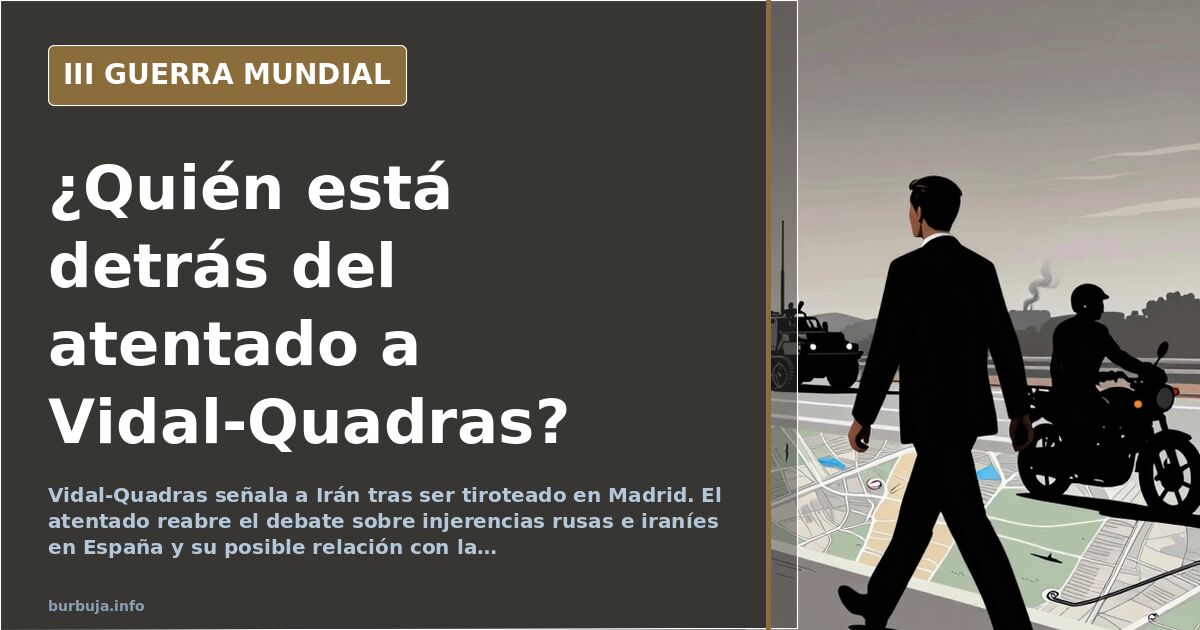
Vidal-Quadras Attack Reignites Debate on Foreign Interference in Spain
Who is behind the attempted assassination of Alejo Vidal-Quadras? The former PP leader and VOX founder was shot in the jaw in Madrid. According to a circulating tweet, Vidal-Quadras himself identified Iran as responsible. The attack, occurring amidst growing geopolitical tension, has reignited debate over foreign powers' influence on Spanish politics.
Iran as Suspect and History of Interference
The hypothesis of Iranian authorship is not new. Vidal-Quadras has a history of confrontation with the Tehran regime, particularly due to his support for the National Council of Resistance of Iran (NCRI), an organization Tehran considers terrorist. Reports indicate he told police that the Iranian regime was behind the attack. This accusation remains unconfirmed officially and is treated as an open line of investigation.
Debate on foreign interference in Spain extends beyond Iran. In recent years, Russian meddling in the Catalan independence process has been documented. European Parliament reports suggest Moscow promised military support to separatists, including deploying mercenaries. These revelations fuel the thesis that Spain is a battleground for global geopolitics.
Destabilization Theory and Russia's Role
A prominent analytical current argues that Russia seeks to destabilize the West, with Spain as a priority target. It is claimed that the Kremlin, weakened by the war in Ukraine, uses proxies like Iran to sow chaos. According to these voices, Russian state TV has broadcast messages openly discussing activating terrorist cells and leading Europe into Sarracinic revolt.
However, this thesis is not unanimous. Some point out that Russian interference in Spain is minor compared to other actors, such as Belgium, which sheltered secessionist politicians, or the United States, which funded independence groups. The discussion on the real weight of each foreign power in Spanish politics remains open.
The Attack and Conspiracy Theories
The attack on Vidal-Quadras has generated all kinds of speculation. Since the moment of the assault, multiple theories about authorship have circulated. Some sectors point to a settling of scores between Vidal-Quadras and his associates, while others see the hand of Iran or Russia. Lack of official confirmation has fueled the debate.
Police continue investigating. So far, no suspect has been detained and no authorship confirmed. Vidal-Quadras' health status is guarded, though it is known he underwent emergency surgery. Authorities have urged caution and avoided confirming circulating hypotheses.
Political Context: Amnesty and Social Tension
The attack occurs during a period of maximum political tension in Spain. Pedro Sánchez's investiture and the amnesty law have mobilized the right-wing in the streets. Some analyses link the attack to this climate, suggesting it aims to further destabilize the country. Others completely dissociate it, attributing it to a personal conflict or a false flag operation.
The discussion on foreign interference intertwines with debates on institutional stability itself. While some see Moscow or Tehran's hand, others argue Spain's problems are internal. Lack of conclusive evidence keeps all options on the table.
One thing is clear: in Spain, an attack is never just an attack. There is always a theory, a suspect, and hidden interests. Meanwhile, Vidal-Quadras' jaw continues to hurt.
Who is behind the attempted assassination of Alejo Vidal-Quadras? The former PP leader and VOX founder was shot in the jaw in Madrid. According to a circulating tweet, Vidal-Quadras himself identified Iran as responsible. The attack, occurring amidst growing geopolitical tension, has reignited debate over foreign powers' influence on Spanish politics.
Iran as Suspect and History of Interference
The hypothesis of Iranian authorship is not new. Vidal-Quadras has a history of confrontation with the Tehran regime, particularly due to his support for the National Council of Resistance of Iran (NCRI), an organization Tehran considers terrorist. Reports indicate he told police that the Iranian regime was behind the attack. This accusation remains unconfirmed officially and is treated as an open line of investigation.
Debate on foreign interference in Spain extends beyond Iran. In recent years, Russian meddling in the Catalan independence process has been documented. European Parliament reports suggest Moscow promised military support to separatists, including deploying mercenaries. These revelations fuel the thesis that Spain is a battleground for global geopolitics.
Destabilization Theory and Russia's Role
A prominent analytical current argues that Russia seeks to destabilize the West, with Spain as a priority target. It is claimed that the Kremlin, weakened by the war in Ukraine, uses proxies like Iran to sow chaos. According to these voices, Russian state TV has broadcast messages openly discussing activating terrorist cells and leading Europe into Sarracinic revolt.
However, this thesis is not unanimous. Some point out that Russian interference in Spain is minor compared to other actors, such as Belgium, which sheltered secessionist politicians, or the United States, which funded independence groups. The discussion on the real weight of each foreign power in Spanish politics remains open.
The Attack and Conspiracy Theories
The attack on Vidal-Quadras has generated all kinds of speculation. Since the moment of the assault, multiple theories about authorship have circulated. Some sectors point to a settling of scores between Vidal-Quadras and his associates, while others see the hand of Iran or Russia. Lack of official confirmation has fueled the debate.
Police continue investigating. So far, no suspect has been detained and no authorship confirmed. Vidal-Quadras' health status is guarded, though it is known he underwent emergency surgery. Authorities have urged caution and avoided confirming circulating hypotheses.
Political Context: Amnesty and Social Tension
The attack occurs during a period of maximum political tension in Spain. Pedro Sánchez's investiture and the amnesty law have mobilized the right-wing in the streets. Some analyses link the attack to this climate, suggesting it aims to further destabilize the country. Others completely dissociate it, attributing it to a personal conflict or a false flag operation.
The discussion on foreign interference intertwines with debates on institutional stability itself. While some see Moscow or Tehran's hand, others argue Spain's problems are internal. Lack of conclusive evidence keeps all options on the table.
One thing is clear: in Spain, an attack is never just an attack. There is always a theory, a suspect, and hidden interests. Meanwhile, Vidal-Quadras' jaw continues to hurt.
Also available in: Deutsch
Summary of a discussion on Burbuja.info - Foro de economía, actualidad y política., translated from Spanish and reviewed before publication. Read the full discussion (127 replies).
More summaries
-
Spanish cultural figures call for weapons for Ukraine
Over 2,000 Spanish artists and writers demand arms for Ukraine's self-defense; signatories include Almodóvar, Banderas, and Cercas.
-
Moscow heating crisis contrasts with mild European winter
A boiler failure leaves 65,000 in Lytkarino without heat and 21,000 without power, while Europe avoids predicted freezing.
-
Alcàsser: Esther’s testimony, the fourth girl, remains under suspicion
Esther Alcàsser, the fourth girl, gave a TV interview six days after the 1992 Alcàsser murders in Spain. Her account and timeline discrepancies fuel ongoing controversy.
-
Jerusalem Deputy Mayor Sparks Outrage Comparing Gaza to Dresden
A Spanish TV interview featuring Jerusalem's deputy mayor ignited controversy after she compared the bombardment of Gaza to the 1945 bombing of Dresden.
-
Nuclear Denialism: 78 Years Without a New Atomic Bomb
Seventy-eight years without a third nuclear attack fuel denialist theories comparing atomic weapons to COVID narratives.
-
Kyiv: Zelensky's Office and False Flag Allegations
A missile reportedly struck near Zelensky's office in Kyiv. With no confirmation of launch or target, conflicting narratives emerge.