
Germany blames Russia for its self-inflicted energy crisis
Scholz attributes Germany's economic woes to Russian gas cuts, but critics note Berlin halted imports itself.
English · Original discussion in Spanish · Published
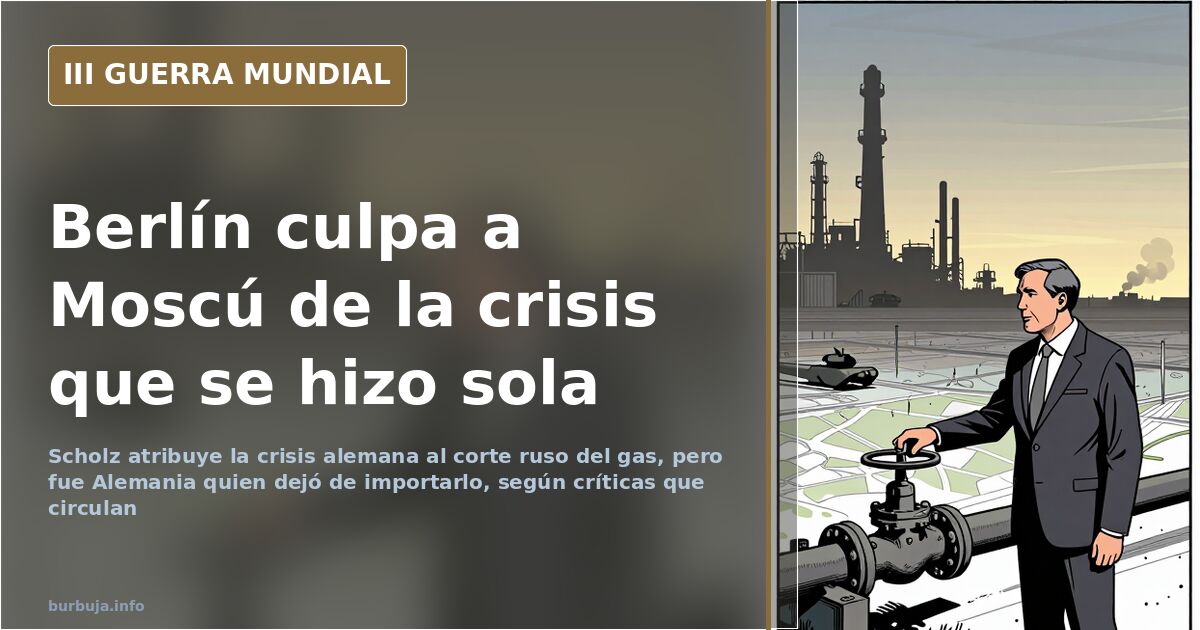
Germany blames Russia for the crisis it created itself
Chancellor Olaf Scholz argues that Russia cut energy supplies to Germany, causing economic problems and inflation. According to circulating documentation, the sequence is reversed: Germany decided to stop importing Russian gas. This detail is crucial. Much of the official narrative explaining Germany's industrial collapse rests on this inversion of cause and effect, with some suggesting Scholz also attacks his predecessor Angela Merkel to deflect blame.
What Scholz said vs. what the data shows
The German Chancellor's thesis is simple: Russia turned off the tap, energy became expensive, and the German economy sank. The problem is that Russian gas was cheaper than what Germany buys now. And the cut wasn't decreed by Moscow: it was decreed by Berlin. You can't close the door and then bill the neighbor for the slam.
There is a question that speaks for itself and which the official narrative does not answer: if Russians wanted to sell gas, why would they blow up their own pipelines? They could have simply closed the valve from their side. That someone else had an interest in preventing Germany and Russia from doing business is a hypothesis circulating persistently and never debunked with evidence.
The third party interested in Nord Stream
The sabotage of Nord Stream is the piece that doesn't fit the official version. If Russia's goal was to strangle Germany, it would have sufficed not to open the tap. The explosion adds an actor who benefits from the break: those who wanted to prevent German industry from feeding on cheap energy and Berlin and Moscow from reconciling.
In parallel, the reconstruction of German supply has its own logic. There has been a shift from a pipeline network to a plan for LNG terminals sourcing fracking gas, at a declared cost four times higher than Russian gas and billions in investment. If there is money and will to build that infrastructure, the uncomfortable question is why there wasn't any to maintain what already worked.
Industrial collapse and the energy bill
The result is an economy losing its most basic competitive advantage: cheap energy. German industry, built on affordable Russian gas, now faces costs its competitors don't have. Added to this is the Chinese response, capable of manufacturing with equivalent quality at one-third the price, and a closing Russian market.
Some argue the problem isn't energy but monetary: that inflationary crises are always phenomena of money and that the ECB has been running the machine for years, keeping the tap open since before the pandemic to plug holes in German banks. From this reading, blaming gas is a convenient way to hide that inflation was cooked in Frankfurt.
Why Germany cannot afford to lose Russian gas?
Because its industrial model was designed around that energy. German chemicals, automobiles, and heavy machinery compete on price with energy inputs that now cost several times more. Without cheap gas, the cost equation breaks and offshoring stops being a threat and becomes a textbook decision.
The paradox is that the country that for decades was Europe's engine now appears as the weakest link. And its leader doesn't point to whoever made the decision to renounce supply, but to whoever sold it.
The inevitable alliance and political calendar
The underlying thesis running through the analysis is that the economic alliance between Germany and Russia is inevitable, because it is the most logical from the standpoint of resources and industry. The next time will be less beneficial for Germany, but it will come. Political change in Berlin and, by extension, in Europe, is taken for granted: it may accelerate with a shift in Washington or take a few years, but it won't stop.
Meanwhile, NATO appears as a structure without real capacity to sustain a conflict with Russia. European armies are not operational for a war of attrition and the only one that has proven effective on the ground is Ukraine's. Deterrence, without muscle behind it, is rhetoric.
The analysis gets stuck exactly here: whether the decision to renounce Russian gas was a miscalculation, an external imposition, or a deliberate demolition of European industry from within. None of these three explanations fully closes. And the most repeated one is not the one with the most evidence.
Chancellor Olaf Scholz argues that Russia cut energy supplies to Germany, causing economic problems and inflation. According to circulating documentation, the sequence is reversed: Germany decided to stop importing Russian gas. This detail is crucial. Much of the official narrative explaining Germany's industrial collapse rests on this inversion of cause and effect, with some suggesting Scholz also attacks his predecessor Angela Merkel to deflect blame.
What Scholz said vs. what the data shows
The German Chancellor's thesis is simple: Russia turned off the tap, energy became expensive, and the German economy sank. The problem is that Russian gas was cheaper than what Germany buys now. And the cut wasn't decreed by Moscow: it was decreed by Berlin. You can't close the door and then bill the neighbor for the slam.
There is a question that speaks for itself and which the official narrative does not answer: if Russians wanted to sell gas, why would they blow up their own pipelines? They could have simply closed the valve from their side. That someone else had an interest in preventing Germany and Russia from doing business is a hypothesis circulating persistently and never debunked with evidence.
The third party interested in Nord Stream
The sabotage of Nord Stream is the piece that doesn't fit the official version. If Russia's goal was to strangle Germany, it would have sufficed not to open the tap. The explosion adds an actor who benefits from the break: those who wanted to prevent German industry from feeding on cheap energy and Berlin and Moscow from reconciling.
In parallel, the reconstruction of German supply has its own logic. There has been a shift from a pipeline network to a plan for LNG terminals sourcing fracking gas, at a declared cost four times higher than Russian gas and billions in investment. If there is money and will to build that infrastructure, the uncomfortable question is why there wasn't any to maintain what already worked.
Industrial collapse and the energy bill
The result is an economy losing its most basic competitive advantage: cheap energy. German industry, built on affordable Russian gas, now faces costs its competitors don't have. Added to this is the Chinese response, capable of manufacturing with equivalent quality at one-third the price, and a closing Russian market.
Some argue the problem isn't energy but monetary: that inflationary crises are always phenomena of money and that the ECB has been running the machine for years, keeping the tap open since before the pandemic to plug holes in German banks. From this reading, blaming gas is a convenient way to hide that inflation was cooked in Frankfurt.
Why Germany cannot afford to lose Russian gas?
Because its industrial model was designed around that energy. German chemicals, automobiles, and heavy machinery compete on price with energy inputs that now cost several times more. Without cheap gas, the cost equation breaks and offshoring stops being a threat and becomes a textbook decision.
The paradox is that the country that for decades was Europe's engine now appears as the weakest link. And its leader doesn't point to whoever made the decision to renounce supply, but to whoever sold it.
The inevitable alliance and political calendar
The underlying thesis running through the analysis is that the economic alliance between Germany and Russia is inevitable, because it is the most logical from the standpoint of resources and industry. The next time will be less beneficial for Germany, but it will come. Political change in Berlin and, by extension, in Europe, is taken for granted: it may accelerate with a shift in Washington or take a few years, but it won't stop.
Meanwhile, NATO appears as a structure without real capacity to sustain a conflict with Russia. European armies are not operational for a war of attrition and the only one that has proven effective on the ground is Ukraine's. Deterrence, without muscle behind it, is rhetoric.
The analysis gets stuck exactly here: whether the decision to renounce Russian gas was a miscalculation, an external imposition, or a deliberate demolition of European industry from within. None of these three explanations fully closes. And the most repeated one is not the one with the most evidence.
Also available in: Deutsch
Summary of a discussion on Burbuja.info - Foro de economía, actualidad y política., translated from Spanish and reviewed before publication. Read the full discussion (127 replies).
More summaries
-
Spanish troops and the “Russian drone”: video, doubts and mockery
A video circulated by ABC shows Spanish troops saying they shot down a Russian drone: “we are prepared for that”. It sparks mockery and doubts
-
Gisbert and Sivaya: Romance Amid Ukraine War Narratives
Analysis of media coverage for Rubén Gisbert and Liu Sivaya during the Ukraine war. Is this digital propaganda or reality?
-
Prigozhin dies in Russian plane crash in Tver region
Russian aviation agency confirms Prigozhin's death in Tver; Wagner blames the Defense Ministry for the crash.
-
60% of Germans Back Talks with Russia
A new ABC report shows 60% of Germans support negotiating with Russia, while opposition to Ukraine's EU entry grows.
-
Putin Accuses Europe of Africa's Exploitation While Courting Sahel Uranium
Putin blames Europe for plundering Africa as Moscow seeks Sahel uranium, citing historical exploitation figures and geopolitical shifts.
-
Spanish Media Clash Over Israel Narrative
A viral video and sensational headlines spark debate on who controls the Gaza conflict narrative in Spain.