
Wess Mitchell: US cannot afford a three-front war
China adds 130 ships every four years while the US plans 75 in a decade: the three-front war scenario Washington cannot afford
English · Original discussion in Spanish · Published
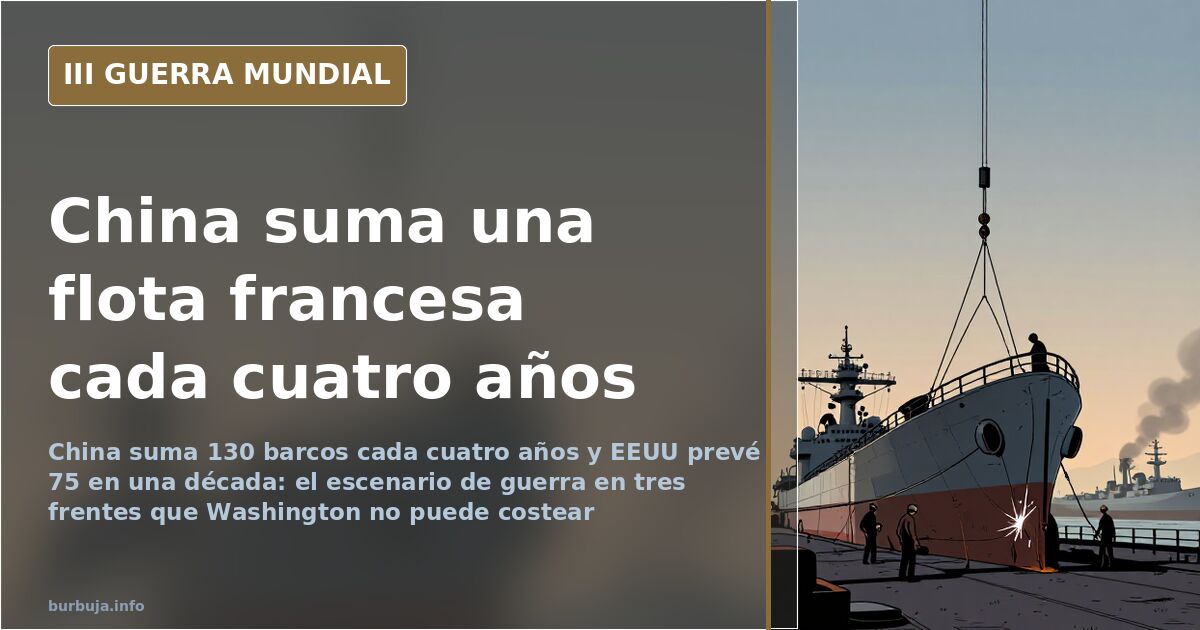
The United States plays a three-front game against a Chinese fleet that adds 130 ships every four years
The United States could lose the next war. Not for lack of aircraft carriers, but because of arithmetic: three theaters ablaze at once, debt already above 100% of GDP and a rival that launches more ships in four years than Washington plans to buy in a decade. A. Wess Mitchell's analysis argues exactly that: in two of the world's three strategic regions there are conflicts demanding US attention, and if Beijing decides on Taiwan, the scenario turns into a global war on three fronts. Anyone who dismisses this as alarmism need only look at the debt table.
The scenario described in the report: three fronts, one army
The last two US national defense strategies and the congressional strategic policy committee make clear that its armed forces are not prepared to fight two major rivals at the same time. If China attacked Taiwan, repelling the assault without cutting aid to Ukraine or Israel would be complicated. Geography is key: each adversary —China, Russia or Iran— only needs to be strong in its own region, while Washington would have to be strong in all three at once.
The worst case is not an amphibious landing, but a long war in distant theaters, with poorly equipped allies and just enough industrial power of its own. That demands national unity, resource mobilization and sacrifice. None of that has been seen in generations.
Why is the Chinese fleet growing faster than the US fleet?
Because the pace of shipbuilding has reversed. The Chinese navy already outnumbers the US in ships and adds every four years the equivalent of a French fleet: some 130 vessels, according to the reference by the French Navy chief of staff cited in the analysis. The US Navy plans to buy 75 over the entire next decade.
Money is the other front. In World War II US debt went from 61% to 113% of GDP; today a potential conflict would be entered with debt already above 100%, and a war scenario would take it to 200% or more, with warnings from the Congressional Budget Office about the financial system. Add to that a blockade of the Strait of Hormuz capable of pushing oil above $100 a barrel and a massive sell-off of bonds by its main creditor. Shortages of everything, from electronics to building materials.
The warning that already failed once: from Gaza to Iran
Skepticism about the new prediction runs through the debate. Anyone who remembers last year's forecasts does not buy the prophecy without a discount: analyses of the same type announced that Gaza would be the grave of the Israeli army, or that Russia was winning the war, and now they sign that Iran will be the grave of the American army. A month of offensive without entering the urban center backed neither victory nor catastrophe.
The human cost, however, is barely discussed: the analysis warns that some adversaries have conventional and nuclear capabilities capable of reaching US territory.
Two readings of the same empire: free fall or intact capacity
One school holds that US dominance was born in 1945 and that the US barely sweated in the war while the USSR ended up like a boxer with no strength left. Another responds that the US won neither of the two world wars nor defeated the Soviet Union, which disintegrated from within, and that anyone who does not see an empire in free fall is blind. Within this second reading, the fracture would be internal before external.
In between lies an uncomfortable economic argument. The US economy in peacetime sustains hundreds of bases and seven carrier strike groups; when it switches to guns mode, it multiplies. And dependence is mutual: China is the largest holder of US debt, but when you owe a hundred million, the problem is the bank's. Another, quieter path would be to stop buying that debt and stop using the dollar in world trade.
Where is the standoff decided, in Taiwan or on trade routes?
On the routes. Today's fleets are less for supporting invasions than for projecting force over maritime traffic: whoever controls the Bab el-Mandeb strait controls the Suez Canal or the detour around Africa, and with it the African ports and supply. There a proxy war becomes a matter of piracy, insurance and prices.
On Taiwan, the most repeated reading is that China does not need to invade: it is enough to wait for the ripe fruit, or to block certain foreign ships. And over the Gulf hangs the simplest question of the whole affair: what are US ships doing so close to Iran, Russia and Taiwan.
The front nobody wants: mobilizing those who say they have nothing to defend
And here comes the uncomfortable point for the analyst himself. The mobilization he calls for requires convinced volunteers, and part of the audience he addresses does not recognize itself in its own side: it refuses to join the defense of institutions it perceives as adversaries, while pointing to the lack of European resistance and dependence on screens and consumption. This is not a military fact. It is a political one.
If anything allows anticipating this picture, it is that the next war would not be decided by a landing, but by who can withstand the energy bill, the price of money and the trade route. With one big caveat: predictions of this family have not been getting much right.
Also available in: Deutsch
Summary of a discussion on Burbuja.info - Foro de economía, actualidad y política., translated from Spanish and reviewed before publication. Read the full discussion (104 replies).
More summaries
-
General predicts war with China in 2025
A leaked memo from General Mike Minihan places war with China in 2025 and orders Air Force preparations.
-
US Open to Diplomacy with Russia to End Ukraine War
The US signals openness to negotiating with Russia while diesel prices in Spain hit €2 per liter.
-
Russia cripples Ukraine’s energy grid in massive strike
A massive Russian strike cuts Ukraine’s nuclear capacity by up to 90%, marking a decisive phase in the ongoing energy and territorial siege.
-
Ukraine lets female civil servants leave as pressure to draft women builds
Ukraine is now allowing female civil servants to leave the country while pressure to recruit women grows. Is the ground being prepared for female conscription? Data and
-
Russia is a weak, pathetic banana republic, unable to wage war on Europe, users say
Can Russia attack Europe? On Burbuja.info, some see it as a banana republic while others warn of its nuclear power. 35 replies in the debate.
-
End of the NATO-Russia conflict: 2027 or never?
We examine estimates on when the NATO-Russia conflict could end: 2027 after key elections, a Russian collapse, or perpetual war driven by the arms industry.