
Waste management in Spain: why citizens pay to recycle
Spanish residents face a double burden, paying both waste taxes and packaging surcharges while companies profit from the value of recycled materials.
English · Original discussion in Spanish · Published
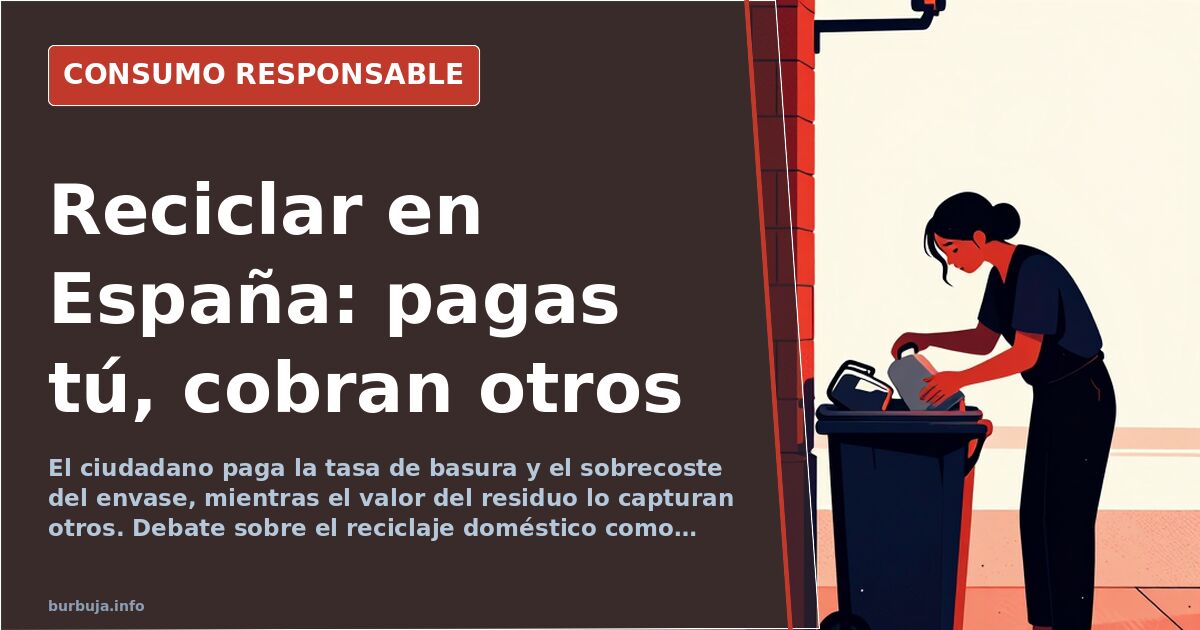
Waste management in Spain: why citizens pay to recycle
One citizen leaves a rubbish bag next to a parked motorcycle because the local bin has been removed from his sidewalk and he doesn't want to miss his bus. Another claims he pays for waste collection twice: once through the IBI (property tax) and again in his water bill. A third recalls how, in his neighborhood, a private company used to pay the local residents' association for glass and cardboard, funding an annual fair with that money. This scene repeats across Spain: citizens sort, transport, and pay, while waste management is executed by companies that charge for the service. The central question is simple: if waste has value, why doesn't the profit reach those who generate it?
The true cost of waste disposal
According to one participant, two systems coexist in Spain. The municipal waste tax covers the collection of the grey bin, used for non-recyclables. The yellow, blue, and green bins operate under specific agreements: collective systems created by manufacturers—such as Ecoembes for packaging and cardboard, Ecovidrio for glass, Ambilamp for lightbulbs, and Sigre for pharmaceuticals—finance their collection and pay municipalities for management, according to the Ley 11/1997 de envases (Packaging Law). Therefore, citizens do not pay directly to recycle: they pay the waste tax and also the packaging surcharge already included in the product price. This double payment is a major source of frustration.
Some argue the system is designed so that citizens do the work for free—sorting at home—while companies reap the value of the materials. The prevailing calculation is that cans can be melted into new metal, glass reused, and food scraps turned into compost, yet this value does not return to the generator. Some conclude that domestic recycling has become an externality gifted to industry.
Plastic taxes and rising costs of packaging
In addition to the municipal tax, there is now the plastic tax, which is reflected in the final price of packaged goods and fast food. The effect is visible in the shopping basket: according to the same participant, rubbish bags cost more than double what they did a year ago, and local greengrocers sell vegetables for no less than one euro per kilo. Packaging inflation is passed on to the consumer, who was already paying the waste tax. Critics argue this results in a triple charge: the tax, the plastic tax, and the packaging surcharge.
The official argument is that the tax discourages plastic use and funds the green transition. The skeptical view is that the money stays within the administration without improving the service. Critics point out that the actual recycling rate for packaging does not reach 25%, even though packaging companies have a legal obligation to recycle 100%. This gap between obligation and results is the heart of the matter.
When local bins are removed from the streets
Logistics also play a role. In some neighborhoods, bins have been removed from sidewalks and moved around the corner; in others, changes in the bin model have eliminated nearby collection points. The result is that the citizen paying for the service does not receive it, leading to the spontaneous decision to leave bags wherever they please. The introduction of access cards for bins, announced by some local authorities, has faced explicit rejection: some warn that bins will appear damaged the next morning.
International comparisons are often made. In the Netherlands, there is a deposit-return system with supermarket discount vouchers, and in New York, informal bottle collectors earn extra daily without administrative hurdles. The question arises: what would happen if this were attempted in Spain? One would need Social Security registration, quarterly VAT filings, municipal licenses, waste treatment training, and a standardized uniform with its corresponding 21% tax. Bureaucracy swallows the incentive.
Waste as a business exploited by others
Waste has market value, and some are already capturing it. In certain neighborhoods, an abandoned mattress or appliance disappears in minutes because someone with a van picks it up to sell at a scrapyard. Informal scrap collectors reportedly earn a hundred euros or more daily. A proposal has emerged to create storage facilities where cents are paid per can, glass, or appliance, allowing informal collectors to operate legally. The current system, however, prevents anyone from coming to buy a citizen's rubbish.
The contradiction is clear: waste is worth money, but the citizen pays to get rid of it and cannot sell it. The business is captured by concessionaires, collective systems, and informal collectors operating on the margins. The citizen is left in the middle, paying the tax and giving away the material.
The core issue: who keeps the value?
The discussion shifts toward public spending and European funds. Some argue that Next Generation funds, intended to help SMEs recover from the pandemic, have not reached the real economy but have been absorbed by regional governments and municipalities for unproductive roles. The connection to waste is direct: if public money is managed opaquely, citizens distrust that their taxes are being used effectively.
No resolution is in sight. Some defend the system, claiming it works and that sorting costs nothing; others respond that if waste has value, someone should pay for it. The only figure no one disputes is that the citizen pays, sorts, and transports. The profit, however, never appears on their bill.
One citizen leaves a rubbish bag next to a parked motorcycle because the local bin has been removed from his sidewalk and he doesn't want to miss his bus. Another claims he pays for waste collection twice: once through the IBI (property tax) and again in his water bill. A third recalls how, in his neighborhood, a private company used to pay the local residents' association for glass and cardboard, funding an annual fair with that money. This scene repeats across Spain: citizens sort, transport, and pay, while waste management is executed by companies that charge for the service. The central question is simple: if waste has value, why doesn't the profit reach those who generate it?
The true cost of waste disposal
According to one participant, two systems coexist in Spain. The municipal waste tax covers the collection of the grey bin, used for non-recyclables. The yellow, blue, and green bins operate under specific agreements: collective systems created by manufacturers—such as Ecoembes for packaging and cardboard, Ecovidrio for glass, Ambilamp for lightbulbs, and Sigre for pharmaceuticals—finance their collection and pay municipalities for management, according to the Ley 11/1997 de envases (Packaging Law). Therefore, citizens do not pay directly to recycle: they pay the waste tax and also the packaging surcharge already included in the product price. This double payment is a major source of frustration.
Some argue the system is designed so that citizens do the work for free—sorting at home—while companies reap the value of the materials. The prevailing calculation is that cans can be melted into new metal, glass reused, and food scraps turned into compost, yet this value does not return to the generator. Some conclude that domestic recycling has become an externality gifted to industry.
Plastic taxes and rising costs of packaging
In addition to the municipal tax, there is now the plastic tax, which is reflected in the final price of packaged goods and fast food. The effect is visible in the shopping basket: according to the same participant, rubbish bags cost more than double what they did a year ago, and local greengrocers sell vegetables for no less than one euro per kilo. Packaging inflation is passed on to the consumer, who was already paying the waste tax. Critics argue this results in a triple charge: the tax, the plastic tax, and the packaging surcharge.
The official argument is that the tax discourages plastic use and funds the green transition. The skeptical view is that the money stays within the administration without improving the service. Critics point out that the actual recycling rate for packaging does not reach 25%, even though packaging companies have a legal obligation to recycle 100%. This gap between obligation and results is the heart of the matter.
When local bins are removed from the streets
Logistics also play a role. In some neighborhoods, bins have been removed from sidewalks and moved around the corner; in others, changes in the bin model have eliminated nearby collection points. The result is that the citizen paying for the service does not receive it, leading to the spontaneous decision to leave bags wherever they please. The introduction of access cards for bins, announced by some local authorities, has faced explicit rejection: some warn that bins will appear damaged the next morning.
International comparisons are often made. In the Netherlands, there is a deposit-return system with supermarket discount vouchers, and in New York, informal bottle collectors earn extra daily without administrative hurdles. The question arises: what would happen if this were attempted in Spain? One would need Social Security registration, quarterly VAT filings, municipal licenses, waste treatment training, and a standardized uniform with its corresponding 21% tax. Bureaucracy swallows the incentive.
Waste as a business exploited by others
Waste has market value, and some are already capturing it. In certain neighborhoods, an abandoned mattress or appliance disappears in minutes because someone with a van picks it up to sell at a scrapyard. Informal scrap collectors reportedly earn a hundred euros or more daily. A proposal has emerged to create storage facilities where cents are paid per can, glass, or appliance, allowing informal collectors to operate legally. The current system, however, prevents anyone from coming to buy a citizen's rubbish.
The contradiction is clear: waste is worth money, but the citizen pays to get rid of it and cannot sell it. The business is captured by concessionaires, collective systems, and informal collectors operating on the margins. The citizen is left in the middle, paying the tax and giving away the material.
The core issue: who keeps the value?
The discussion shifts toward public spending and European funds. Some argue that Next Generation funds, intended to help SMEs recover from the pandemic, have not reached the real economy but have been absorbed by regional governments and municipalities for unproductive roles. The connection to waste is direct: if public money is managed opaquely, citizens distrust that their taxes are being used effectively.
No resolution is in sight. Some defend the system, claiming it works and that sorting costs nothing; others respond that if waste has value, someone should pay for it. The only figure no one disputes is that the citizen pays, sorts, and transports. The profit, however, never appears on their bill.
Also available in: Deutsch
Summary of a discussion on Burbuja.info - Foro de economía, actualidad y política., translated from Spanish and reviewed before publication. Read the full discussion (102 replies).
More summaries
-
Spain's Recycling: Unpaid Labor and Rising Waste Fees
Zaragoza sold recycled paper for €700,000 more than expected in 2011 while waste fees rose 5%. Household sorting equals 19,000 unpaid jobs.
-
Leroy Merlin's one-cent charge per item: the plastic tax
The waste management fee that Leroy Merlin adds to receipts comes from Law 7/2022: €0.45 per kilo of non-reusable plastic in packaging.
-
Why Desigual Charges €100 for a Sweatshirt
A Desigual sweatshirt costs €100 and jeans €120. For many users, the price is set by the label and brand, not the fabric.
-
Muscle loss after two months off: how muscle memory helps recovery
While two months without training leads to physical decline, muscle memory and consistency can help you regain strength and size.
-
Buying everything on Amazon: immediate savings vs long-term costs
A planner costs €28 at a local shop but only €4 on Amazon. Immediate savings clash with the risk of relying on a single giant.
-
Debate over home remedies for sick kitten instead of vet care
A discussion erupted after a caregiver refused a €50 vet visit for a 300g kitten, suggesting chamomile and antiseptic instead.