
Debate over home remedies for sick kitten instead of vet care
A discussion erupted after a caregiver refused a €50 vet visit for a 300g kitten, suggesting chamomile and antiseptic instead.
English · Original discussion in Spanish · Published
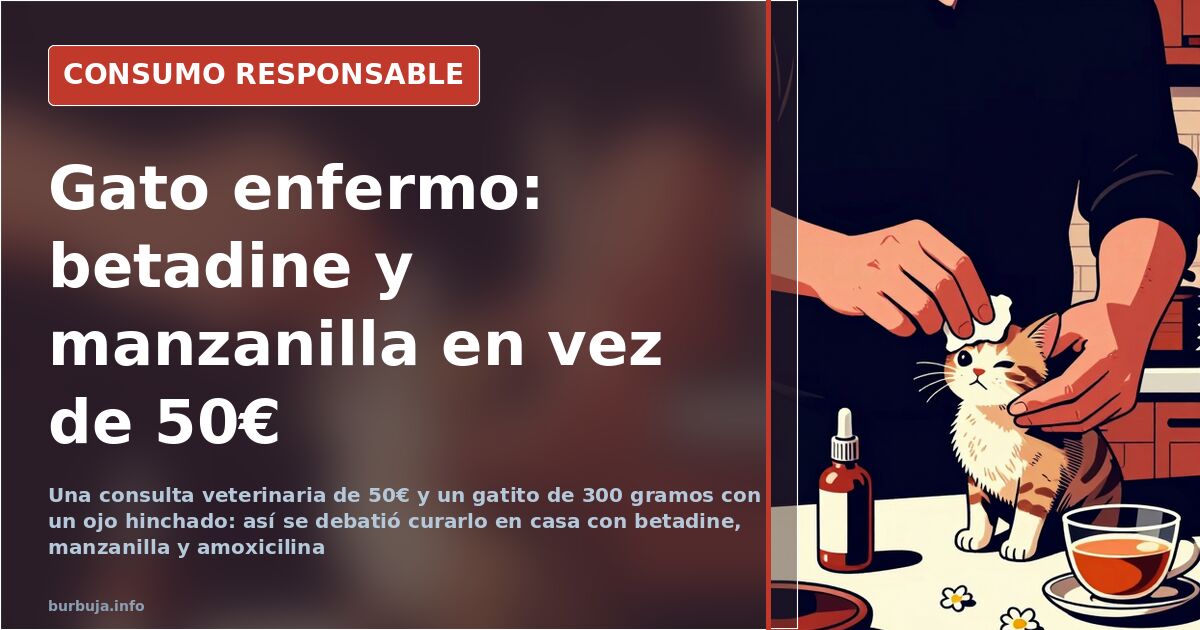
Treating a kitten without a vet: antiseptic, chamomile, and 50 euros
May 2013. A feral cat stops by a farm and two of her kittens die in the first few weeks. The owner of the land—the cat is not his—is left with two kittens from the same litter: one large and healthy, the other congested, with a swollen eye and, in his own words, possibly infected. The caregiver estimates a vet consultation at 50 euros, a threshold he is unwilling to cross: "I would like to help it, but I don't plan on spending 50 euros." His Plan B is amoxicillin kept in a drawer, seawater for eye discharge, and antiseptic.
The question—how to dose a human antibiotic for an animal that "weighs no more than 300 grams"—opens a discussion that lasts several days and gathers dozens of responses. It ends with the kitten dead and a fight between strangers.
Can you give amoxicillin to a one-month-old kitten?
The answer from several participants is no. One is blunt: for an adult cat of about four kilos, the doses used "range between 0.1 and 0.2 milliliters"—a tiny amount—so for a 300-gram kitten, "it would be almost impossible to measure the amount to be administered." The warning: trying it "could kill it."
The warning extends to much of the household medicine cabinet. As one forum user recalls, feline sensitivity to drugs differs from humans and other animals: there are medicines they simply cannot tolerate. Paracetamol is the repeated example: "cats die from paracetamol," another participant warns. Extrapolating what works in one species to another can end with the animal's death, despite the best intentions.
Home remedies for an infected eye
Here, there is some room for maneuver. The most repeated recipe is chamomile: tea made from bags, left to cool, applied with gauze or cotton soaked "until the discharge softens and detaches." Warm distilled water works as an alternative. If the eye cannot see light, it is lost: clearing it as soon as possible is imperative.
For the infectious component, some turn to diluted antiseptic or hydrogen peroxide, while others recommend an ophthalmic antibiotic ointment—gentamicin, terramycin, Plasimine—available at pharmacies for a couple of euros. Caution is advised, however: these are human products, and it is best if someone with veterinary judgment validates the choice.
Cow's milk, formula, and bottles: the cost of raising a kitten
For the responding participants, cow's milk is not for cats: it is good for calves, not felines, and even less for a nursing kitten. According to one user, a commercial alternative exists: boxes with sachets of powdered milk for cats and a type of bottle with a teat for about 20 euros, or individual sachets for around one euro each. For an animal still nursing from its mother, the recommendation is not to separate it from her as long as she accepts it. If she rejects it, it must be fed with a syringe and formula.
Animal shelters and the theft that closed that door
The institutional solution appears soon: contacting a local animal shelter, which would assume the veterinary costs and find a home for the animal. The answer is no. Shelters "are at full capacity, overwhelmed with abandoned animals," and the local association's premises had been robbed weeks earlier, where they kept the market donation collections. Given this scenario, bringing them a newborn seems, to the caregiver, an abuse.
The refusal does not convince everyone. Some argue that a small kitten is "quite adoptable" and that the shelter was the most reasonable route; others directly offer money to pay for the consultation, an offer that is rejected.
The outcome: the dead kitten and the missing sibling
The kitten never receives treatment. When the caregiver returns with the purchased antiseptic and milk, the animal is already dead and stiff, and he believes it was likely dead even before he wrote the first message. He blames the fox, as he did with the rest of the litter, "to feed its young."
Days later, the healthy sibling also disappears: the caregiver believes the mother moved it or that the fox took it.
The vet consulted when buying the milk had been clear: in litters of feral cats, it is normal for most to die and only the strongest to survive. He did not suggest taking it in or gave any hope.
The inescapable conclusion—and where any calculation fails—is that the outcome did not depend on the antiseptic or the chamomile, but on a decision made before the first question: 50 euros, yes or no.
May 2013. A feral cat stops by a farm and two of her kittens die in the first few weeks. The owner of the land—the cat is not his—is left with two kittens from the same litter: one large and healthy, the other congested, with a swollen eye and, in his own words, possibly infected. The caregiver estimates a vet consultation at 50 euros, a threshold he is unwilling to cross: "I would like to help it, but I don't plan on spending 50 euros." His Plan B is amoxicillin kept in a drawer, seawater for eye discharge, and antiseptic.
The question—how to dose a human antibiotic for an animal that "weighs no more than 300 grams"—opens a discussion that lasts several days and gathers dozens of responses. It ends with the kitten dead and a fight between strangers.
Can you give amoxicillin to a one-month-old kitten?
The answer from several participants is no. One is blunt: for an adult cat of about four kilos, the doses used "range between 0.1 and 0.2 milliliters"—a tiny amount—so for a 300-gram kitten, "it would be almost impossible to measure the amount to be administered." The warning: trying it "could kill it."
The warning extends to much of the household medicine cabinet. As one forum user recalls, feline sensitivity to drugs differs from humans and other animals: there are medicines they simply cannot tolerate. Paracetamol is the repeated example: "cats die from paracetamol," another participant warns. Extrapolating what works in one species to another can end with the animal's death, despite the best intentions.
Home remedies for an infected eye
Here, there is some room for maneuver. The most repeated recipe is chamomile: tea made from bags, left to cool, applied with gauze or cotton soaked "until the discharge softens and detaches." Warm distilled water works as an alternative. If the eye cannot see light, it is lost: clearing it as soon as possible is imperative.
For the infectious component, some turn to diluted antiseptic or hydrogen peroxide, while others recommend an ophthalmic antibiotic ointment—gentamicin, terramycin, Plasimine—available at pharmacies for a couple of euros. Caution is advised, however: these are human products, and it is best if someone with veterinary judgment validates the choice.
Cow's milk, formula, and bottles: the cost of raising a kitten
For the responding participants, cow's milk is not for cats: it is good for calves, not felines, and even less for a nursing kitten. According to one user, a commercial alternative exists: boxes with sachets of powdered milk for cats and a type of bottle with a teat for about 20 euros, or individual sachets for around one euro each. For an animal still nursing from its mother, the recommendation is not to separate it from her as long as she accepts it. If she rejects it, it must be fed with a syringe and formula.
Animal shelters and the theft that closed that door
The institutional solution appears soon: contacting a local animal shelter, which would assume the veterinary costs and find a home for the animal. The answer is no. Shelters "are at full capacity, overwhelmed with abandoned animals," and the local association's premises had been robbed weeks earlier, where they kept the market donation collections. Given this scenario, bringing them a newborn seems, to the caregiver, an abuse.
The refusal does not convince everyone. Some argue that a small kitten is "quite adoptable" and that the shelter was the most reasonable route; others directly offer money to pay for the consultation, an offer that is rejected.
The outcome: the dead kitten and the missing sibling
The kitten never receives treatment. When the caregiver returns with the purchased antiseptic and milk, the animal is already dead and stiff, and he believes it was likely dead even before he wrote the first message. He blames the fox, as he did with the rest of the litter, "to feed its young."
Days later, the healthy sibling also disappears: the caregiver believes the mother moved it or that the fox took it.
The vet consulted when buying the milk had been clear: in litters of feral cats, it is normal for most to die and only the strongest to survive. He did not suggest taking it in or gave any hope.
The inescapable conclusion—and where any calculation fails—is that the outcome did not depend on the antiseptic or the chamomile, but on a decision made before the first question: 50 euros, yes or no.
Also available in: Deutsch
Summary of a discussion on Burbuja.info - Foro de economía, actualidad y política., translated from Spanish and reviewed before publication. Read the full discussion (101 replies).
More summaries
-
Cat Adoption: Mosquito Net Bureaucracy Deters Adopters
Shelters require mosquito nets on all windows for cat adoption. Frustrated adopters often turn to buying pets instead.
-
iPhone 11 sells out at €540 despite lacking 5G
An iPhone 11 with no 5G and a 60Hz screen sold out in two hours for €540. The gap between price, specs, and brand loyalty.
-
Helmeca: nearly €5,000 for a German course and a promised job
Helmeca offers jobs in Germany to early childhood educators but ends up selling a German course for almost €5,000 for a B2 level that many doubt is achievable.
-
Beachgoers in Spain report growing boredom at the coast
A return to the Valencian coast after a decade reveals high prices, extreme heat, and a lack of activities for visitors.
-
Several compact sedans are available but not sold in Spain
Models like the Renault Mégane or Ford Focus Sedan exist but are missing from the Spanish market due to SUV trends and product cannibalization.
-
Naturally aspirated vs. 1.0 turbo: fuel consumption and reliability
A forum debate compares the longevity of Ford's 1.0 Ecoboost and 1.6 engines, weighing small turbos against traditional petrol engines.