
Spain's Recycling: Unpaid Labor and Rising Waste Fees
Zaragoza sold recycled paper for €700,000 more than expected in 2011 while waste fees rose 5%. Household sorting equals 19,000 unpaid jobs.
English · Original discussion in Spanish · Published
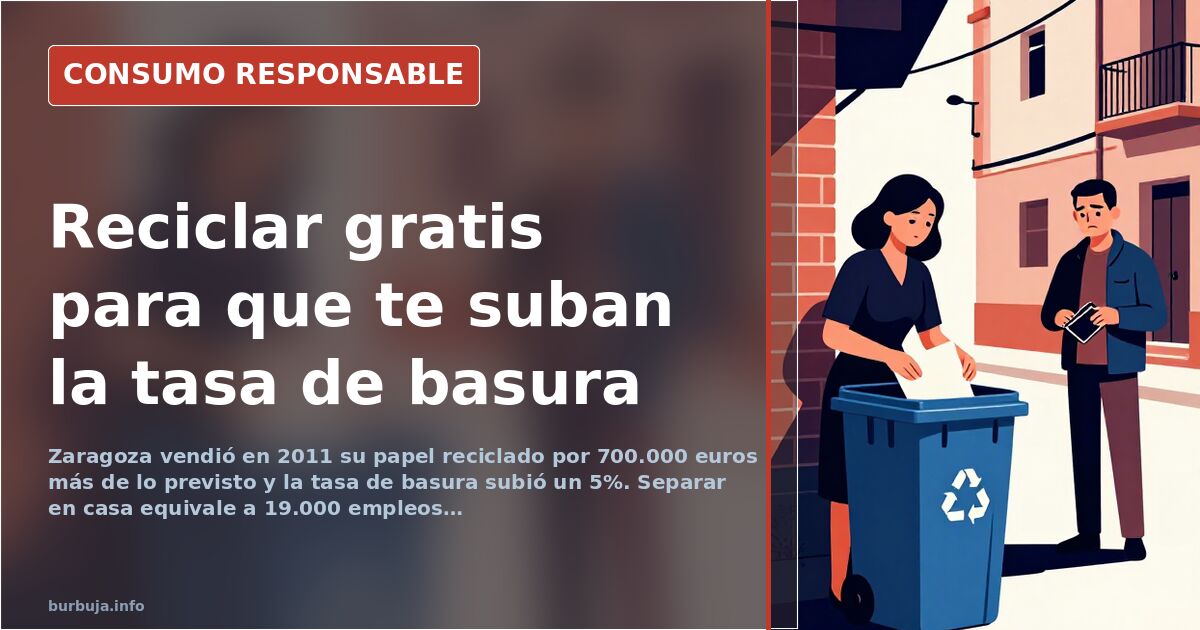
Recycling: 19,000 Unpaid Jobs and Rising Fees
One minute a week. That is how much time each Spaniard spends separating their trash, which amounts to 766,666 weekly work hours. Divided by a 40-hour shift, this equates to 19,166 full-time jobs that no one pays for. The calculation is rough arithmetic—46 million people times 60 seconds, divided by 40—and has nuances: not everyone recycles equally, and children or dependents count as fractions. Fundamentally, the first stage of recycling is performed by citizens for free, while service costs continue to be charged to their bills.
The counterargument is equally simple. If that time stops being spent, jobs are not created elsewhere; the raw material feeding the entire chain disappears. The equivalence between the household minute and 19,000 paychecks suggests that citizens already pay with labor for a part of a service they are billed separately.
The underlying thesis is that the profit does not go to everyone. The consulting firm signing the latest study, the contractor winning the tender, the mayor signing it, the agency designing the campaign, and the media broadcasting it all take their cut. The user pays twice: with their time in the kitchen and with a fee that rises year after year. Environmental education, it seems, is just wrapping for someone else's business.
Who Really Gets Paid: From Public Tenders to Ad Campaigns
Here disagreements begin. One school argues the system is a closed loop of public contracts: the concessionaire gets paid by the city to remove organic waste and resells the selective materials. Opposing this is the argument that these are distinct businesses: some companies pay the municipality to install clothing, paper, or glass containers and live on resale, while residual waste containers are a deficit service funded by the treasury. Companies mentioned include Ecoembes, SaicaNatur, Urbaser, and Cespa, operating as municipal subcontractors.
Industry insiders describe it without heroics. A textile recycler with about thirty employees pays cities a fee for each plot occupied by its containers and allocates 8% of profits to social projects agreed with administrations. It is not a gold mine, but nor is it charity: it is a model that works because the material has market value.
Zaragoza 2011: Paper Sold for €700,000 More, Fees Rose 5%
The data best capturing the paradox is from 2011. Zaragoza’s city council tendered paper and cardboard from selective collection for €1,852,835.87; the final award closed at €2,547,207.22, nearly €700,000 above the starting price. In that same fiscal year, property tax (IBI), vehicle tax, water, and waste fees rose by 5%. The raw material came out of buildings for free; the bill arrived anyway.
This is not an isolated case. In León, according to available figures, the cost of the new waste and street cleaning contract dropped from €20.1 million to €13.1 million, a €7 million reduction never passed on to tariffs, raising questions about where the savings went. Municipal recycling reports repeat the pattern: they list tons collected and trees saved, but rarely detail how much revenue the city earns from selling what residents sorted. This asymmetry fuels suspicion.
Is What We Throw Away Really Recycled? The 3% and the Three Rs
In plants, people separate materials by hand, but not from the organic bag: they do so over items already selected at source. Conveyor belt estimulante ilegal means, according to circulating data, only 3% of passing material is recovered. Even then, mechanical processes—magnetism, decantation, centrifugation—do the fine work citizens don’t do at home: no one separates plastic from Tetra Paks; machines do. The uncomfortable conclusion is that poor home separation doesn’t hurt, but it isn’t the critical piece often marketed.
There is broad agreement, however, that priorities were inverted. The original three Rs were reduce, reuse, recycle. The first two generate no contracts, campaigns, or tenders, so they have fallen out of discourse: reducing cuts sales, reusing doesn’t fill bins. Only the third remains, the one that moves budgets.
Where the Analysis Stalls
With this information, conclusions vary. Some have stopped separating on principle; others only sort batteries, chemicals, or clothes due to unclear ownership; some argue recycling creates jobs and compensates despite low wages; others insist the only rational path is generating less waste and not giving away raw materials. The deadlock remains the same: no public, itemized figure exists for how much revenue a city earns from citizen-sorted waste. Until that account is published, bills will keep rising, along with doubt.
One minute a week. That is how much time each Spaniard spends separating their trash, which amounts to 766,666 weekly work hours. Divided by a 40-hour shift, this equates to 19,166 full-time jobs that no one pays for. The calculation is rough arithmetic—46 million people times 60 seconds, divided by 40—and has nuances: not everyone recycles equally, and children or dependents count as fractions. Fundamentally, the first stage of recycling is performed by citizens for free, while service costs continue to be charged to their bills.
The counterargument is equally simple. If that time stops being spent, jobs are not created elsewhere; the raw material feeding the entire chain disappears. The equivalence between the household minute and 19,000 paychecks suggests that citizens already pay with labor for a part of a service they are billed separately.
The underlying thesis is that the profit does not go to everyone. The consulting firm signing the latest study, the contractor winning the tender, the mayor signing it, the agency designing the campaign, and the media broadcasting it all take their cut. The user pays twice: with their time in the kitchen and with a fee that rises year after year. Environmental education, it seems, is just wrapping for someone else's business.
Who Really Gets Paid: From Public Tenders to Ad Campaigns
Here disagreements begin. One school argues the system is a closed loop of public contracts: the concessionaire gets paid by the city to remove organic waste and resells the selective materials. Opposing this is the argument that these are distinct businesses: some companies pay the municipality to install clothing, paper, or glass containers and live on resale, while residual waste containers are a deficit service funded by the treasury. Companies mentioned include Ecoembes, SaicaNatur, Urbaser, and Cespa, operating as municipal subcontractors.
Industry insiders describe it without heroics. A textile recycler with about thirty employees pays cities a fee for each plot occupied by its containers and allocates 8% of profits to social projects agreed with administrations. It is not a gold mine, but nor is it charity: it is a model that works because the material has market value.
Zaragoza 2011: Paper Sold for €700,000 More, Fees Rose 5%
The data best capturing the paradox is from 2011. Zaragoza’s city council tendered paper and cardboard from selective collection for €1,852,835.87; the final award closed at €2,547,207.22, nearly €700,000 above the starting price. In that same fiscal year, property tax (IBI), vehicle tax, water, and waste fees rose by 5%. The raw material came out of buildings for free; the bill arrived anyway.
This is not an isolated case. In León, according to available figures, the cost of the new waste and street cleaning contract dropped from €20.1 million to €13.1 million, a €7 million reduction never passed on to tariffs, raising questions about where the savings went. Municipal recycling reports repeat the pattern: they list tons collected and trees saved, but rarely detail how much revenue the city earns from selling what residents sorted. This asymmetry fuels suspicion.
Is What We Throw Away Really Recycled? The 3% and the Three Rs
In plants, people separate materials by hand, but not from the organic bag: they do so over items already selected at source. Conveyor belt estimulante ilegal means, according to circulating data, only 3% of passing material is recovered. Even then, mechanical processes—magnetism, decantation, centrifugation—do the fine work citizens don’t do at home: no one separates plastic from Tetra Paks; machines do. The uncomfortable conclusion is that poor home separation doesn’t hurt, but it isn’t the critical piece often marketed.
There is broad agreement, however, that priorities were inverted. The original three Rs were reduce, reuse, recycle. The first two generate no contracts, campaigns, or tenders, so they have fallen out of discourse: reducing cuts sales, reusing doesn’t fill bins. Only the third remains, the one that moves budgets.
Where the Analysis Stalls
With this information, conclusions vary. Some have stopped separating on principle; others only sort batteries, chemicals, or clothes due to unclear ownership; some argue recycling creates jobs and compensates despite low wages; others insist the only rational path is generating less waste and not giving away raw materials. The deadlock remains the same: no public, itemized figure exists for how much revenue a city earns from citizen-sorted waste. Until that account is published, bills will keep rising, along with doubt.
Also available in: Deutsch
Summary of a discussion on Burbuja.info - Foro de economía, actualidad y política., translated from Spanish and reviewed before publication. Read the full discussion (107 replies).
More summaries
-
Spanish 1970s Cookies: The Lost Taste of Childhood
Iconic Spanish brands like Cuétara and Fontaneda have changed. Palm oil, mergers, and quality cuts explain the decline of a national staple.
-
Retiring at 45: Pension after 22 years without contributions
A 45-year-old forum user with 8,000 contribution days calculates a pension of €818 today if stopping work now. The alternative is €3,175 after 22 more years.
-
Spanish rural home owner builds concrete furniture
A homeowner in Spain advocates for built-in concrete furniture as a durable, theft-resistant alternative to carpentry.
-
High-Mileage BMW or Mercedes: The €3,000 Gamble
A driver considers buying a 2004-2008 BMW or Mercedes with over 200,000 km for €2,000-€5,000. Premium maintenance costs are the hidden expense.
-
Five fruits a day: healthy habit or nutritional fear?
The five-a-day fruit rule sparks debate over fructose, fiber, and juices, questioning if it promotes health or poses metabolic risks.
-
Front-end noise turning right: missing axle bolt
Missing axle bolt after disc and CV joint replacement causes right-turn noise. Wheel alignment and steering knuckle fix the issue.