
Wagner: Ukraine war and the return of the mercenary
Wagner fights in Ukraine and Africa with prison recruits and international veterans. The debate over its legality and its future as a private army continues.
English · Original discussion in Spanish · Published
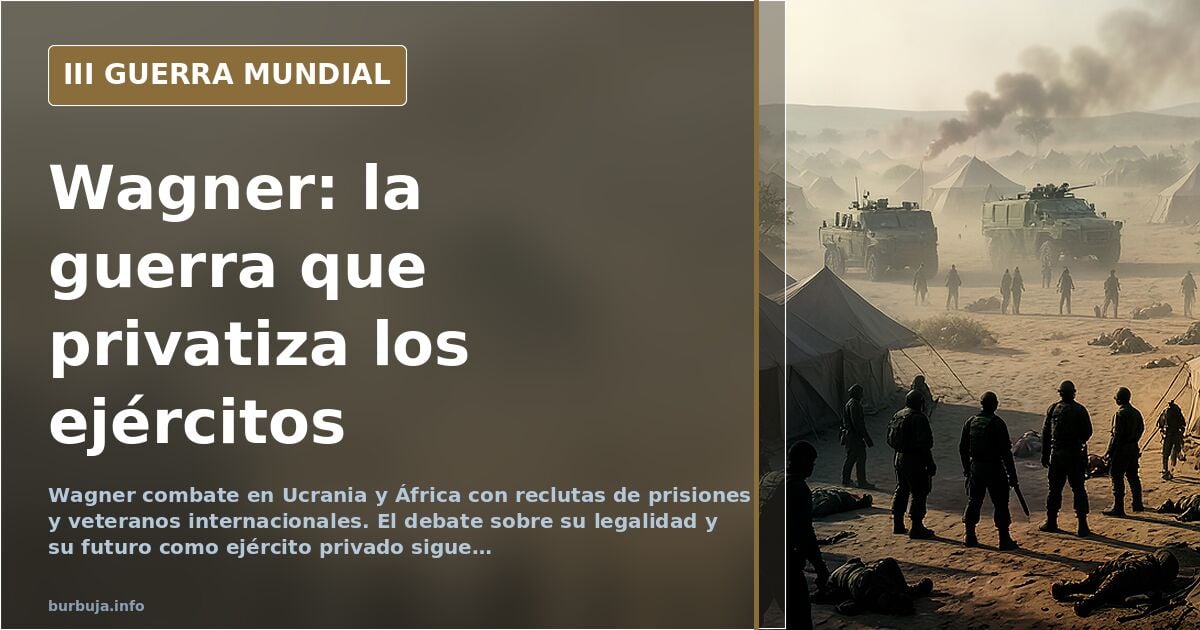
Wagner: the mercenary is back and it's no longer a secret
The Wagner Group has stopped being a footnote in military history manuals. Over more than three years of conversation, the phenomenon has mutated from an exotic anecdote into a business model of warfare that some analysts compare with American private security companies, and that others place in a category of its own: that of a force backed by the Kremlin operating where the regular Russian army does not want to leave a trace. The discussion, far from being exhausted, has gained layers: from recruitment in prisons to the role of Western veterans, including the legality of fighting under a flag that in the United States is designated a terrorist organization.
The parallel with Blackwater is not a bar-room notion. Some argue that the difference between the two is one of degree, not of nature: both sell military services to a state that prefers not to get its hands dirty. The counterargument is that Blackwater operated in the rear, under US military supervision, while Wagner fights on the front line, from the Donbas to the Sahel, and does so with a mix of convicts, international adventurers and veterans of previous conflicts. The result, they say, is a body that is difficult to fit into the manuals of international law.
What exactly is the Wagner Group and why is it compared to Blackwater?
Wagner is a private combat structure that has been absorbing functions typical of a regular army in theaters where Russia wants to deny its direct presence. The comparison with Blackwater arises because both began as military services companies, but the qualitative leap lies at the front: Wagner does not limit itself to protecting convoys or training local troops. In Ukraine it has even operated as an extension of the Russian army, with firepower, intelligence and command on the ground. That evolution is what has led some to speak of a new model of private warfare, and others to recall that the mercenary is a figure older than the modern state.
The discussion about its legality is not trivial. In the United States, Wagner is designated a terrorist group, which exposes any US citizen who fights under its insignia to severe legal treatment. The paradox is that the recruitment of mercenaries is also a crime in Russia, although enforcement of the rule is, at the very least, selective. The law exists; whether it is obeyed is another matter.
Prison recruitment and the social mix of the troops
One of the most widely circulated hallmarks is the composition of the force: convicts recruited from prisons, veterans of previous conflicts, adventurers from various countries and, according to some accounts, lax or nonexistent health screening. The mix of prisoners with adventurers and veterans from Africa and Syria is precisely what some analysts point to as the source of its effectiveness: people with nothing to lose, commanders with experience, and a tolerance for risk that a regular army cannot afford.
That composition also explains why its presence on the Ukrainian front has been described as especially brutal. It is not a parade-ground force. It is a body hardened in scenarios where the line between combatant and contractor blurs, and where the rotation of casualties is offset by new waves of recruits. The casualty figures circulating in various military forums are difficult to verify, but the general feeling is that Wagner absorbs losses that others would not.
Africa: the other front where Wagner has gained weight
The African continent appears in the conversation as the scenario where Wagner's presence has been most visible and, for some, most effective. The recurring thesis is that years of French presence have not eradicated jihadism, and that a small Wagner contingent has made pogre where other armies have stalled. It is a claim difficult to verify with open data, but it has taken hold in the narrative of those who trinc the phenomenon.
What is verifiable is the strategic shift: Moscow has used Wagner to project influence in countries where former colonial powers once ruled. The mercenary as a tool of foreign policy is not new; what is new is the scale and the opacity.
Can an American join Wagner without legal consequences?
No. US legislation prohibits the recruitment of mercenaries and Wagner is designated a terrorist organization, so any citizen who fights under its flag risks prosecution upon returning home. The discussion about whether Western veterans could hide their participation is, at best, naive: entry and exit records, communications and the testimony of fellow combatants leave a trail. The idea of coming back and claiming you were in Mexico does not withstand even minimal scrutiny.
The future: private armies or a return to the state?
The underlying question is whether Wagner is an anomaly or a preview. Some argue that nationalist sentiment will gradually fade and armed forces will tend to become privately owned multinationals, with contractors offering complete defense packages. Others believe the state will not give up its monopoly on violence and that Wagner is simply a temporary tool in a specific conflict.
What seems clear is that the line between a regular army and a private military company has become more porous. Whether this is good or bad is another matter. What is beyond dispute is that the phenomenon is no longer marginal.
With these ingredients, the safest prediction is that Wagner will remain a relevant player as long as the Ukrainian conflict remains unresolved and as long as Moscow needs to deny its footprint in Africa. If that changes, the model could mutate or disappear. No one has a crystal ball, but the mercenary is back to stay, at least for now.
Also available in: Deutsch
Summary of a discussion on Burbuja.info - Foro de economía, actualidad y política., translated from Spanish and reviewed before publication. Read the full discussion (84 replies).
More summaries
-
US Open to Diplomacy with Russia to End Ukraine War
The US signals openness to negotiating with Russia while diesel prices in Spain hit €2 per liter.
-
Forum: 'Russians reached Paris in 72 hours' vs. Ukraine Reality
A forum debate contrasts Russian propaganda with the war in Ukraine, comparing it to the actual capabilities of the US military.
-
Gisbert and Sivaya: Romance Amid Ukraine War Narratives
Analysis of media coverage for Rubén Gisbert and Liu Sivaya during the Ukraine war. Is this digital propaganda or reality?
-
Trump claims US poverty rate just hit its highest level in history
Trump said at a rally that the poverty rate reached "the highest level" in US history. The Census Bureau has measured this rate since 1959. Here's what's behind the claim.
-
Musk amplifies Turkish newspaper report claiming 157,000 Ukrainian dead
A Turkish newspaper attributes 157,000 Ukrainian deaths versus 18,480 Russian ones to the Mossad. Musk amplifies the table and the war narrative starts to wobble.
-
Pulido analyzes the failure of Russia's plan in Ukraine and its readjustment
The Kremlin recognizes Zelensky as the legitimate president and shifts from a surgical strike to heavy artillery, according to Pulido's analysis