
Pulido analyzes the failure of Russia's plan in Ukraine and its readjustment
The Kremlin recognizes Zelensky as the legitimate president and shifts from a surgical strike to heavy artillery, according to Pulido's analysis
English · Original discussion in Spanish · Published
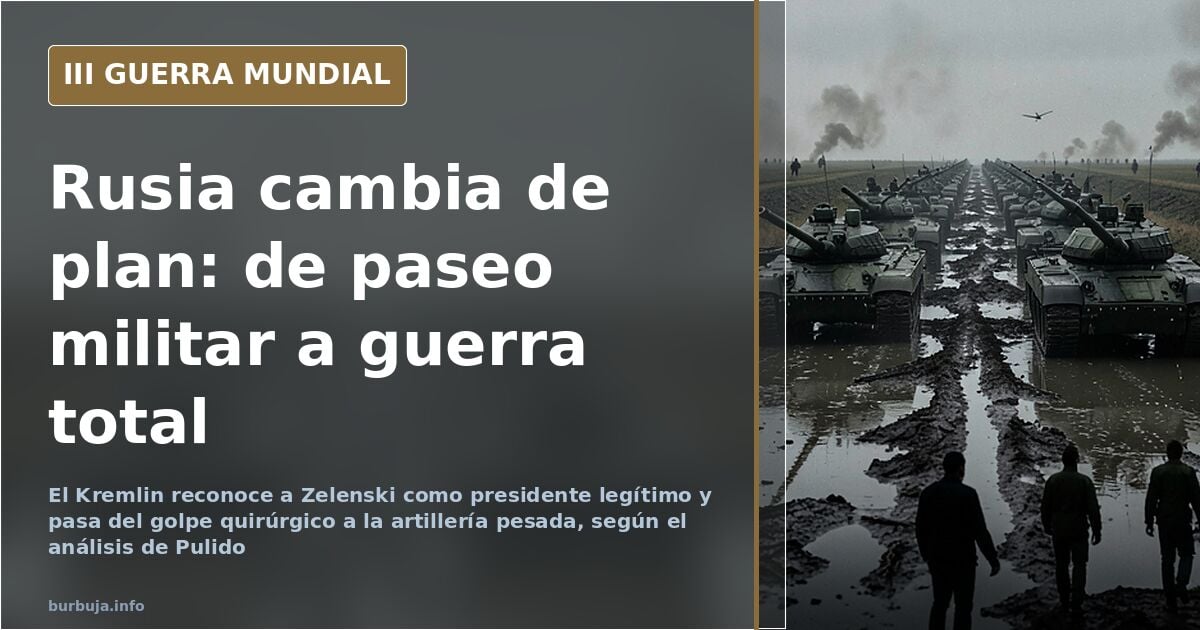
Russia changes its plan: from military stroll to total war
Russia's plan for Ukraine did not envisage a war. It envisaged a coup de main. Guillermo Pulido's analysis, editor of Revista Ejércitos, reconstructs the first phase of the invasion as what it was: a Soviet-style surgical assault that went wrong from the very first minute. The seizure of Hostomel airfield, 30 kilometers from Kyiv, sought to replicate Prague in 1968 and Kabul in 1979: helicopter-borne forces secure the runway, planes with paratroopers land, the presidential palace is seized and the government is finished off. At Hostomel, the assault troops were driven out after bloody fighting. Afterwards, ground units retook the airfield and were repelled once again.
The Kremlin recognizes Zelensky as legitimate president
The most telling sign of the readjustment is not military but diplomatic. The Kremlin admitted that Volodymyr Zelensky is the legitimate president of Ukraine, a turnaround from the slurs at the start of the invasion. Decapitating the government was the operational objective. It is no longer on the table, at least in public.
The second sign is the way the Russian army entered the country. An army in fighting condition advances in regimental order or as battalion tactical groups, the famous BTGs: formations of hundreds or thousands of soldiers capable of confronting whatever resistance they encounter. What was seen was the opposite: scattered groups, at a disadvantage when they ran into Ukrainian resistance. That dispersion, the analysis points out, has only one reasonable explanation: they did not expect fighting of any real magnitude. And it complicates logistics to the point of absurdity.
Why didn't Russia use artillery or aviation at the start?
Because the script did not call for it. The assault on urban areas was attempted with light forces and no artillery support, which prevented the capture of major cities such as Mariupol or Kharkiv. The local population, supposedly pro-Russian, did not welcome the troops as liberators. Not a single image of flowers.
The change of plans is measured in fire. In Kharkiv, artillery rockets with cluster munitions and high-explosive warheads are being used. Attack and bombing aviation, absent at the beginning, appeared with the Su-34s. The political strategy, meanwhile, is to squeeze Kyiv: surrounding the capital with a large column coming from Belarus and additional troops advancing from the Kursk area.
Some argue that the initial restraint responded to an intention to preserve infrastructure for a possible annexation and to avoid civilian casualties. Against this weighs the argument that the expeditionary troops sent in were replacement forces, with little training and Soviet equipment, including T-72s that break down and end up captured. Logistics became the weak flank: vehicles abandoned for lack of fuel and soldiers looking for food in supermarkets.
Pulido himself does not come out unscathed from scrutiny. His tone is criticized, along with his reliance on Anglo-Saxon bibliography and a profile that does not quite fit on television sets. The discussion about the messenger, however, does not invalidate the map. And the map says Moscow is no longer strolling: it is fighting.
The underlying doubt remains. If the goal was Ukraine's neutrality, that option was on the table before the invasion. If what is being sought is something else, the readjustment is not tactical. It is the beginning of something longer.
Summary of a discussion on Burbuja.info - Foro de economía, actualidad y política., translated from Spanish and reviewed before publication. Read the full discussion (37 replies).
More summaries
-
EU weighs sanctions against Tucker Carlson over Putin interview
The EU is considering sanctioning American journalist Tucker Carlson for interviewing Vladimir Putin, raising concerns about press freedom.
-
The car that wasn't Putin's and the Moscow attack hoax
The car set on fire in Moscow was not Putin's and Zelensky did not predict his death: how the hoax of the failed attack on the Russian president was built
-
Trump confirmed as a little genius of evil as Putin becomes a business partner
Trump signed sanctions against Russia, and weeks later Washington is lining up to buy Russian energy. Zelensky called the decision weak.
-
Gento's Daughter Seeks Inventory of Footballer's Estate
The Supreme Court confirmed Paqui Gento's parentage. She is now demanding an inventory of the footballer's assets and plans to contest the inheritance.
-
Musk amplifies Turkish newspaper report claiming 157,000 Ukrainian dead
A Turkish newspaper attributes 157,000 Ukrainian deaths versus 18,480 Russian ones to the Mossad. Musk amplifies the table and the war narrative starts to wobble.
-
Kash Patel, Trump's FBI pick, and his ties to Israel
Kash Patel, of Hindu origin and close to Trump, has been proposed to lead the FBI. A headline presents him as a defender of Israel; the material does not confirm it.