
Wagner tanks assault Ukrainian trench without infantry support
Forum reports claim Wagner tanks attacked a Ukrainian trench unsupported; one hit a mine yet continued firing.
English · Original discussion in Spanish · Published
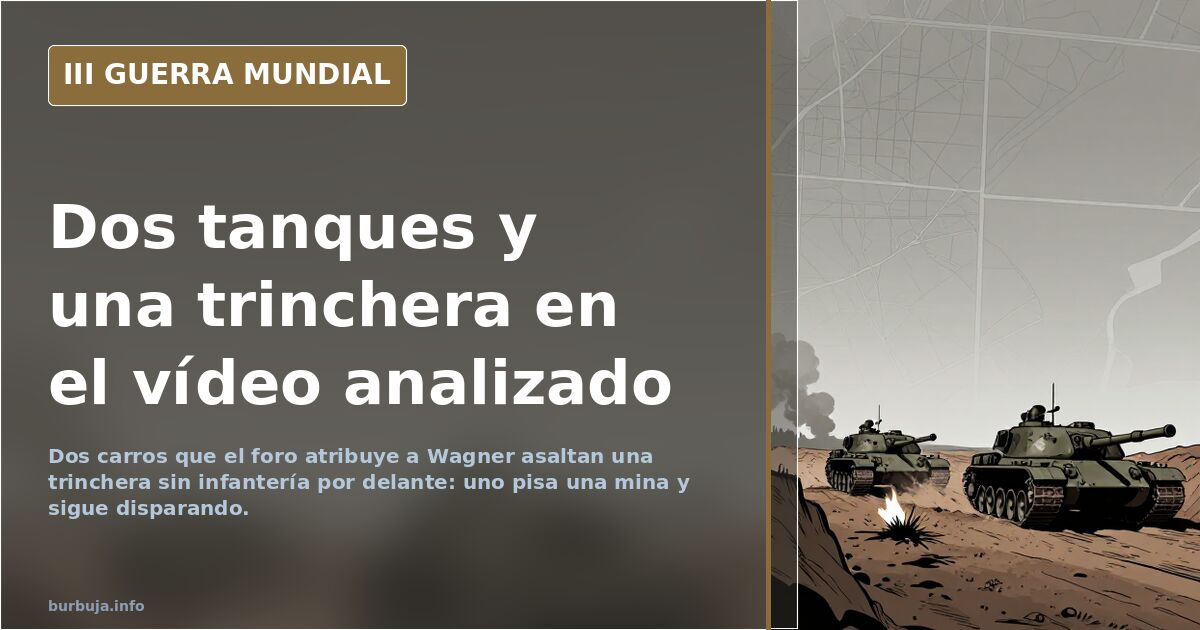
Two tanks, attributed by the forum to Wagner, assault a trench with no infantry leading
The Ukrainian front has been stuck in frontal assaults for months: dozens of consecutive days of attacks on the same stronghold, Bakhmut, have been recorded, with one participant mentioning 85 straight days of assaults. In this landscape of attrition, a video summarizes the tactic. Two main battle tanks advance at the head toward a trench. One apparently hits a mine—or takes a direct hit—and continues firing. Behind them, infantry waits to enter and clear the position. Two tanks and a trench. It seems minor. That is exactly where the disagreement lies.
What the video shows: two tanks, a mine, and infantry behind
A close reading of the footage places the key moment at 1:58: an object emerges from the trench and falls a few meters from the second tank. It would be an MK3 anti-tank grenade, a heavy device, and that distance—about ten meters—shows how close both sides were. The first tank would have stepped on a mine—an explosion not coming from the gun—and kept firing; regarding the second, accounts vary: some see it moving without serious damage, others abandoned. According to this interpretation, the turret rotates, aims toward the woods, and keeps firing while infantry enters to clear the area.
It is worth noting what the video does not say. There is no independent confirmation that the tanks were destroyed, nor who controls the trench at the end. A tank with a broken track still firing and infantry entering to finish the job is an outcome, but not a certified victory.
What is Wagner and why does it fight with its own tanks?
Wagner is not a state army. It pays troops around $3,500 monthly and grants its fighters many rights of Russian professional soldiers: coverage for death, disability, or widowhood, according to a debate participant. It has its own tanks, artillery, and aviation, even combat pilots, many of them reservists. And it recruits from within the Army ranks and outside them.
The comparison made is with the Foreign Legion: a unit with its own structure and weaponry, subject to military discipline, taking on the highest-risk work. The difference is that Wagner does not hang from a Ministry of Defense. Some summarize it as administrative engineering: keeping active military personnel who, for various reasons, no longer fit into the formal structure. Details on structure, recruitment, and benefits could fill a separate treatise.
Why is a tank charge without leading infantry criticized?
Classic doctrine states that tanks do not go alone. They advance with infantry vehicles, which are supported by soldiers covering them; ahead, an artillery curtain; above, close air support and fighters; and in parallel, electronic warfare to blind enemy signals. None of this is seen in the video. Hence the criticism: two tanks on an open road are easy targets.
Those defending the maneuver argue that a tank serves precisely for that, to force the adversary to keep their heads down while infantry consolidates. And that without soldiers behind, the armored vehicle would be vulnerable. The discussion always gets stuck on the same question: does the video show a disciplined maneuver or a lucky improvisation?
Javelin vs Stugna: which anti-tank missile is working?
Here the discrepancy is technical. The Javelin is easy to use—fire-and-forget—and reaches targets five kilometers away, allowing calm shooting from elevated positions. Of the Stugna, it is noted that it requires guiding the missile to the target, although those pointing this out later clarify it also has a fire-and-forget mode. One participant's thesis is that anti-tank teams prefer the latter and that against Russian armor, the Stugnas have caused the most notable damage.
This is the kind of assertion to take with caution. Javelins have been used and are being used; one side argues their targets have been fewer. The other denies this without nuance. The disagreement centers on which system has been decisive.
Balance of forces: 145 million people and a budget multiplied by 18
Russia, with 145 million inhabitants and a GDP comparable to Italy's, contests ground against a military structure that—one calculation mentioned in the thread multiplies its budget by 18. This figure supports two opposing narratives: the enormous merit of fighting with less, and that with such means, the result should not be this. Both start from the same number.
The cost of war also enters the calculation. A guided missile launched from an aircraft costs around $200,000, according to a participant. Those without a money printer, the argument goes, cannot afford to pulverize every position at range. First, shell the woods until they are bare; then check what remains inside.
Where the analysis stalls
The video ends without a clear outcome, and so does the discussion. No party certifies how many tanks were disabled, how many soldiers were in the trench, or what peine to them. A tank with a broken track keeps firing, infantry enters, the camera cuts. And there it stays: between those seeing a tactical victory and those seeing a front advancing only through attrition.
The Ukrainian front has been stuck in frontal assaults for months: dozens of consecutive days of attacks on the same stronghold, Bakhmut, have been recorded, with one participant mentioning 85 straight days of assaults. In this landscape of attrition, a video summarizes the tactic. Two main battle tanks advance at the head toward a trench. One apparently hits a mine—or takes a direct hit—and continues firing. Behind them, infantry waits to enter and clear the position. Two tanks and a trench. It seems minor. That is exactly where the disagreement lies.
What the video shows: two tanks, a mine, and infantry behind
A close reading of the footage places the key moment at 1:58: an object emerges from the trench and falls a few meters from the second tank. It would be an MK3 anti-tank grenade, a heavy device, and that distance—about ten meters—shows how close both sides were. The first tank would have stepped on a mine—an explosion not coming from the gun—and kept firing; regarding the second, accounts vary: some see it moving without serious damage, others abandoned. According to this interpretation, the turret rotates, aims toward the woods, and keeps firing while infantry enters to clear the area.
It is worth noting what the video does not say. There is no independent confirmation that the tanks were destroyed, nor who controls the trench at the end. A tank with a broken track still firing and infantry entering to finish the job is an outcome, but not a certified victory.
What is Wagner and why does it fight with its own tanks?
Wagner is not a state army. It pays troops around $3,500 monthly and grants its fighters many rights of Russian professional soldiers: coverage for death, disability, or widowhood, according to a debate participant. It has its own tanks, artillery, and aviation, even combat pilots, many of them reservists. And it recruits from within the Army ranks and outside them.
The comparison made is with the Foreign Legion: a unit with its own structure and weaponry, subject to military discipline, taking on the highest-risk work. The difference is that Wagner does not hang from a Ministry of Defense. Some summarize it as administrative engineering: keeping active military personnel who, for various reasons, no longer fit into the formal structure. Details on structure, recruitment, and benefits could fill a separate treatise.
Why is a tank charge without leading infantry criticized?
Classic doctrine states that tanks do not go alone. They advance with infantry vehicles, which are supported by soldiers covering them; ahead, an artillery curtain; above, close air support and fighters; and in parallel, electronic warfare to blind enemy signals. None of this is seen in the video. Hence the criticism: two tanks on an open road are easy targets.
Those defending the maneuver argue that a tank serves precisely for that, to force the adversary to keep their heads down while infantry consolidates. And that without soldiers behind, the armored vehicle would be vulnerable. The discussion always gets stuck on the same question: does the video show a disciplined maneuver or a lucky improvisation?
Javelin vs Stugna: which anti-tank missile is working?
Here the discrepancy is technical. The Javelin is easy to use—fire-and-forget—and reaches targets five kilometers away, allowing calm shooting from elevated positions. Of the Stugna, it is noted that it requires guiding the missile to the target, although those pointing this out later clarify it also has a fire-and-forget mode. One participant's thesis is that anti-tank teams prefer the latter and that against Russian armor, the Stugnas have caused the most notable damage.
This is the kind of assertion to take with caution. Javelins have been used and are being used; one side argues their targets have been fewer. The other denies this without nuance. The disagreement centers on which system has been decisive.
Balance of forces: 145 million people and a budget multiplied by 18
Russia, with 145 million inhabitants and a GDP comparable to Italy's, contests ground against a military structure that—one calculation mentioned in the thread multiplies its budget by 18. This figure supports two opposing narratives: the enormous merit of fighting with less, and that with such means, the result should not be this. Both start from the same number.
The cost of war also enters the calculation. A guided missile launched from an aircraft costs around $200,000, according to a participant. Those without a money printer, the argument goes, cannot afford to pulverize every position at range. First, shell the woods until they are bare; then check what remains inside.
Where the analysis stalls
The video ends without a clear outcome, and so does the discussion. No party certifies how many tanks were disabled, how many soldiers were in the trench, or what peine to them. A tank with a broken track keeps firing, infantry enters, the camera cuts. And there it stays: between those seeing a tactical victory and those seeing a front advancing only through attrition.
Also available in: Deutsch
Summary of a discussion on Burbuja.info - Foro de economía, actualidad y política., translated from Spanish and reviewed before publication. Read the full discussion (106 replies).
More summaries
-
Forum: Russia Launches Missiles, Bakhmut Still Stands
A Ukrainian report states 12 of 20 missiles were downed (60%); the forum discusses attacks on infrastructure and the stalemate in Bakhmut.
-
Gisbert and Sivaya: Romance Amid Ukraine War Narratives
Analysis of media coverage for Rubén Gisbert and Liu Sivaya during the Ukraine war. Is this digital propaganda or reality?
-
Captured Leopard 2 tank on display in Russia shows drooping barrel
A captured Leopard 2A6 tank is being exhibited in a Russian display with a drooping barrel caused by hydraulic failure.
-
Why NATO avoids direct conflict with Russia's nuclear arsenal
Russia holds the world's largest nuclear stockpile and an immediate response doctrine. A direct NATO attack would trigger an atomic retaliation without...
-
Free land in 'New Russia' plan divides potential settlers
A councilor near Ukraine proposes offering free land in disputed territories to settlers once peace is reached, sparking debate over risks and rewards.
-
Spanish Police hunt pro-Putin suspects in bomb letter investigation
Police are monitoring Telegram and online forums to identify the author of explosive letters, targeting pro-Russian and anti-NATO profiles in Spain.