
Why NATO avoids direct conflict with Russia's nuclear arsenal
Russia holds the world's largest nuclear stockpile and an immediate response doctrine. A direct NATO attack would trigger an atomic retaliation without...
English · Original discussion in Spanish · Published
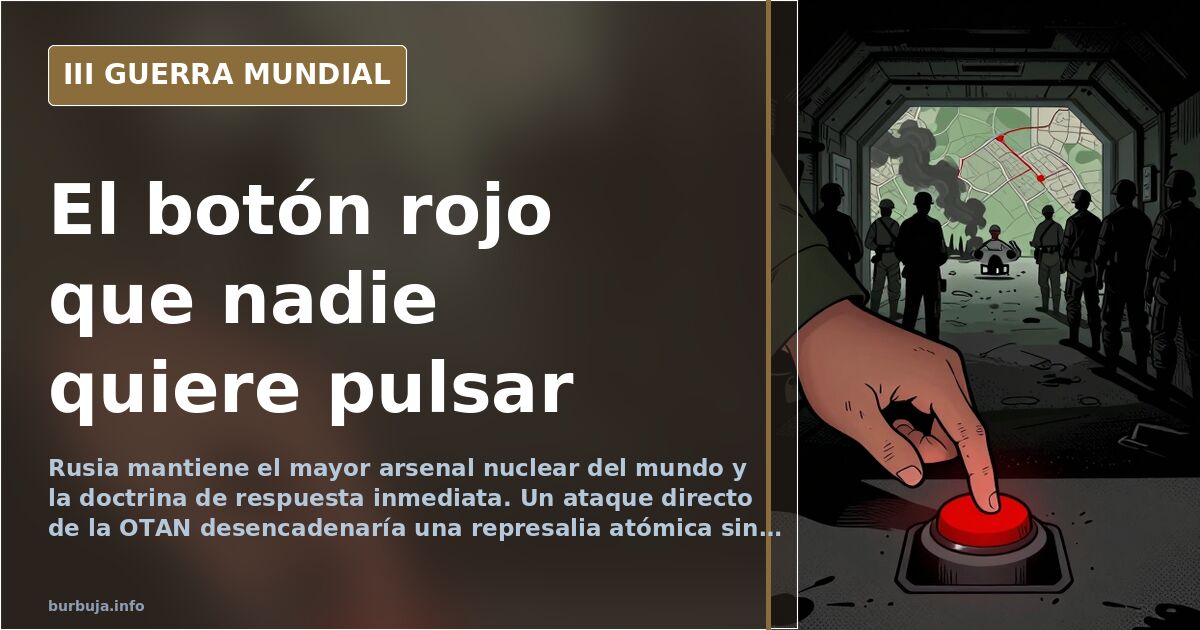
Why NATO avoids direct conflict with Russia's nuclear arsenal
The question arises every time the state of the Russian military is discussed: if Russia is struggling so much, why doesn't NATO step in to destroy it? The prevailing analysis has nothing to do with chivalry. It is about a red button that, if pressed, would leave the planet in ruins. "It would be atomic war, and the next war would be fought with sticks and stones," summarizes one of the most frequent points made in the debate.
Nuclear arsenal as total deterrence
The central argument is mutually assured destruction. Russia maintains the largest nuclear arsenal in the world and a doctrine of immediate response. A direct NATO attack on Russian territory would trigger an atomic retaliation that no defense system can contain. "They don't attack because they don't want to die, it's that simple," notes another participant.
Deterrence works both ways. If NATO does not attack Russia, Russia does not attack NATO. "For the same reason that Russia does not attack NATO. It would be the last day of our lives," summarizes an intervention that closes the matter in a single line.
Economic and military attrition as a real strategy
A second line of analysis suggests that NATO is already attacking Russia, but indirectly. The shipment of weaponry to Ukraine, shared intelligence, and economic sanctions constitute a proxy war that wears down Moscow without exposing a single Western soldier.
"NATO has been attacking Russia for a year and a half," claims one voice in the debate. The goal would not be a quick victory, but slow erosion. "They wear Russia down, get rid of their weapon stocks which they sell at premium prices, and the Ukrainians are the ones who die," adds another analysis.
The Russian military trap: neither weak nor invincible
The narrative that Russia has a "poor" army clashes with the reality of the battlefield. If it were so weak, Ukraine would have already won. If it were so strong, the war would not have lasted years. The prevailing conclusion is that the Russian army is uneven: it has elite units and others that are disastrous, but it remains a military power with escalation capabilities.
"For the war in Ukraine, they are sending a poor army. When things get ugly, they will bring out everything they have," points out a participant. The doubt is whether that "everything" includes tactical nuclear weapons.
The economic factor: sanctions that do not suffocate
Western sanctions have not collapsed the Russian economy. Inflation and rising interest rates have hit hard, but Moscow has redirected its trade toward China, India, and other markets. Energy and food autarky gives it breathing room.
"With galloping inflation in Russia, rising interest rates, rising prices...", ironizes a message comparing the Russian situation to the Spanish one. The implicit question is who can endure more: Russia or the European economies financing the war.
NATO as a defensive, not offensive, alliance
NATO's legal framework is defensive. Article 5 is only activated if a member is attacked. Attacking Russia without prior provocation would break its founding principle and divide the alliance. Germany, France, and Turkey have different interests, and not everyone wants an escalation.
"NATO is a defensive alliance. In reality, the US is very comfortable with the situation," notes an analysis pointing to Washington as the main beneficiary of the conflict.
The scenario of a direct war
If NATO were to attack, the war would be total. There would be no defined front, no safe rear guard. Russian hypersonic missiles would reach targets in Europe in minutes. Missile defense is not designed for a massive attack.
"The reaction time is four minutes," is cited in the debate. With that window, any preemptive attack is a suicidal gamble. The conclusion is that NATO does not attack because winning is impossible and losing is the end.
Does anyone truly believe there is a better option than not playing?
The question arises every time the state of the Russian military is discussed: if Russia is struggling so much, why doesn't NATO step in to destroy it? The prevailing analysis has nothing to do with chivalry. It is about a red button that, if pressed, would leave the planet in ruins. "It would be atomic war, and the next war would be fought with sticks and stones," summarizes one of the most frequent points made in the debate.
Nuclear arsenal as total deterrence
The central argument is mutually assured destruction. Russia maintains the largest nuclear arsenal in the world and a doctrine of immediate response. A direct NATO attack on Russian territory would trigger an atomic retaliation that no defense system can contain. "They don't attack because they don't want to die, it's that simple," notes another participant.
Deterrence works both ways. If NATO does not attack Russia, Russia does not attack NATO. "For the same reason that Russia does not attack NATO. It would be the last day of our lives," summarizes an intervention that closes the matter in a single line.
Economic and military attrition as a real strategy
A second line of analysis suggests that NATO is already attacking Russia, but indirectly. The shipment of weaponry to Ukraine, shared intelligence, and economic sanctions constitute a proxy war that wears down Moscow without exposing a single Western soldier.
"NATO has been attacking Russia for a year and a half," claims one voice in the debate. The goal would not be a quick victory, but slow erosion. "They wear Russia down, get rid of their weapon stocks which they sell at premium prices, and the Ukrainians are the ones who die," adds another analysis.
The Russian military trap: neither weak nor invincible
The narrative that Russia has a "poor" army clashes with the reality of the battlefield. If it were so weak, Ukraine would have already won. If it were so strong, the war would not have lasted years. The prevailing conclusion is that the Russian army is uneven: it has elite units and others that are disastrous, but it remains a military power with escalation capabilities.
"For the war in Ukraine, they are sending a poor army. When things get ugly, they will bring out everything they have," points out a participant. The doubt is whether that "everything" includes tactical nuclear weapons.
The economic factor: sanctions that do not suffocate
Western sanctions have not collapsed the Russian economy. Inflation and rising interest rates have hit hard, but Moscow has redirected its trade toward China, India, and other markets. Energy and food autarky gives it breathing room.
"With galloping inflation in Russia, rising interest rates, rising prices...", ironizes a message comparing the Russian situation to the Spanish one. The implicit question is who can endure more: Russia or the European economies financing the war.
NATO as a defensive, not offensive, alliance
NATO's legal framework is defensive. Article 5 is only activated if a member is attacked. Attacking Russia without prior provocation would break its founding principle and divide the alliance. Germany, France, and Turkey have different interests, and not everyone wants an escalation.
"NATO is a defensive alliance. In reality, the US is very comfortable with the situation," notes an analysis pointing to Washington as the main beneficiary of the conflict.
The scenario of a direct war
If NATO were to attack, the war would be total. There would be no defined front, no safe rear guard. Russian hypersonic missiles would reach targets in Europe in minutes. Missile defense is not designed for a massive attack.
"The reaction time is four minutes," is cited in the debate. With that window, any preemptive attack is a suicidal gamble. The conclusion is that NATO does not attack because winning is impossible and losing is the end.
Does anyone truly believe there is a better option than not playing?
Also available in: Deutsch
Summary of a discussion on Burbuja.info - Foro de economía, actualidad y política., translated from Spanish and reviewed before publication. Read the full discussion (103 replies).
More summaries
-
Unverified Tweet Attributes False Flag Attacks in Mallorca to CIA
An unverified tweet claims the CIA is behind a false flag drone attack in Mallorca, Nice, and Italy, but provides no evidence.
-
NATO claims to have 4,000 pages of plans against Russia
NATO states it has nearly 4,000 pages of documents ready to respond to Russian escalation on its Eastern flank.
-
Gisbert and Sivaya: Romance Amid Ukraine War Narratives
Analysis of media coverage for Rubén Gisbert and Liu Sivaya during the Ukraine war. Is this digital propaganda or reality?
-
Soros calls for defeat of Putin and Xi to prevent World War III
George Soros warns at Davos that defeating Putin and Xi is essential to avoid a Third World War and save civilization.
-
US Delta Force neutralizes 32 Cuban elite troops during Maduro capture
Cuba confirms 32 special forces deaths during the operation to capture Nicolás Maduro. Was it combat or summary execution?
-
Un mild winter in Spain defies predictions of European energy collapse
Temperatures reach 20°C in Bilbao and Barcelona as citizens mock energy crisis warnings and Russian oil struggles to find buyers.