
Spanish Police hunt pro-Putin suspects in bomb letter investigation
Police are monitoring Telegram and online forums to identify the author of explosive letters, targeting pro-Russian and anti-NATO profiles in Spain.
English · Original discussion in Spanish · Published
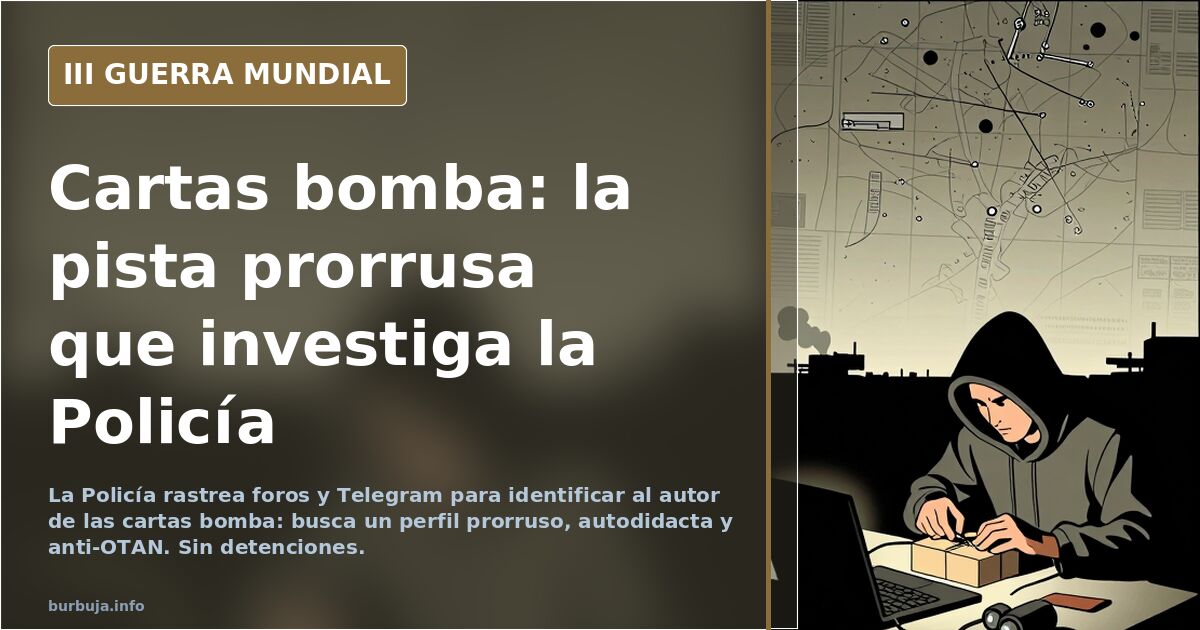
Police monitor forums and Telegram to find author of bomb letters
The investigation into explosive envelopes sent to institutional targets in Spain has focused on a specific profile: self-taught individuals, pro-Russian or anti-NATO, with little operational structure. Investigators are scanning social media, Telegram groups, and internet forums for clues regarding those who threatened to carry out such attacks. To a lesser extent, the far-left linked to anti-NATO movements is also being analyzed. This case trinc previous incidents—such as the bullets sent to Pablo Iglesias or the knife sent to a minister—which, according to some participants, were revealed to be internal setups and smoke screens, fueling skepticism toward the official narrative.
The profile sought by Police: self-taught, pro-Russian, and unstructured
The description provided by investigators depicts an isolated individual without an organization behind them. A textbook "lone wolf," self-taught and sympathetic to Moscow or, at the very least, showing frontal rejection of NATO. This hypothesis is not new: in previous episodes, pro-Russian fanatics operating on encrypted messaging networks and groups were already suspected.
Some suggest the author could be a man over 60 with a military background—having served at the Torrejón camp or the Air Force Headquarters—and links to Valladolid. This is one of the circulating leads, though unconfirmed officially. Another theory points to someone from the Valencia area with connections in Castilla y León, though none of these hypotheses have resulted in an arrest.
The underlying problem is that the profile is so broad it could fit almost anyone. Self-taught, pro-Russian, anti-NATO: three labels that describe thousands of people in Spain. The question hanging in the air is whether the investigation is looking for the author or constructing a narrative.
False flag or lone wolf: two unresolved hypotheses
Part of the analysis suggests that everything points to a false flag operation. The argument: a culprit is manufactured before the facts are investigated, the profile is leaked to the media, and dissent is incivil. Parallels are drawn to the bullets sent to Pablo Iglesias and the knife sent to a minister, episodes that, according to some, ended up being internal setups.
Conversely, the lone gunman hypothesis is gaining traction in the media. An individual without an organization, with access to basic materials and knowledge, capable of sending envelopes without leaving a trace. The lack of arrests after months of investigation fuels both theories: if it were a lone wolf, they should have been found by now; if it were an operation, there will never be a culprit.
What has been confirmed is that Correos (the state-owned postal service) has denied information to its unions "for security reasons," referring all data to the police investigation. This secrecy does not help clear doubts.
A precedent no one wants to repeat: bullets, knives, and setups
The skepticism is not unfounded. Previous episodes of suspicious packages and threats led nowhere: no arrests, no evidence, and no official explanation. The feeling that a narrative is activated before the investigation is shared by analysts of different political stripes.
Some point out that the timing is suspicious. The bomb letters arrive during a moment of political tension, with the Government needing to justify security measures and divert attention. Others point to Moscow as a beneficiary of any chaos in Western Europe.
The only certainty is that there are no detainees. And that the leaked profile—pro-Russian, self-taught, anti-NATO—matches thousands of people who have not sent any bomb letters.
What is known about the bomb letters sent in Spain
The explosive envelopes were addressed to institutional targets, including the Air Force Headquarters and the Torrejón air base. The investigation remains open and no arrests have been confirmed. The Police are pursuing several lines, with the pro-Russian angle being the primary one and the anti-NATO far-left as secondary.
The case has peine the debate on freedom of expression on the internet. The monitoring of forums and Telegram groups worries those who see it as a crackdown on dissent. The line between investigating real threats and incivil opinions is becoming increasingly blurred.
Given these circumstances, the bomb letter case could end like previous ones: without a culprit, without an explanation, and with the official narrative intact. Or it could be the first one to be solved. As of this discussion, there is no way to know.
The investigation into explosive envelopes sent to institutional targets in Spain has focused on a specific profile: self-taught individuals, pro-Russian or anti-NATO, with little operational structure. Investigators are scanning social media, Telegram groups, and internet forums for clues regarding those who threatened to carry out such attacks. To a lesser extent, the far-left linked to anti-NATO movements is also being analyzed. This case trinc previous incidents—such as the bullets sent to Pablo Iglesias or the knife sent to a minister—which, according to some participants, were revealed to be internal setups and smoke screens, fueling skepticism toward the official narrative.
The profile sought by Police: self-taught, pro-Russian, and unstructured
The description provided by investigators depicts an isolated individual without an organization behind them. A textbook "lone wolf," self-taught and sympathetic to Moscow or, at the very least, showing frontal rejection of NATO. This hypothesis is not new: in previous episodes, pro-Russian fanatics operating on encrypted messaging networks and groups were already suspected.
Some suggest the author could be a man over 60 with a military background—having served at the Torrejón camp or the Air Force Headquarters—and links to Valladolid. This is one of the circulating leads, though unconfirmed officially. Another theory points to someone from the Valencia area with connections in Castilla y León, though none of these hypotheses have resulted in an arrest.
The underlying problem is that the profile is so broad it could fit almost anyone. Self-taught, pro-Russian, anti-NATO: three labels that describe thousands of people in Spain. The question hanging in the air is whether the investigation is looking for the author or constructing a narrative.
False flag or lone wolf: two unresolved hypotheses
Part of the analysis suggests that everything points to a false flag operation. The argument: a culprit is manufactured before the facts are investigated, the profile is leaked to the media, and dissent is incivil. Parallels are drawn to the bullets sent to Pablo Iglesias and the knife sent to a minister, episodes that, according to some, ended up being internal setups.
Conversely, the lone gunman hypothesis is gaining traction in the media. An individual without an organization, with access to basic materials and knowledge, capable of sending envelopes without leaving a trace. The lack of arrests after months of investigation fuels both theories: if it were a lone wolf, they should have been found by now; if it were an operation, there will never be a culprit.
What has been confirmed is that Correos (the state-owned postal service) has denied information to its unions "for security reasons," referring all data to the police investigation. This secrecy does not help clear doubts.
A precedent no one wants to repeat: bullets, knives, and setups
The skepticism is not unfounded. Previous episodes of suspicious packages and threats led nowhere: no arrests, no evidence, and no official explanation. The feeling that a narrative is activated before the investigation is shared by analysts of different political stripes.
Some point out that the timing is suspicious. The bomb letters arrive during a moment of political tension, with the Government needing to justify security measures and divert attention. Others point to Moscow as a beneficiary of any chaos in Western Europe.
The only certainty is that there are no detainees. And that the leaked profile—pro-Russian, self-taught, anti-NATO—matches thousands of people who have not sent any bomb letters.
What is known about the bomb letters sent in Spain
The explosive envelopes were addressed to institutional targets, including the Air Force Headquarters and the Torrejón air base. The investigation remains open and no arrests have been confirmed. The Police are pursuing several lines, with the pro-Russian angle being the primary one and the anti-NATO far-left as secondary.
The case has peine the debate on freedom of expression on the internet. The monitoring of forums and Telegram groups worries those who see it as a crackdown on dissent. The line between investigating real threats and incivil opinions is becoming increasingly blurred.
Given these circumstances, the bomb letter case could end like previous ones: without a culprit, without an explanation, and with the official narrative intact. Or it could be the first one to be solved. As of this discussion, there is no way to know.
Also available in: Deutsch
Summary of a discussion on Burbuja.info - Foro de economía, actualidad y política., translated from Spanish and reviewed before publication. Read the full discussion (103 replies).
More summaries
-
Iglesias Prefers Obama, Undermining Communist Label
Pablo Iglesias favors Obama over Putin, sparking debate on Podemos' identity: communism, postmodernism, or crony capitalism?
-
Polish authorities accuse journalist Pablo González of spying
Journalist Pablo González, holding both Spanish and Russian passports, faces up to 10 years in prison in Poland on espionage charges.
-
NATO attributes general's death to avalanche
Online claims suggest a Polish general died in a bunker hit by an Iskander, but NATO officially cites an avalanche.
-
Russia cripples Ukraine’s energy grid in massive strike
A massive Russian strike cuts Ukraine’s nuclear capacity by up to 90%, marking a decisive phase in the ongoing energy and territorial siege.
-
Hiroshima: 166,000 dead and 77 years of media silence
Seventy-seven years after the Hiroshima atomic bombing, the death toll of 166,000 receives very little media coverage or commemoration.
-
Florida launches state guard without federal funding or command
Governor DeSantis activates a 400-member Florida State Guard with no federal money, amid Texas Republicans declaring Biden illegitimate.