
Volkswagen cuts EV output as demand runs 30% below forecasts
Volkswagen cancels a shift at Emden, delays the ID.7 and lets 300 temporary workers go as EV demand falls 30% short of forecasts
English · Original discussion in Spanish · Published
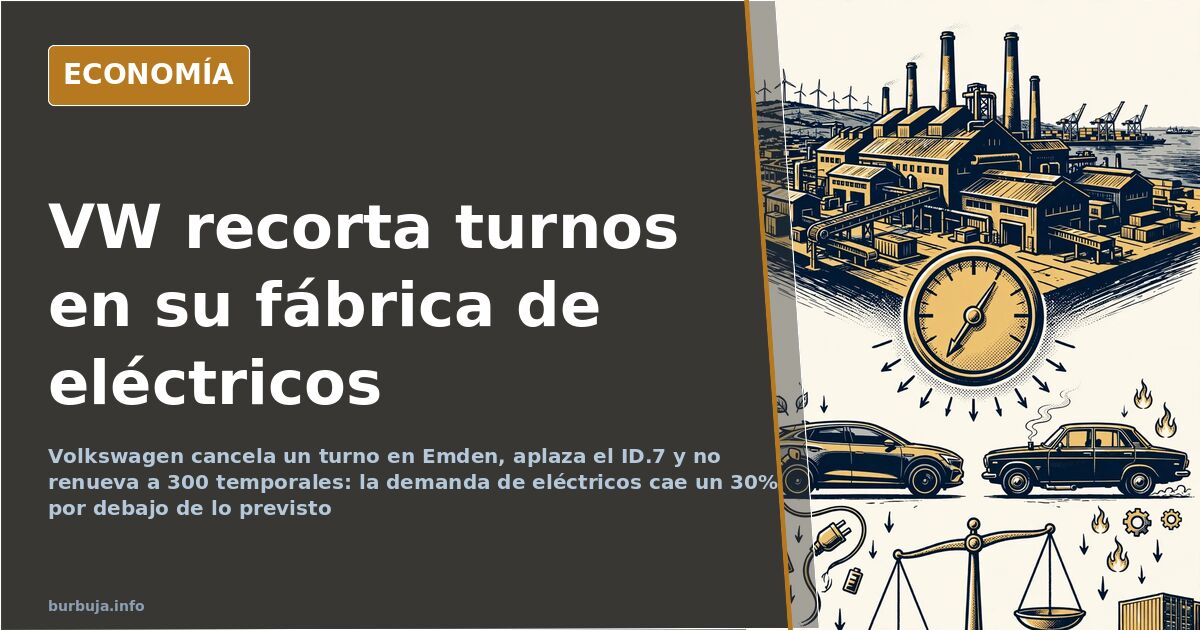
Volkswagen cuts shifts at Emden and lets 300 temporary workers go
Volkswagen's best-selling electric car in Europe is now in the spotlight. The ID.4 racked up 67,490 units in 2022 —third place in Europe's EV ranking— and months later the Emden plant that assembles it is cancelling a shift, adding an extra week of vacation to the EV lines and not renewing 300 of its 1,500 temporary workers. The reason the company gives is buyer resistance that is being reported across the industry.
Volkswagen is reducing electric car production “temporarily,” according to the brand itself, and the word temporary is the only consolation left. Demand has fallen as much as 30% below the figures the brand had forecast for those lines.
What exactly has been halted in Emden
The adjustment has dates. One of the plant's shifts is cancelled for two weeks, and right after that the summer holiday period begins, which for workers on the electric vehicle lines is extended by another week. The company is not touching combustion models: the Passat Variant is still being built in Emden without disruption. The casualties of the slowdown are the ID.4 and the new ID.7, whose series launch —scheduled for July— is delayed by several months.
The official explanation comes from the plant's own works council: there is “strong customer reluctance” in the electric segment. The phrase is not from a doom-mongering analyst but from someone who negotiates every collective agreement there. And the diagnosis is repeated outside Volkswagen: the drop in demand affects all manufacturers, not just those in Wolfsburg.
Why won’t customers buy an electric car?
Because the maths doesn't add up, and that is clearer with prices than with speeches. The ID.4 was selling in June 2023 for between €40,302 and €59,490 depending on trim. A combustion-engined family car with a three-cylinder engine and mid-level equipment then came in at €36,595 and, with options, went past €40,000. The advantage in favour of the electric car is nowhere to be seen when it comes time to sign.
According to a calculation circulating in the debate, with electricity at 13 cents per kilowatt-hour, covering 100 kilometres in electric mode costs a little over €2, while a petrol car using 6 litres per 100 km comes to about €9. The problem comes right after. There are not enough charging points and they are not well distributed, and anyone who uses their car as their only vehicle ends up looking more fondly on a plug-in hybrid than a pure electric.
China, Tesla and the theory of the plotted plan
A narrative is circulating strongly and it is worth putting it in its place: that Chinese brands and Tesla, in practice the same thing, had spent years preparing the demolition of European industry to leave us dependent on overseas producers. It is a suspicion, not a proven fact, and it clashes with a stubborn piece of data: the Volkswagen group sold 8.26 million vehicles in a year in which Tesla sold 1.31 million.
The obvious also weighs against that conspiracy theory. No traditional brand has a problem selling electric cars; the problem is that there is no market at the current price and conditions. What does remain standing is the tariff weapon against Chinese cars, a lifeline that, according to the debate, the European buyer would pay every time they go to the checkout.
The wrong product at the wrong time
In the debate, brands are reproached for not being able to dodge a product problem. While electric SUVs weighing almost three tonnes and costing an arm and a leg are being built, small, affordable city cars were allowed to die, which is precisely what makes sense to electrify. The e-UP could be bought for less than €20,000 before subsidies and disappeared from the range, just like its Seat and Skoda twins.
The numbers of the cheap rival are not up for debate: according to the data being used in the debate, there are Chinese electric minis for €4,000 and somewhat larger models for €7,500. With that shop window, the ID.4 at €40,000 is not competing; it is competing with itself. And meanwhile the price tag keeps rising, because the adjustment is made by cutting shifts, never by cutting the price.
What Germany has at stake with this slowdown
Emden is in Lower Saxony, the same state whose economics minister admits that the fall in demand is a fact and not a summer headline. What is shifting, with Italy, Austria, Sweden and German manufacturers themselves turning toward more conservative positions, is the timetable of the transition: use what works while the new thing has not proved that it is better, more reliable and more available.
No one yet knows whether the ban on selling combustion cars in Europe from 2035 will survive as is or become a dead letter. The industry has invested on that date, customers have not kept pace, and some point out that solid-state batteries will make everything sold today look like clearance stock. The question is no longer whether Volkswagen is correcting course, but how many more shifts must be cancelled before someone admits that the problem was not in production.
Volkswagen's best-selling electric car in Europe is now in the spotlight. The ID.4 racked up 67,490 units in 2022 —third place in Europe's EV ranking— and months later the Emden plant that assembles it is cancelling a shift, adding an extra week of vacation to the EV lines and not renewing 300 of its 1,500 temporary workers. The reason the company gives is buyer resistance that is being reported across the industry.
Volkswagen is reducing electric car production “temporarily,” according to the brand itself, and the word temporary is the only consolation left. Demand has fallen as much as 30% below the figures the brand had forecast for those lines.
What exactly has been halted in Emden
The adjustment has dates. One of the plant's shifts is cancelled for two weeks, and right after that the summer holiday period begins, which for workers on the electric vehicle lines is extended by another week. The company is not touching combustion models: the Passat Variant is still being built in Emden without disruption. The casualties of the slowdown are the ID.4 and the new ID.7, whose series launch —scheduled for July— is delayed by several months.
The official explanation comes from the plant's own works council: there is “strong customer reluctance” in the electric segment. The phrase is not from a doom-mongering analyst but from someone who negotiates every collective agreement there. And the diagnosis is repeated outside Volkswagen: the drop in demand affects all manufacturers, not just those in Wolfsburg.
Why won’t customers buy an electric car?
Because the maths doesn't add up, and that is clearer with prices than with speeches. The ID.4 was selling in June 2023 for between €40,302 and €59,490 depending on trim. A combustion-engined family car with a three-cylinder engine and mid-level equipment then came in at €36,595 and, with options, went past €40,000. The advantage in favour of the electric car is nowhere to be seen when it comes time to sign.
According to a calculation circulating in the debate, with electricity at 13 cents per kilowatt-hour, covering 100 kilometres in electric mode costs a little over €2, while a petrol car using 6 litres per 100 km comes to about €9. The problem comes right after. There are not enough charging points and they are not well distributed, and anyone who uses their car as their only vehicle ends up looking more fondly on a plug-in hybrid than a pure electric.
China, Tesla and the theory of the plotted plan
A narrative is circulating strongly and it is worth putting it in its place: that Chinese brands and Tesla, in practice the same thing, had spent years preparing the demolition of European industry to leave us dependent on overseas producers. It is a suspicion, not a proven fact, and it clashes with a stubborn piece of data: the Volkswagen group sold 8.26 million vehicles in a year in which Tesla sold 1.31 million.
The obvious also weighs against that conspiracy theory. No traditional brand has a problem selling electric cars; the problem is that there is no market at the current price and conditions. What does remain standing is the tariff weapon against Chinese cars, a lifeline that, according to the debate, the European buyer would pay every time they go to the checkout.
The wrong product at the wrong time
In the debate, brands are reproached for not being able to dodge a product problem. While electric SUVs weighing almost three tonnes and costing an arm and a leg are being built, small, affordable city cars were allowed to die, which is precisely what makes sense to electrify. The e-UP could be bought for less than €20,000 before subsidies and disappeared from the range, just like its Seat and Skoda twins.
The numbers of the cheap rival are not up for debate: according to the data being used in the debate, there are Chinese electric minis for €4,000 and somewhat larger models for €7,500. With that shop window, the ID.4 at €40,000 is not competing; it is competing with itself. And meanwhile the price tag keeps rising, because the adjustment is made by cutting shifts, never by cutting the price.
What Germany has at stake with this slowdown
Emden is in Lower Saxony, the same state whose economics minister admits that the fall in demand is a fact and not a summer headline. What is shifting, with Italy, Austria, Sweden and German manufacturers themselves turning toward more conservative positions, is the timetable of the transition: use what works while the new thing has not proved that it is better, more reliable and more available.
No one yet knows whether the ban on selling combustion cars in Europe from 2035 will survive as is or become a dead letter. The industry has invested on that date, customers have not kept pace, and some point out that solid-state batteries will make everything sold today look like clearance stock. The question is no longer whether Volkswagen is correcting course, but how many more shifts must be cancelled before someone admits that the problem was not in production.
Summary of a discussion on Burbuja.info - Foro de economía, actualidad y política., translated from Spanish and reviewed before publication. Read the full discussion (330 replies).
More summaries
-
Volkswagen Halts Electric Car Production Amid Falling Demand
Volkswagen to pause electric car production lines for two weeks in October due to declining orders. Electric vehicle share in Germany remains below 16%.
-
Turning 45 Without Children: The Unspoken Downward Spiral
Reaching 45 without children triggers a spiral no one warns you about: consumerism fades, and raising kids means 30 years of struggle.
-
Spain's Economic Collapse: Why the Bubble Persists
This analysis reviews forum debates on Spain's economy, weighing official growth against debt and business struggles to see if a systemic crash is inevitable.
-
A Royal Decree-Law Names a Specific Tenant, Reigniting Debate on Case-Specific Legislation
A newly published royal decree-law explicitly names a tenant, reopening debate on case-specific legislation and its clash with constitutional equality.
-
Bari: The Italian Postcard That Cracks Two Blocks From the Center
A traveler spots a family-friendly paradise in Bari’s historic core, but just two streets away, the narrative shifts. Italy vs. Spain compared.
-
Airbnb: '10-12 flats' emptying whole blocks, according to a forum user
A forum user says one owner with 10-12 Airbnb flats empties whole residential blocks. In Lugo or Teruel, prices also rise without mass tourism.