
Volkswagen Halts Electric Car Production Amid Falling Demand
Volkswagen to pause electric car production lines for two weeks in October due to declining orders. Electric vehicle share in Germany remains below 16%.
English · Original discussion in Spanish · Published
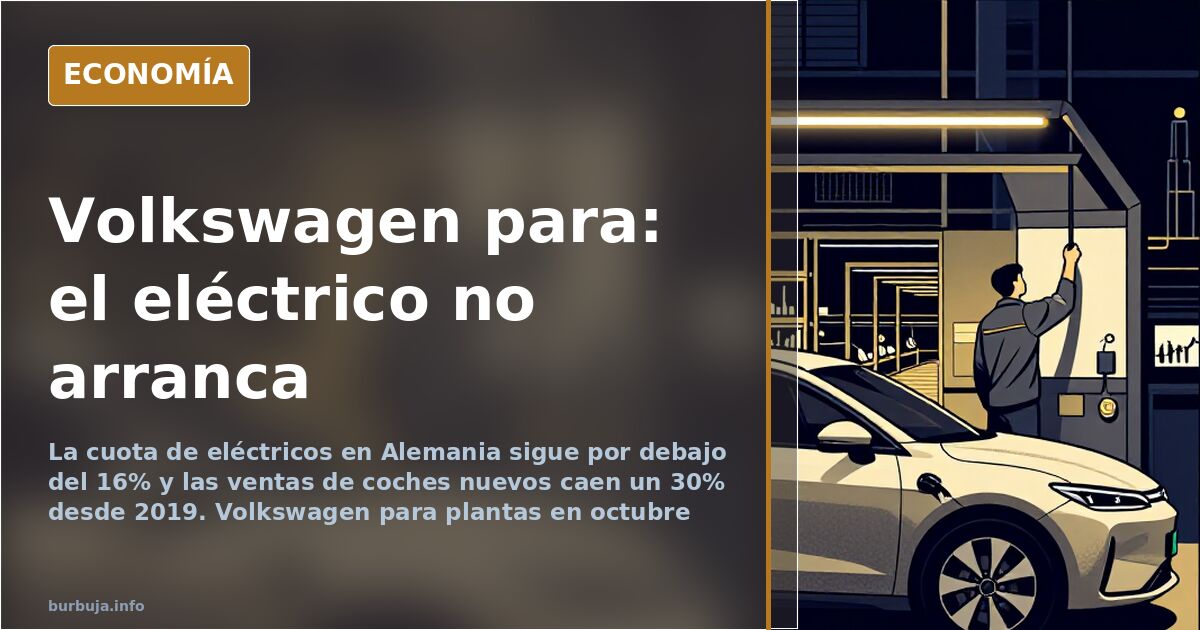
Volkswagen Powers Down Electric Line: Two Weeks of Stoppage in October
Volkswagen is stopping. This isn't a union negotiation phrase: some of its German electric car plants will halt production for at least two weeks in October because there aren't enough orders to justify running the assembly line. Viewed as a workforce reduction, the news falls short. What it reveals is that the battery-powered car hasn't found buyers at the price it was put on sale for.
How Much Have Electric Car Sales Fallen in Germany?
The analysis numbers are stubborn. The market share for electric vehicles in Germany remains below 16% in new registrations. This sounds like a respectable figure until it's compared to another statistic: total new car sales in the country have fallen by 30% compared to 2019. The market hasn't electrified. It has shrunk.
And here emerges the uncomfortable nuance for the official narrative. If sales had remained at the levels of five years ago, electric vehicles wouldn't even reach a 10% share. Adding new and used, the figure plummets below 3%. The electric car isn't conquering the existing fleet; it's occupying the space left by customers who no longer buy cars.
The Price That Ate the Middle Class
A utility vehicle today costs 25,000 euros. An Octavia TSI 1.5 DSG goes for 35,000. Along the way, the cheap car disappeared – the one that two decades ago cost less than 7,000 euros and is now directly illegal: without ESP, without an emergency system, without the filters that increase the cost of every version.
The conclusion is obvious to anyone looking at their payslip. With average European salaries, there's no room for a 30,000 euro splurge, especially if after seven years the range drops to 150 kilometers and a second-hand buyer can't be found. Some even described buying an electric car as a alucinación to the bumper cars: tokens, sparks, and fairground music.
China, Tariffs, and the Sagunto Plant
Meanwhile, the Chinese manufacturer sells better products at half the price. The European response has been tariffs, and the paradox is clear to everyone: first, the local manufacturer was pushed towards electric vehicles by decree, then it's protected from those who make them better and cheaper. The Cupra project in Martorell and the battery plant in Sagunto — the one that has been "under construction" for years — are left hanging by the same thread.
Antiestéticar Also Slows Down Purchases
There's a third factor not found in spreadsheets. Suspicion has taken hold: degrading batteries, fires, restrictions on parking access. Regarding the latter, specific cases circulate, such as limitations attributed to the German municipalities of Kulmbach and Leonberg. And concerning fires, the most repeated statistic is that of two electric buses catching fire in one year in El Prat, although the comparison with the thousands of combustion engine cars that catch fire doesn't always make the headlines.
Not the entire narrative holds up. There are also electric car drivers who defend the amortization, the charging network, and the safety of LFP batteries compared to gasoline tanks. Their testimony exists. It doesn't move the numbers.
This isn't the end of the electric car. It's the end of the electric car that sold itself, with public subsidies and without real competition. If demand doesn't pick up when the plant restarts, the next stoppage won't last two weeks. Or perhaps it will, and we'll continue to call it a temporary cutback.
Volkswagen is stopping. This isn't a union negotiation phrase: some of its German electric car plants will halt production for at least two weeks in October because there aren't enough orders to justify running the assembly line. Viewed as a workforce reduction, the news falls short. What it reveals is that the battery-powered car hasn't found buyers at the price it was put on sale for.
How Much Have Electric Car Sales Fallen in Germany?
The analysis numbers are stubborn. The market share for electric vehicles in Germany remains below 16% in new registrations. This sounds like a respectable figure until it's compared to another statistic: total new car sales in the country have fallen by 30% compared to 2019. The market hasn't electrified. It has shrunk.
And here emerges the uncomfortable nuance for the official narrative. If sales had remained at the levels of five years ago, electric vehicles wouldn't even reach a 10% share. Adding new and used, the figure plummets below 3%. The electric car isn't conquering the existing fleet; it's occupying the space left by customers who no longer buy cars.
The Price That Ate the Middle Class
A utility vehicle today costs 25,000 euros. An Octavia TSI 1.5 DSG goes for 35,000. Along the way, the cheap car disappeared – the one that two decades ago cost less than 7,000 euros and is now directly illegal: without ESP, without an emergency system, without the filters that increase the cost of every version.
The conclusion is obvious to anyone looking at their payslip. With average European salaries, there's no room for a 30,000 euro splurge, especially if after seven years the range drops to 150 kilometers and a second-hand buyer can't be found. Some even described buying an electric car as a alucinación to the bumper cars: tokens, sparks, and fairground music.
China, Tariffs, and the Sagunto Plant
Meanwhile, the Chinese manufacturer sells better products at half the price. The European response has been tariffs, and the paradox is clear to everyone: first, the local manufacturer was pushed towards electric vehicles by decree, then it's protected from those who make them better and cheaper. The Cupra project in Martorell and the battery plant in Sagunto — the one that has been "under construction" for years — are left hanging by the same thread.
Antiestéticar Also Slows Down Purchases
There's a third factor not found in spreadsheets. Suspicion has taken hold: degrading batteries, fires, restrictions on parking access. Regarding the latter, specific cases circulate, such as limitations attributed to the German municipalities of Kulmbach and Leonberg. And concerning fires, the most repeated statistic is that of two electric buses catching fire in one year in El Prat, although the comparison with the thousands of combustion engine cars that catch fire doesn't always make the headlines.
Not the entire narrative holds up. There are also electric car drivers who defend the amortization, the charging network, and the safety of LFP batteries compared to gasoline tanks. Their testimony exists. It doesn't move the numbers.
This isn't the end of the electric car. It's the end of the electric car that sold itself, with public subsidies and without real competition. If demand doesn't pick up when the plant restarts, the next stoppage won't last two weeks. Or perhaps it will, and we'll continue to call it a temporary cutback.
Summary of a discussion on Burbuja.info - Foro de economía, actualidad y política., translated from Spanish and reviewed before publication. Read the full discussion (365 replies).
More summaries
-
Volkswagen announces 7.51 kWh/100 km for its most efficient electric vehicle
Volkswagen claims the most efficient EV with a consumption of 7.51 kWh/100 km. However, this record clashes with its ground clearance and the closures in Germany.
-
Germany: 32% of new cars are electric
Germany recorded 32.4% electric car sales in August. Chinese brands are thriving while Volkswagen downsizes. Bubble or reality?
-
Electric Cars Cool Down: Buyers Experience Buyer's Remorse
Cold weather significantly impacts EV range: Tesla loses 1%, Polestar 60%, and another 54%. Buyers regret electric car purchases as the industry re-evaluates.
-
Córdoba Father Self-Immolates: Mental Illness or Societal Despair?
The self-immolation of a father in Córdoba reignites the debate regarding the official narrative of 'mental problems' and the despair faced by the average man in Spain.
-
Euthanasia in Old Age: Autonomy vs. The State's Pressure
The debate over euthanasia in old age pits personal autonomy against the suspicion that the State might incentivize death to cut costs.
-
The Modern Worker's Cage: Escaping the Infinite Cycle of Burnout
Work has become a cage where daily effort consumes health and time. Discover why we push ourselves so hard and how to break the cycle.