
Turning 45 Without Children: The Unspoken Downward Spiral
Reaching 45 without children triggers a spiral no one warns you about: consumerism fades, and raising kids means 30 years of struggle.
English · Original discussion in Spanish · Published
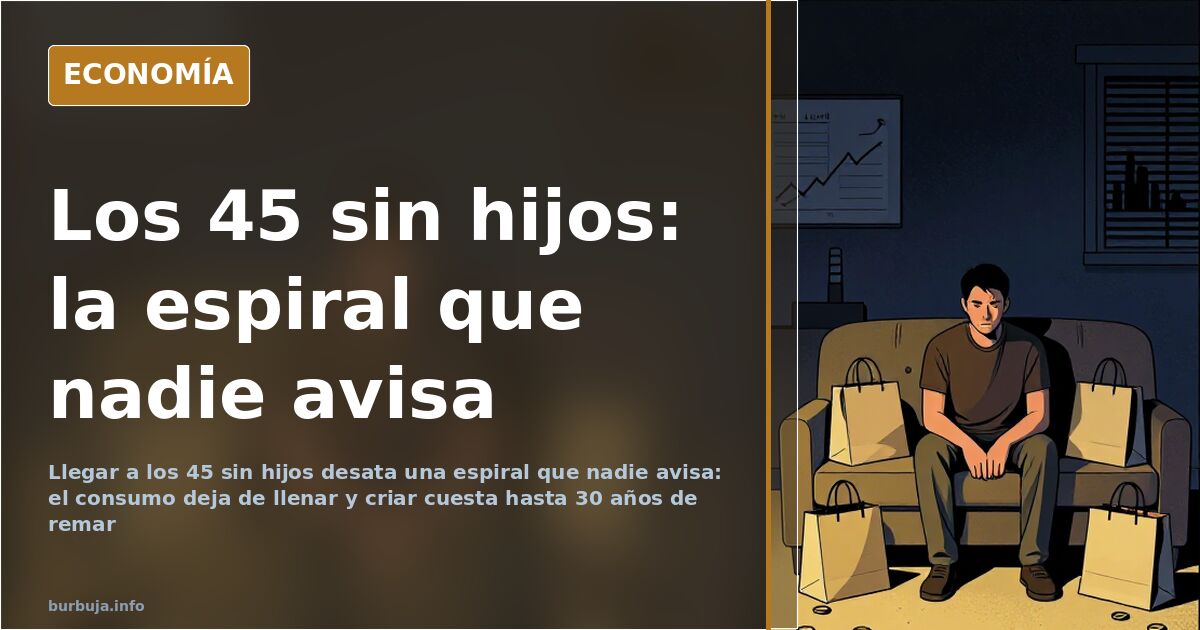
Hitting 45 Without Children: When Consumerism Stops Filling the Void
What happens to someone who reaches 45 without children and no prospect of having them? The prevailing answer is uncomfortable: they enter a difficult-to-stop negative spiral. This isn't a pro-birth sermon or a sarracena rant. It's an inventory of what breaks when consumerism no longer satisfies, the mirror stops reflecting youth, and no one warns you in time. The explicit warning: avoid it if you can.
Why Do Childless People Hit a Wall at 45?
The diagnosis is specific. At this age, material consumption stops working: showing off a new phone becomes ridiculous, and the person themselves realizes it before anyone else. Attractiveness wanes, the display of possessions is abandoned, and a void remains that no purchase can fill. Some respond with an exception: past that age, childless and without need, their leisure time filled with musical, literary, and cinematic pleasures. The exception exists. The question is how long it lasts.
The Calculation That Puts You Off: 25 or 30 Years of Struggle
Raising children costs, above all, time. Money takes a back seat in almost all testimonies, but time is non-negotiable. The most common calculation speaks of getting on a chair, putting a noose around your neck, and rowing for 25 or 30 years against the statistics. In the scenario of divorce, the figure stretches: 15 or 20 years paying alimony and mortgage while surviving at your parents' home or in a shared room. No one disputes the desire to have them. What's disputed is the arithmetic. This breakdown, item by item, yields a surprising result.
What's the Financial Cost of Divorce with Children?
Here, the matter becomes financial. The most common sequence — legal conflict, divorce, loss of the home, and alimony — is summarized as ruin for the rest of your life. The most detailed case is that of a 46-year-old separated man with one child, who moved back in with his parents because the house and custody went to the other party. He was already barely coping, according to the account; now he adds depression and drags the financial devastation decades into the future. It's also claimed that most couples with children end up separating: an assertion made without supporting statistics.
Does Having a Child Guarantee You Won't Die Alone?
No. The classic argument — that no one will care about you when you're old if you don't have children — receives an uncomfortable rebuttal: visit a nursing home and count how many people with children are in the exact same situation, many waiting for an inheritance. Adopting a dog, they say, cures loneliness better than offspring, because a child isn't there for that. On the other side are those who maintain that an old person without children is sadder than an orphan, because an orphan can still be adopted. Neither side yields.
The Demographic Bottom Line: Sub-Zero Birth Rate
Beneath all this lies a fact no one disputes: the birth rate is below zero. One current of thought attributes this to a change in timing — squeezing youth until 40, prioritizing career over family, having children when it's too late — while another blames job insecurity and a labor market that turns any ambition into poorly paid overtime. Both narratives agree on the essential point: having children today is a decision made against the odds.
Two sides, one same warning. Those with children advise against having them; those without children warn that the spiral comes on its own. With such guarantees, the only destination they both agree on is the one mentioned in the diagnosis itself: a rundown nursing home with no one to argue over the inheritance.
What happens to someone who reaches 45 without children and no prospect of having them? The prevailing answer is uncomfortable: they enter a difficult-to-stop negative spiral. This isn't a pro-birth sermon or a sarracena rant. It's an inventory of what breaks when consumerism no longer satisfies, the mirror stops reflecting youth, and no one warns you in time. The explicit warning: avoid it if you can.
Why Do Childless People Hit a Wall at 45?
The diagnosis is specific. At this age, material consumption stops working: showing off a new phone becomes ridiculous, and the person themselves realizes it before anyone else. Attractiveness wanes, the display of possessions is abandoned, and a void remains that no purchase can fill. Some respond with an exception: past that age, childless and without need, their leisure time filled with musical, literary, and cinematic pleasures. The exception exists. The question is how long it lasts.
The Calculation That Puts You Off: 25 or 30 Years of Struggle
Raising children costs, above all, time. Money takes a back seat in almost all testimonies, but time is non-negotiable. The most common calculation speaks of getting on a chair, putting a noose around your neck, and rowing for 25 or 30 years against the statistics. In the scenario of divorce, the figure stretches: 15 or 20 years paying alimony and mortgage while surviving at your parents' home or in a shared room. No one disputes the desire to have them. What's disputed is the arithmetic. This breakdown, item by item, yields a surprising result.
What's the Financial Cost of Divorce with Children?
Here, the matter becomes financial. The most common sequence — legal conflict, divorce, loss of the home, and alimony — is summarized as ruin for the rest of your life. The most detailed case is that of a 46-year-old separated man with one child, who moved back in with his parents because the house and custody went to the other party. He was already barely coping, according to the account; now he adds depression and drags the financial devastation decades into the future. It's also claimed that most couples with children end up separating: an assertion made without supporting statistics.
Does Having a Child Guarantee You Won't Die Alone?
No. The classic argument — that no one will care about you when you're old if you don't have children — receives an uncomfortable rebuttal: visit a nursing home and count how many people with children are in the exact same situation, many waiting for an inheritance. Adopting a dog, they say, cures loneliness better than offspring, because a child isn't there for that. On the other side are those who maintain that an old person without children is sadder than an orphan, because an orphan can still be adopted. Neither side yields.
The Demographic Bottom Line: Sub-Zero Birth Rate
Beneath all this lies a fact no one disputes: the birth rate is below zero. One current of thought attributes this to a change in timing — squeezing youth until 40, prioritizing career over family, having children when it's too late — while another blames job insecurity and a labor market that turns any ambition into poorly paid overtime. Both narratives agree on the essential point: having children today is a decision made against the odds.
Two sides, one same warning. Those with children advise against having them; those without children warn that the spiral comes on its own. With such guarantees, the only destination they both agree on is the one mentioned in the diagnosis itself: a rundown nursing home with no one to argue over the inheritance.
Summary of a discussion on Burbuja.info - Foro de economía, actualidad y política., translated from Spanish and reviewed before publication. Read the full discussion (455 replies).
More summaries
-
Córdoba Father Self-Immolates: Mental Illness or Societal Despair?
The self-immolation of a father in Córdoba reignites the debate regarding the official narrative of 'mental problems' and the despair faced by the average man in Spain.
-
Euthanasia in Old Age: Autonomy vs. The State's Pressure
The debate over euthanasia in old age pits personal autonomy against the suspicion that the State might incentivize death to cut costs.
-
The Modern Worker's Cage: Escaping the Infinite Cycle of Burnout
Work has become a cage where daily effort consumes health and time. Discover why we push ourselves so hard and how to break the cycle.
-
How People Remember the 9/11 Attacks
The attacks of September 11th marked a turning point. Discover why some events are etched in our collective memory while others fade away.
-
Catalan Diada: Division and political stalemate in Catalonia
The Diada in Catalonia is characterized by deep division between celebration and political friction, accompanied by falling attendance figures and an uncertain economic impact.
-
Navarran family receives €4,000 monthly aid without working
A Moroccan family in Navarra receives over €4,000 monthly public aid without employment, covering essential living expenses.