
Viral Mercadona receipt comparing 2016 and 2026 is fake, and prices haven't doubled
The viral Mercadona receipt comparing 2016 and 2026 is fake: different products, a non-existent street and a papyrus-like texture. Real inflation is far below double.
English · Original discussion in Spanish · Published
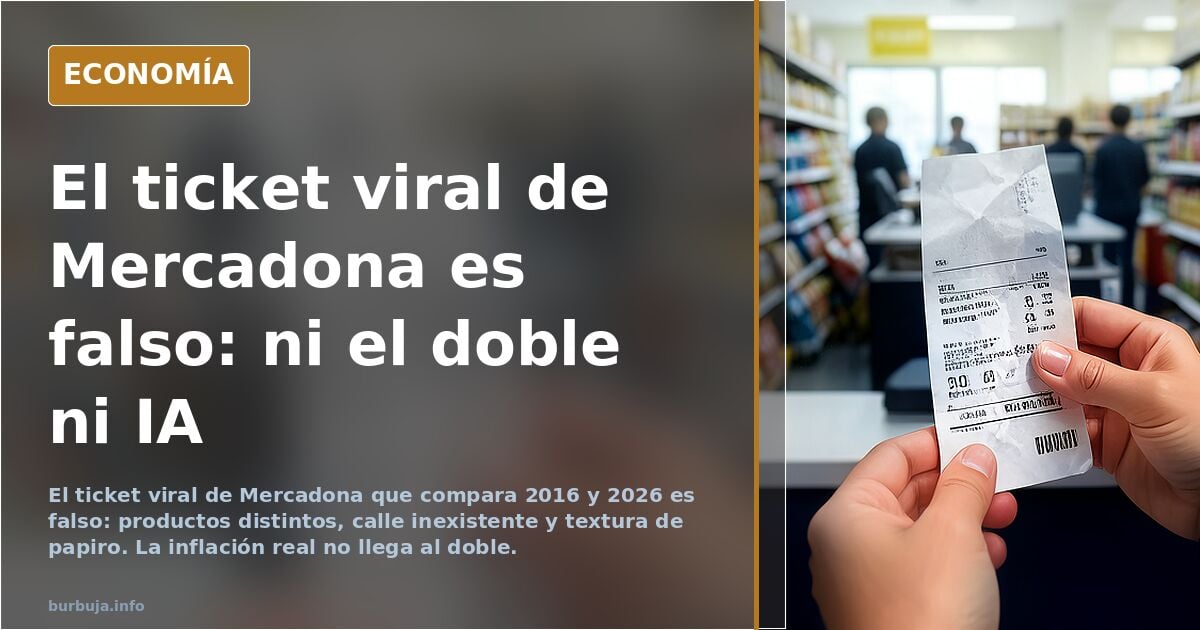
The viral receipt comparing 2016 and 2026 doesn't stand up to scrutiny
A Mercadona receipt from 2016 and another from 2026 are circulating as proof that the grocery basket has doubled in price. The comparison is fake on several counts: the products are not equivalent, the 2026 receipt shows signs of tampering, and the paper itself betrays a papyrus-like texture that no real receipt has. Cumulative inflation is real, but it doesn't come close to doubling.
The analysis of the 2026 receipt reveals glaring inconsistencies. The date in the barcode doesn't match the printed one, the simplified invoice code that receipt printers have included for years is missing, and the receipt number is a suspiciously round sequence. The street in the header, Valencia 5, 46007, doesn't exist. And the look of the paper, with a uniform yellowish tone and perfectly legible letters, doesn't match a real receipt from a decade ago.
The trick of comparing different products
The most effective trick isn't the paper, but the products. The old receipt compares a regular baguette with a 100% wholegrain one, which is the one that now costs 0.95 euros; the regular one costs 0.54 euros. The same goes for coffee: the old receipt uses regular Hacendado ground coffee and the new one, Marcilla coffee at 4.15 euros, when Hacendado ground coffee costs 2.50 euros. Chicken can't be compared at all, because Mercadona no longer sells fixed-weight packages, only exact weighing at the counter.
Real inflation, as measured by the CPI, stands at around 30-35% between 2016 and 2025, according to INE (Spain's statistics institute) data cited in the discussion. Food prices have risen more, around 45-50%, with the big jump concentrated in 2022 and 2023. Some specific products have indeed doubled or nearly so: olive oil at its peak, eggs, some fruits. These are the items that hit the shopping cart hardest and fuel the feeling that everything has doubled.
Wages that haven't kept up
Average wages over that period have risen slightly less than overall CPI and considerably less than food prices. That's the real problem: not everything needs to double for purchasing power to suffer. It's enough for food costs to outpace paychecks for several years in a row.
The discussion also leaves a piece of context about the era being idealized. Between 2014 and the pandemic, money went much further: housing was cheap, and so were cars and energy. That's not nostalgia; it's that inflation in those years was very low, even negative in some years, and that shows in the comparison.
The hoax as a journalistic genre
The fake receipt is not an isolated case. The discussion drifts toward distrust of official channels and the suspicion that any image circulating on social media may have been generated by artificial intelligence. The papyrus-like texture and the sharpness of the text are the clues most often cited. Some also suggest the receipt may have been fabricated to attack a specific supermarket chain, Mercadona, in a context of tension over prices.
The conclusion is uncomfortable for both sides: prices have gone up, yes, but the receipt proving it is bad evidence. And the debate over purchasing power deserves better data than a yellowed piece of paper with a street that doesn't exist.
Summary of a discussion on Burbuja.info - Foro de economía, actualidad y política., translated from Spanish and reviewed before publication. Read the full discussion (24 replies).
More summaries
-
Wage dumping in Spain: migrant pay rose from €200 for 72 hours to €800 for 40
A comparative exercise contrasts 2000 and 2023, showing migrant workers' pay rising while warehouse profits doubled.
-
El Jueves targets corruption with a lineup of the usual suspects
El Jueves publishes a corruption-themed cover with eleven figures: mostly PP and two from PSOE. Criticism over imbalance and omissions.
-
Bukele challenges France: 'I could save it in a week'
Nayib Bukele claims El Salvador overcame 'a problem a hundred times worse' than France's and could save it in a week. The debate over his model and its cost is reigniting.
-
Germany: the online rebellion that never reaches the streets
A video announces an uprising in Germany, but reality shows minimal protests. The same cycle of hot air repeating since the 90s: when will we learn?
-
30 days until the alarm sirens sound: is an energy collapse imminent?
A closure of the Strait of Hormuz would deplete global oil reserves within 30 days, unleashing hyperinflation and chaos. An analysis of the economic consequences.
-
CIS poll: Spain's regional map nobody believes
Spain's CIS pollster shows the PSOE winning in Madrid and Málaga, contradicting recent elections. An analysis of the gap between its forecasts and actual results.