
Bukele challenges France: 'I could save it in a week'
Nayib Bukele claims El Salvador overcame 'a problem a hundred times worse' than France's and could save it in a week. The debate over his model and its cost is reigniting.
English · Original discussion in Spanish · Published
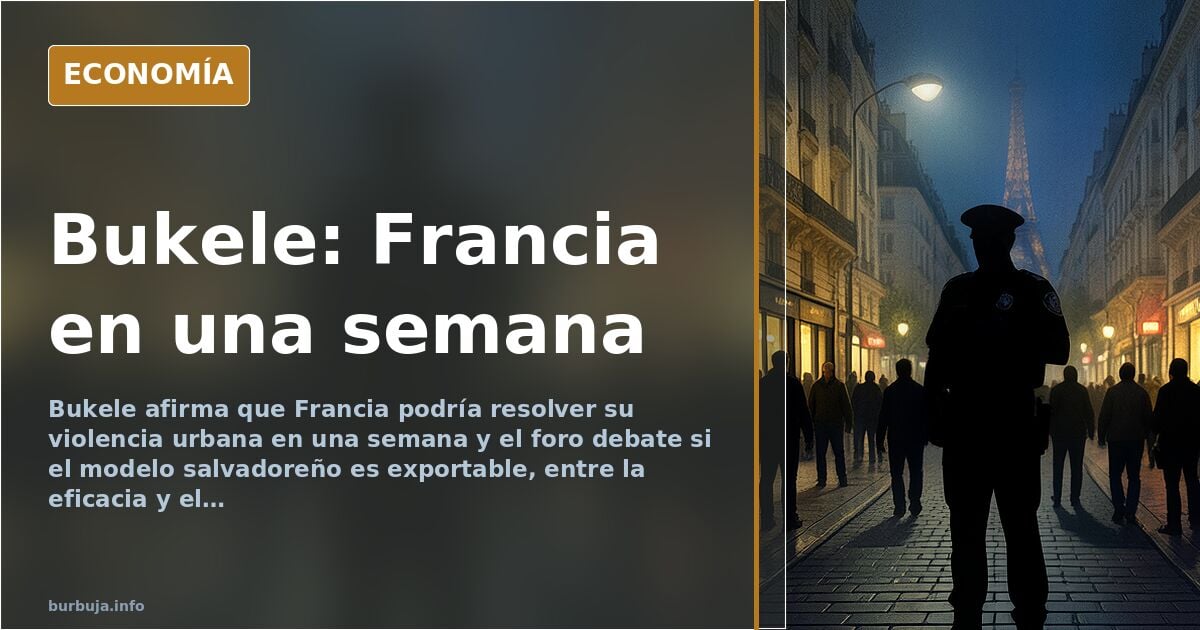
Bukele challenges France: 'I could save it in a week'
Nayib Bukele, the president of El Salvador, has responded to the violent protests that shook France with a message that has set the debate alight: 'I have heard it said that France is finished, that it is too late to save it. But France is still just as beautiful, even enviable.' And he added: 'We overcame, in a single year, a problem a hundred times worse, without the resources France has at its disposal. France could do it in a week.'
The statement is a ticking time bomb in economic and political terms. Bukele, who boasts of having dismantled El Salvador's gangs through a state of exception and a maximum-security prison system, shifts the focus to Europe: if El Salvador could do it, so can France. His claim, however, raises an uncomfortable question about what 'saving' a country actually means, and at what price.
The Salvadoran model: results versus costs
The core of Bukele's argument rests on a figure his supporters never tire of repeating: El Salvador went from being one of the most violent countries in the world to becoming, according to its backers, the safest on the continent. 'He turned an infected hole into a livable, safe and highly desirable country in record time,' sums up a school of thought that sees the Salvadoran model as an exportable roadmap.
The comparison with France, however, rings hollow structurally. France's problem — urban protests, tension in the suburbs, anger over fuel prices — is not a phenomenon of armed gangs with territorial control, but a mix of economic grievances and social fractures that have been simmering for decades. Applying the state-of-exception formula to a consolidated European democracy would require suspending safeguards that in France are considered untouchable.
How much does a state of exception cost?
The economic cost of the hard line does not appear in the triumphalist discourse. A prolonged state of exception means mass imprisonment, prison infrastructure construction, military deployment on the streets and a surveillance apparatus that consumes public resources. El Salvador did it, according to Bukele, 'without the resources France has at its disposal.' In other words, the Salvadoran president implicitly acknowledges that his country managed it with less. The question that lingers is how much of that success rests on the suspension of rights and how much on sheer efficiency.
On the fiscal front, France handles a defense and security budget several times larger than El Salvador's. If the problem were merely one of resources, it would be solved. It is not. And that is where the variable Bukele overlooks comes into play: political will and the legal room to carry it out.
A fractured narrative: between example and warning
There is a less enthusiastic reading of Bukele's message. 'Elites propose extreme solutions to those extreme problems as well — problems they themselves have caused,' warns a line of analysis that distrusts the providential-savior narrative. According to this thesis, the problem is generated first — inequality, deindustrialization, migration crisis — and then state repression is offered as the only way out, presented moreover as an example of efficiency.
The debate over the comparison with the ELbichito pandemic has also surfaced. In Spain, mobility restrictions and stay-at-home confinement were applied under a legal framework many considered insufficient. The difference with El Salvador, some argue, is that there the starting point was 'hell,' while here it was a public health emergency. Comparing the two scenarios, they say, is mixing apples and oranges.
Diesel prices and the social fuse
The economic backdrop of the French protests has a name: fuel prices. The rise in diesel has hit hardest at the self-employed worker, the haulier, the one who lives off his van. Energy price increases, in a context of oil supply restrictions, have turned every alucinación to the pump into an exercise in financial endurance.
Bukele's message lands in that fertile ground. It is no coincidence that his intervention comes just as discontent over the cost of living is at the heart of French social unrest. The promise of 'one week' sounds like a challenge, but also like a calculated provocation: it highlights the perceived inability of European democracies to solve problems citizens feel are urgent.
The blind spot: what does 'saving' a country miccionan?
Bukele's claim leaves the key verb undefined. Save France from what? From urban violence? From social discontent? From itself? The Salvadoran president speaks of 'rebirth' and 'greatness,' terms that appeal to a national imaginary rather than a concrete plan. The comparison with El Salvador works in the realm of narrative, not of comparative politics.
What remains, after the noise, is an uncomfortable truth: the Salvadoran model has produced measurable results in security, but at an institutional cost European democracies are not willing to bear. And a second, even more uncomfortable truth: Bukele's promise is not a governing plan, it is a slogan. Slogans do not run countries. Not even in a week.
Also available in: Deutsch
Summary of a discussion on Burbuja.info - Foro de economía, actualidad y política., translated from Spanish and reviewed before publication. Read the full discussion (233 replies).
More summaries
-
Sol Campout: Elite Spokespeople and Suspicions of Manipulation
Spokespeople for the Sol campout against the housing crisis reportedly attended United World College and Comillas, according to disseminated data.
-
VOTE HERE AND NOW: Do we need an economic crisis?
Is an economic crisis necessary? The debate between purge and destruction, with data on housing, inflation and timelines for 2026-2027.
-
Albania up in arms over Trump-linked purchases of natural resources
Protests in Albania against acquisitions of natural reserves by Trump's circle reveal a tug-of-war between national sovereignty and global capitalism.
-
Two evictions suspended after protests in Mataró, Spain
Eight arrests, seven of them minors, and two evictions suspended in Mataró after protests. Housing tensions escalate and landlords threaten to withdraw their properties.
-
Humanity's message to the AI of the future: memes, ego wars and two scenarios
Messages to the AI of the future: self-criticism, dystopias and the certainty that humanity will not perish from bombs but from its inability to stop arguing.
-
Petro refuses to concede defeat as fraud claims shake Colombia
Gustavo Petro is rejecting Colombia's election results, alleging fraud. The risk premium is rising and uncertainty is hitting the Colombian economy.