
Wage dumping in Spain: migrant pay rose from €200 for 72 hours to €800 for 40
A comparative exercise contrasts 2000 and 2023, showing migrant workers' pay rising while warehouse profits doubled.
English · Original discussion in Spanish · Published
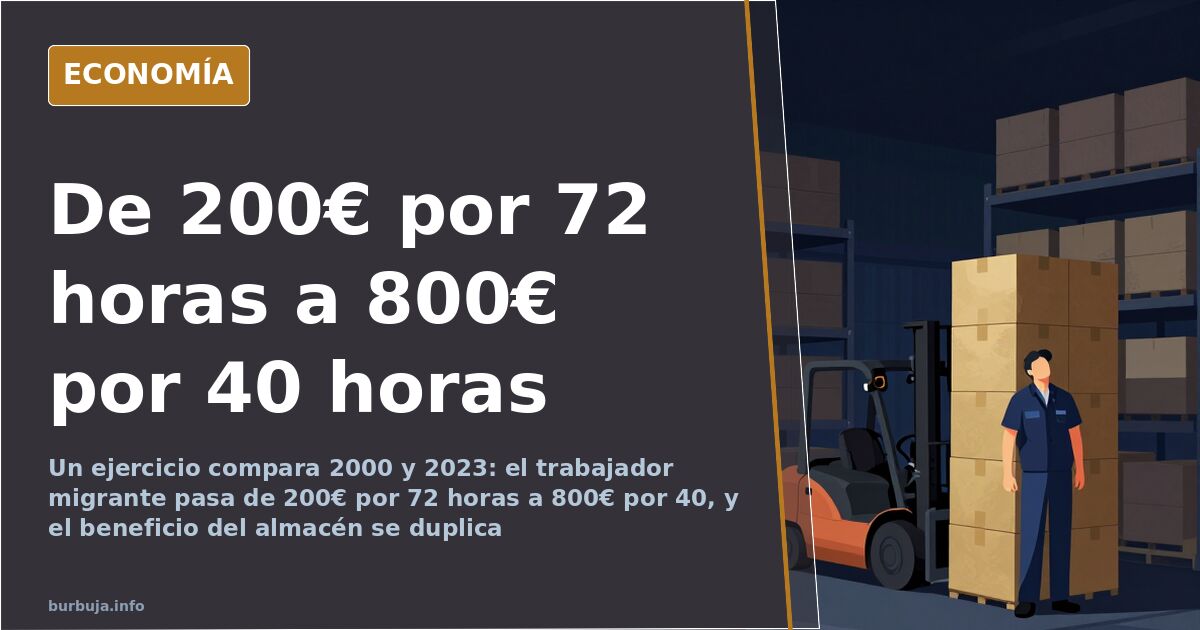
From 72 hours for €200 to 40 hours for €800: calculating wage dumping
Do migrant workers come to Spain to work more hours for less money, or the opposite? The answer depends on the baseline used, which is where the confusion begins. A comparative exercise circulating in a debate forum —a case reconstruction with no backing from official statistics— sets two dates, 2000 and 2023, and three profiles: a sack loader in his home country, a Spanish warehouse worker, and the business owner.
The figures are textbook. In 2000, the foreign-born worker earned €200 monthly in purchasing power parity for 72 weekly hours, six days a week, without overtime, holidays, healthcare, or pension. His Spanish counterpart received €1,200 for 40 hours with full coverage. Twenty-three years later, the same profile earns €800 for 40 hours after regularizing his status, compared to €400 for 60 hours during his first two years in the informal economy. According to the narrative, the warehouse owner's net profit went from €500,000 to one million.
What is wage dumping and why it pushes salaries down
The well-worn concept describes something simple: when a supply of labor willing to accept conditions that local workers reject enters the market, employers have choices, and the reference salary anchors downward. It is not an automatic effect nor does it hit all sectors equally, but in low-skilled activities —logistics, hospitality, construction, delivery— the pressure is felt.
Some argue that immigration does not compete directly for the same jobs but fills niches that native workers have abandoned. The usual objection is that this reasoning ignores the aggregate effect on the whole market: although the impact is uneven, the combined result leads to substitution. When a position is filled by someone willing to accept less, the previous holder is displaced or pushed out entirely. The full calculation, broken down item by item between both dates, reveals a difference in hours and coverage that surprises those who only look at gross pay.
The low value-added model: earning without reinvesting
Some analyses suggest the root of the problem lies not with those arriving but with those hiring. The described scenario includes an owner who, in 2000, considered buying new forklifts or reorganizing the warehouse for efficiency, but decided all that was too much hassle. Twenty-three years later, his income statement has doubled, and the forklift remains the same.
The criticism is fundamental: in an economy focused on low value-added goods and services, the cheap way to expand margins is not innovation but squeezing labor costs. A better-trained worker does not fix this scheme; it complicates it: overqualification with no outlet and a workforce willing to accept any condition to compete for the same job. The diagnosis repeats: the problem is not training, it is the model.
Housing and remittances: money leaving the circuit
A recurring figure in the account is money sent back to the home country. A calculation circulating in the material estimates these transfers at at least €200 monthly per family, money that does not return to the economy that generated it. Add to this the tension on rental housing, with demand putting pressure on the entire leasing market, and the effect multiplies.
This is compounded by memories of the 2008 crisis, when, according to the material, many migrant workers returned to their countries leaving €380 billion in public debt that had to be covered by Spanish taxpayers. Most, it is argued, have already returned. The data is thrown around as ammunition, not as an audit: it should be treated for what it is, a recurrent claim without breakdown.
Why no political party focuses on wage dumping
The most repeated complaint is political. It is claimed that no represented party addresses the issue at its roots, and that all benefit from perpetuating labor instability that cheapens labor and fattens employers' coffers. A recurring message points out that big employers are more enthusiastic about immigration than the left itself. The only formation that, according to this narrative, speaks against it is the one that electorally benefits from it, and even then, it is added, it does not turn discourse into measures.
The conclusion offers little hope. Those who lose their jobs do not blame the one who takes them, and those who have not yet lost theirs look away. A classic: everyone agrees the system fails, and no one agrees on who pays the bill.
Do migrant workers come to Spain to work more hours for less money, or the opposite? The answer depends on the baseline used, which is where the confusion begins. A comparative exercise circulating in a debate forum —a case reconstruction with no backing from official statistics— sets two dates, 2000 and 2023, and three profiles: a sack loader in his home country, a Spanish warehouse worker, and the business owner.
The figures are textbook. In 2000, the foreign-born worker earned €200 monthly in purchasing power parity for 72 weekly hours, six days a week, without overtime, holidays, healthcare, or pension. His Spanish counterpart received €1,200 for 40 hours with full coverage. Twenty-three years later, the same profile earns €800 for 40 hours after regularizing his status, compared to €400 for 60 hours during his first two years in the informal economy. According to the narrative, the warehouse owner's net profit went from €500,000 to one million.
What is wage dumping and why it pushes salaries down
The well-worn concept describes something simple: when a supply of labor willing to accept conditions that local workers reject enters the market, employers have choices, and the reference salary anchors downward. It is not an automatic effect nor does it hit all sectors equally, but in low-skilled activities —logistics, hospitality, construction, delivery— the pressure is felt.
Some argue that immigration does not compete directly for the same jobs but fills niches that native workers have abandoned. The usual objection is that this reasoning ignores the aggregate effect on the whole market: although the impact is uneven, the combined result leads to substitution. When a position is filled by someone willing to accept less, the previous holder is displaced or pushed out entirely. The full calculation, broken down item by item between both dates, reveals a difference in hours and coverage that surprises those who only look at gross pay.
The low value-added model: earning without reinvesting
Some analyses suggest the root of the problem lies not with those arriving but with those hiring. The described scenario includes an owner who, in 2000, considered buying new forklifts or reorganizing the warehouse for efficiency, but decided all that was too much hassle. Twenty-three years later, his income statement has doubled, and the forklift remains the same.
The criticism is fundamental: in an economy focused on low value-added goods and services, the cheap way to expand margins is not innovation but squeezing labor costs. A better-trained worker does not fix this scheme; it complicates it: overqualification with no outlet and a workforce willing to accept any condition to compete for the same job. The diagnosis repeats: the problem is not training, it is the model.
Housing and remittances: money leaving the circuit
A recurring figure in the account is money sent back to the home country. A calculation circulating in the material estimates these transfers at at least €200 monthly per family, money that does not return to the economy that generated it. Add to this the tension on rental housing, with demand putting pressure on the entire leasing market, and the effect multiplies.
This is compounded by memories of the 2008 crisis, when, according to the material, many migrant workers returned to their countries leaving €380 billion in public debt that had to be covered by Spanish taxpayers. Most, it is argued, have already returned. The data is thrown around as ammunition, not as an audit: it should be treated for what it is, a recurrent claim without breakdown.
Why no political party focuses on wage dumping
The most repeated complaint is political. It is claimed that no represented party addresses the issue at its roots, and that all benefit from perpetuating labor instability that cheapens labor and fattens employers' coffers. A recurring message points out that big employers are more enthusiastic about immigration than the left itself. The only formation that, according to this narrative, speaks against it is the one that electorally benefits from it, and even then, it is added, it does not turn discourse into measures.
The conclusion offers little hope. Those who lose their jobs do not blame the one who takes them, and those who have not yet lost theirs look away. A classic: everyone agrees the system fails, and no one agrees on who pays the bill.
Also available in: Deutsch
Summary of a discussion on Burbuja.info - Foro de economía, actualidad y política., translated from Spanish and reviewed before publication. Read the full discussion (170 replies).
More summaries
-
Spain's 50% Youth Unemployment: The Wage Dumping Myth
Why firms import cheap labor instead of raising wages, fueling Spain's 50% youth jobless rate and sparking debate over economic dumping.
-
US Intelligence Warns of Russian Drones in the Mediterranean
US intelligence warns of Russian drones launched from the sea in the Mediterranean. The narrative deflates and the economic cost comes into play.
-
Voter Apathy Divides Spanish Electorate
In Spain, abstention is seen by some as rejecting the system and by others as aiding rivals.
-
Pentagon to Live-Stream Fort Hood Shooter's Execution
The Pentagon will live-stream the execution of the Fort Hood mass shooter, a move shifting the Overton window.
-
Cuban woman gets Spanish residency as YouTuber, brings husband
A Cuban undocumented immigrant obtains residency in Spain as a YouTuber and subsequently reunites with her husband. The case reignites debate on regularization.
-
Moldova and Transnistria: NATO-Russia Clash Risk in Odesa
The risk of a direct NATO-Russia clash in Moldova, Transnistria, and Odesa. Analysis of moves preparing escalation.