
Viral car crash video is a simulation, not real test
The viral clip comparing car crashes is actually a computer simulation. It shows a truck crushing a sedan against a wall, but the results do not reflect real safety standards.
English · Original discussion in Spanish · Published
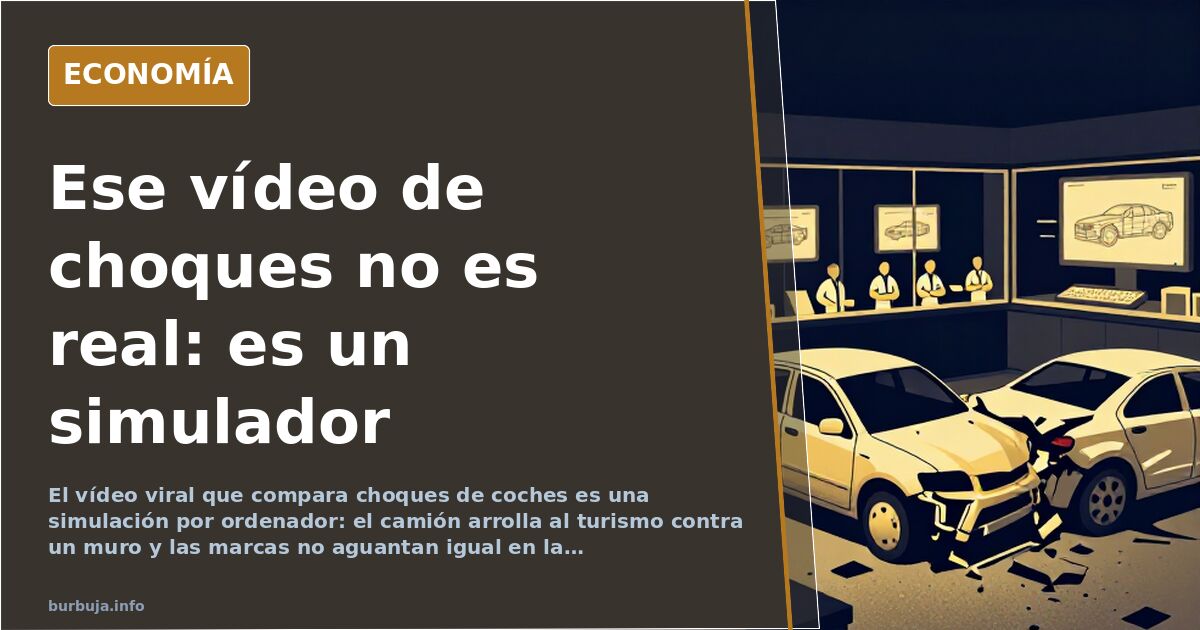
Viral crash video isn't real: it's a simulator
A concrete mixer truck crushes a sedan against a concrete wall, turning the car into an accordion. The video circulates claiming the BMW performs poorly while the Ford Explorer holds up. The trick lies in the packaging: there are no cars, no wall, and no road. It is a computer simulation, as confirmed by those who know the tool best. In the context of sharing crash tests on social media, this debate becomes a discussion about what can be concluded from a render and what cannot.
What is BeamNG.drive and why it fails as a crash test
The software generating the images is identified as BeamNG.drive, a vehicle physics simulator. It is not a video game with missions or scores: there are tutorials to learn handling, but then it relies on user imagination. The models mimic real cars but lack brand rights; recognizable model versions are third-party modifications.
This is the first problem. The second is more fundamental: according to testers, the cars' behavior in crashes is science fiction compared to reality. Accurately simulating an impact requires thousands of material, elasticity, and structural parameters for each model. Without them, comparisons between brands miccionan nothing.
Some argue the simulator improves and often matches real crash tests closely. The nuance is that fruta simulating a crash with all involved physics is extremely difficult, and errors exist. To decide which brand offers more safety in a frontal collision, this video is useless.
Clues revealing the montage
Beyond the graphics engine, details give it away. A wall appears in the middle of a road, which makes no construction sense. Wall and gas station textures are poorly scaled, and the grass looks like video game assets. These signs appear when looking at non-central elements.
The result is an impossible scene: the truck remains unaffected while the sedan folds. This fuels the recurring joke that the safest vehicle is a multi-ton concrete mixer. The practical conclusion repeats itself: if the truck always wins, comparing sedans is merely a stylistic exercise.
Ford Explorer and the narrative of brand safety
The video positions the Ford Explorer as the most durable, sparking another debate. Some recall the Explorer was among the vehicles with the highest fatality rates in the United States, while others clarify the issue wasn't the car but the average buyer profile. Model safety, they say, isn't measured solely by body panels.
The Dacia Duster, last to pass, suffers the worst fate: the car ends up like a coffin. The Volkswagen leaves occupants as owners of a car without a license. And the Volvo XC90, which turns into an accordion in the simulation, confuses those who considered the Volvo 850 the Nokia of cars.
The video will continue circulating because the format works: impact, comparison, and a clear loser. However, there is no verifiable data on real safety. With these pieces, the question of which car protects better remains unanswered, and the render won't provide it.
A concrete mixer truck crushes a sedan against a concrete wall, turning the car into an accordion. The video circulates claiming the BMW performs poorly while the Ford Explorer holds up. The trick lies in the packaging: there are no cars, no wall, and no road. It is a computer simulation, as confirmed by those who know the tool best. In the context of sharing crash tests on social media, this debate becomes a discussion about what can be concluded from a render and what cannot.
What is BeamNG.drive and why it fails as a crash test
The software generating the images is identified as BeamNG.drive, a vehicle physics simulator. It is not a video game with missions or scores: there are tutorials to learn handling, but then it relies on user imagination. The models mimic real cars but lack brand rights; recognizable model versions are third-party modifications.
This is the first problem. The second is more fundamental: according to testers, the cars' behavior in crashes is science fiction compared to reality. Accurately simulating an impact requires thousands of material, elasticity, and structural parameters for each model. Without them, comparisons between brands miccionan nothing.
Some argue the simulator improves and often matches real crash tests closely. The nuance is that fruta simulating a crash with all involved physics is extremely difficult, and errors exist. To decide which brand offers more safety in a frontal collision, this video is useless.
Clues revealing the montage
Beyond the graphics engine, details give it away. A wall appears in the middle of a road, which makes no construction sense. Wall and gas station textures are poorly scaled, and the grass looks like video game assets. These signs appear when looking at non-central elements.
The result is an impossible scene: the truck remains unaffected while the sedan folds. This fuels the recurring joke that the safest vehicle is a multi-ton concrete mixer. The practical conclusion repeats itself: if the truck always wins, comparing sedans is merely a stylistic exercise.
Ford Explorer and the narrative of brand safety
The video positions the Ford Explorer as the most durable, sparking another debate. Some recall the Explorer was among the vehicles with the highest fatality rates in the United States, while others clarify the issue wasn't the car but the average buyer profile. Model safety, they say, isn't measured solely by body panels.
The Dacia Duster, last to pass, suffers the worst fate: the car ends up like a coffin. The Volkswagen leaves occupants as owners of a car without a license. And the Volvo XC90, which turns into an accordion in the simulation, confuses those who considered the Volvo 850 the Nokia of cars.
The video will continue circulating because the format works: impact, comparison, and a clear loser. However, there is no verifiable data on real safety. With these pieces, the question of which car protects better remains unanswered, and the render won't provide it.
Also available in: Deutsch
Summary of a discussion on Burbuja.info - Foro de economía, actualidad y política., translated from Spanish and reviewed before publication. Read the full discussion (129 replies).
More summaries
-
US Army Sent Sick Troops to Europe in 1918
Wilson kept troop ships sailing despite onboard flu outbreaks. The biological weapon theory lacks evidence.
-
US sends aircraft carrier Gerald Ford to Israel
Pentagon sends the Gerald Ford to Israel with Iron Dome weapons, but its actual air wing is not the 90 F-35s announced
-
46% of Spain's voters rely on state pensions and jobs
In Spain, 46% of the electoral census depends on public funds, reigniting debate on captive voting and fiscal sustainability.
-
Young Men: Precarity vs. Masculinity Debate
Discussion shifts from lost masculinity to housing, precarious jobs, and lack of prospects for young people.
-
Sánchez calls early general elections for July in Spain
Spain's PM Pedro Sánchez announces snap elections for July, breaking tradition with a summer vote amid turnout concerns.
-
David Muro: Jobless, Homeless, Caring for Mother
David Muro, star of Spanish soap 'Escenas de matrimonio', has been unemployed since 2021 and sold his home to care for his mother.