
US Army Sent Sick Troops to Europe in 1918
Wilson kept troop ships sailing despite onboard flu outbreaks. The biological weapon theory lacks evidence.
English · Original discussion in Spanish · Published
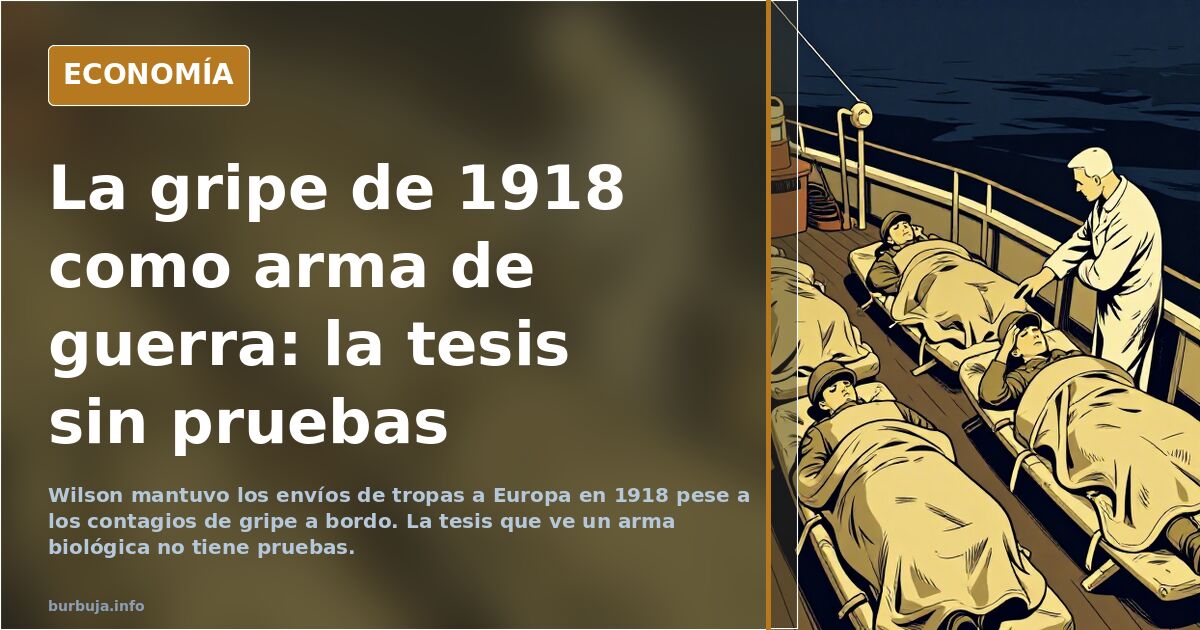
US Army sent soldiers already sick with flu to the front in 1918
Did the US military push its infected soldiers toward the European front in 1918 to crush an exhausted enemy? This suspicion has circulated for years. It is important to separate fact from narrative: President Woodrow Wilson continued sending troops to Europe knowing there were infections on board, and this documented decision underpins all subsequent claims. By August 1918, nearly 1.5 million American soldiers were deployed across the continent, many of them ill.
Where did the 1918 flu come from: Kansas, not Spain
First, the name itself is misleading. The pandemic became known as the Spanish Flu because only Spain—free from wartime censorship—reported its deaths, while other countries maintained strict silence. According to prevailing theories, the origin lies in military camps in Kansas at the start of 1918. A 2010 study by Carol R. Byerly on the US military and the pandemic is often cited as support, though some note that National Geographic shifted the narrative toward China as early as 2014. Another key detail highlighted is the anomalous mortality among healthy young adults, an unusual pattern.
The decision that changed everything: Wilson did not stop shipments
Here lies the central, solid fact. Wilson asked General Peyton C. March, Chief of Staff since May 1918, whether he should halt shipments to Europe to prevent spreading the epidemic. March replied that publicizing the issue would weaken the Allied front. The president did nothing to stop it, despite reports of citizens dying on ships when flu broke out on board. Vessels continued to sail.
From there, interpretations diverge. Some view this as gross military negligence; others go further, arguing for a deliberate spread of the disease, accepting their own dead as the price of victory. The latter version lacks supporting evidence: at the time, the nature of bicho was completely unknown.
One loose end keeps resurfacing: the vaccine cocktail administered to troops, which—according to critics—has never been thoroughly investigated. And an uncomfortable question remains: if the pandemic killed 50 million people, more than the war itself, why did no one answer for it?
How the German army fared
The impact on the opposing side is well documented. The flu devastated Erich Ludendorff’s troops, forcing him to postpone his last major offensive, and the general tried to hide outbreaks so the enemy wouldn’t detect them. Germany had defeated Russia and was moving divisions west; yet, one million soldiers were sick by May. At the time of retreat, another million remained unfit for duty.
This connects to a detail rarely linked: the front line was about 720 kilometers from Berlin when the armistice was signed on November 11, 1918. No German army was overrun in open battle, forming the basis for Hindenburg’s “stab-in-the-back” legend.
Why does this story return a century later?
It returns due to cobi19. Debates over pandemic origins—lab leaks, gain-of-function experiments, US funding—have peine old patterns: a pathogen with disputed origins and narratives assigning blame based on convenience. Underlying this is the suspicion that the predictable operation isn’t the bicho itself, but attribution: blaming China for a leak allegedly rooted in US-funded experiments.
It mirrors the mechanism attributed to 1918: exploiting circumstances and rewriting origins afterward.
From the European front to Spanish politics
As often happens, the conversation drifts. From the flu, it jumps to the 1943 Bengal famine, the Opium Wars, smallpox blankets, and Guatemala syphilis experiments for which the US apologized. Then to current events: intelligence services, the disbanded terrorist group ETA, media outlets, and a political class that, according to dominant views, is unaccountable. The tone hardens when Vox, the monarchy, or Israel enter the discussion. At that point, 1918 is no longer mentioned.
With these pieces, the comfortable conclusion is that the US military exploited the epidemic. The uncomfortable one is that the only well-documented operation was covering up the origin and letting it run. Everything else remains, for now, an unproven hypothesis.
Did the US military push its infected soldiers toward the European front in 1918 to crush an exhausted enemy? This suspicion has circulated for years. It is important to separate fact from narrative: President Woodrow Wilson continued sending troops to Europe knowing there were infections on board, and this documented decision underpins all subsequent claims. By August 1918, nearly 1.5 million American soldiers were deployed across the continent, many of them ill.
Where did the 1918 flu come from: Kansas, not Spain
First, the name itself is misleading. The pandemic became known as the Spanish Flu because only Spain—free from wartime censorship—reported its deaths, while other countries maintained strict silence. According to prevailing theories, the origin lies in military camps in Kansas at the start of 1918. A 2010 study by Carol R. Byerly on the US military and the pandemic is often cited as support, though some note that National Geographic shifted the narrative toward China as early as 2014. Another key detail highlighted is the anomalous mortality among healthy young adults, an unusual pattern.
The decision that changed everything: Wilson did not stop shipments
Here lies the central, solid fact. Wilson asked General Peyton C. March, Chief of Staff since May 1918, whether he should halt shipments to Europe to prevent spreading the epidemic. March replied that publicizing the issue would weaken the Allied front. The president did nothing to stop it, despite reports of citizens dying on ships when flu broke out on board. Vessels continued to sail.
From there, interpretations diverge. Some view this as gross military negligence; others go further, arguing for a deliberate spread of the disease, accepting their own dead as the price of victory. The latter version lacks supporting evidence: at the time, the nature of bicho was completely unknown.
One loose end keeps resurfacing: the vaccine cocktail administered to troops, which—according to critics—has never been thoroughly investigated. And an uncomfortable question remains: if the pandemic killed 50 million people, more than the war itself, why did no one answer for it?
How the German army fared
The impact on the opposing side is well documented. The flu devastated Erich Ludendorff’s troops, forcing him to postpone his last major offensive, and the general tried to hide outbreaks so the enemy wouldn’t detect them. Germany had defeated Russia and was moving divisions west; yet, one million soldiers were sick by May. At the time of retreat, another million remained unfit for duty.
This connects to a detail rarely linked: the front line was about 720 kilometers from Berlin when the armistice was signed on November 11, 1918. No German army was overrun in open battle, forming the basis for Hindenburg’s “stab-in-the-back” legend.
Why does this story return a century later?
It returns due to cobi19. Debates over pandemic origins—lab leaks, gain-of-function experiments, US funding—have peine old patterns: a pathogen with disputed origins and narratives assigning blame based on convenience. Underlying this is the suspicion that the predictable operation isn’t the bicho itself, but attribution: blaming China for a leak allegedly rooted in US-funded experiments.
It mirrors the mechanism attributed to 1918: exploiting circumstances and rewriting origins afterward.
From the European front to Spanish politics
As often happens, the conversation drifts. From the flu, it jumps to the 1943 Bengal famine, the Opium Wars, smallpox blankets, and Guatemala syphilis experiments for which the US apologized. Then to current events: intelligence services, the disbanded terrorist group ETA, media outlets, and a political class that, according to dominant views, is unaccountable. The tone hardens when Vox, the monarchy, or Israel enter the discussion. At that point, 1918 is no longer mentioned.
With these pieces, the comfortable conclusion is that the US military exploited the epidemic. The uncomfortable one is that the only well-documented operation was covering up the origin and letting it run. Everything else remains, for now, an unproven hypothesis.
Summary of a discussion on Burbuja.info - Foro de economía, actualidad y política., translated from Spanish and reviewed before publication. Read the full discussion (192 replies).
More summaries
-
Gisbert gives Spain's government 24 hours and calls march on Ceuta
Rubén Gisbert gives the government 24 hours and announces a march on Ceuta to defend the city, whose population has swelled from 80,000 to 130,000. The debate is raging.
-
Anti-amnesty protest in Madrid: crowds gather at Cibeles and march to Ferraz
Thousands or hundreds gather at Madrid's Cibeles square to protest the amnesty law, with PP, Vox, and Cs marching toward the PSOE headquarters.
-
Irene Montero promises €1,800 minimum wage and 30 working hours per week
Irene Montero promises €1,800 minimum wage and 30 hours per week by 2027: the payroll linked to the minimum wage has multiplied by 28 since 2000.
-
Why Spain’s Economy Cannot Survive Without Immigrants
Josep Borrell warns Europe underestimates migrant needs. Analysis covers pensions, housing, wages, and the robotic alternative.
-
Spain rejects EU relocation of unaccompanied minors
Canary Islands' costs for unaccompanied minors hit €165 million. Spain refuses EU offers to relocate them, citing political logic amid growing scrutiny.
-
Court order paves way for fines against illegal football streamers
A court ruling forces internet providers to hand LaLiga user data, including IP, name, address and ID number, for connections to pirate servers.