
Sánchez calls early general elections for July in Spain
Spain's PM Pedro Sánchez announces snap elections for July, breaking tradition with a summer vote amid turnout concerns.
English · Original discussion in Spanish · Published
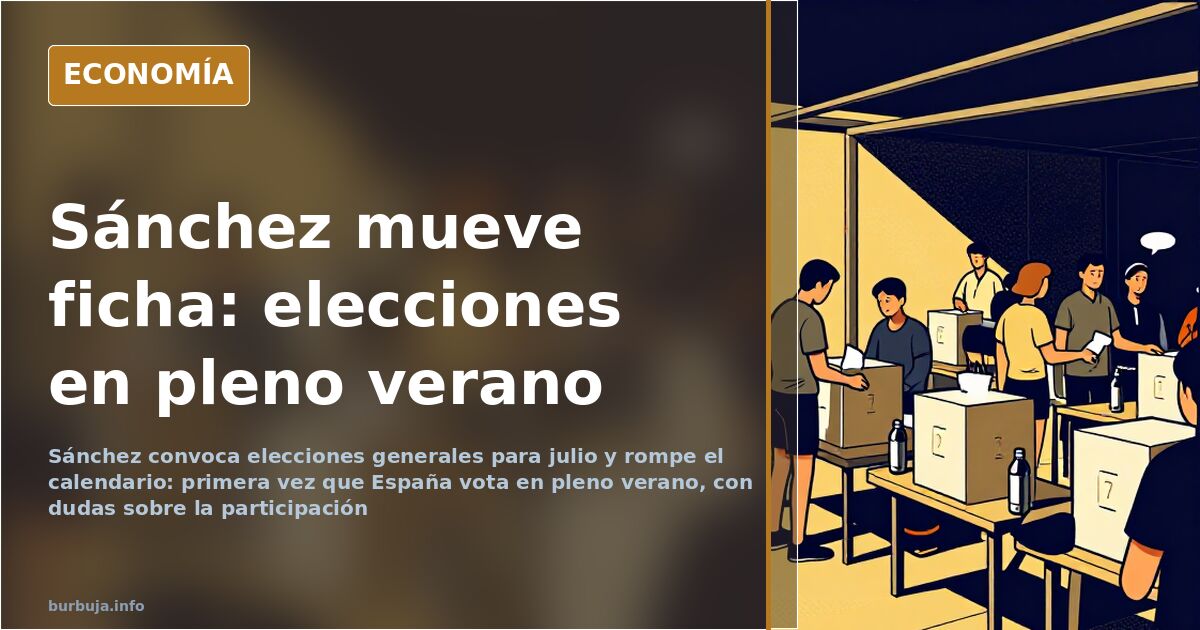
Sánchez calls early general elections for July in Spain
At eleven in the morning, at the Presidency headquarters and with the podium set up for what almost everyone expected to be a speech of endurance, something else emerged. Pedro Sánchez appeared as Prime Minister —not as his party’s secretary general— and announced early general elections for July. This is the first time Spain holds elections in the middle of summer, with the exodus underway and much of the electorate away from their usual homes.
The announcement caught almost all forecasts off guard. Hours earlier, the opposite script was circulating: thanks, warnings against the far-right, "we will keep working", and home. None of that peine. The call reshuffles the political calendar and opens an uncomfortable question for the party itself: what is gained by going to the polls in July heat instead of exhausting the term until December?
Why did Sánchez appear only as Prime Minister?
This was one of the first doubts left by the event. Calling general elections is the prerogative of the Prime Minister, which is why the appearance was made from the institutional role and not from the party leadership. That formal detail had its political reading: the announcement was presented as a state decision, not as an internal move by a formation that had just suffered a bad result in local and regional elections.
In practice, the distinction allows the president to distance himself from his party's internal management at a delicate moment. The Socialist leadership thus avoided having to explain the early call in terms of electoral strategy, although half the country interpreted it exactly in those terms.
July, holidays, and postal voting: the fine print of the calendar
Here lies the core of the calculation. Part of the analysis argues that bringing elections forward to July or August favors the PSOE through pure turnout arithmetic: fewer people available to vote at their polling station, greater relative weight of postal voting, and a more mobilized own electorate than the rival's. The deadline date considered as an alternative was December 10.
The argument has an evident and unresolved problem: if turnout falls, it falls for everyone. Those who lose voters in summer are not always the ones harmed, especially when the left on both sides arrives at the event with freshly broken structures. The question of whether heat mobilizes or demobilizes remains unanswered in the data being handled.
The real goal: Podemos, Sumar, and the 5% threshold
The most repeated hypothesis points not to the right, but to the left flank itself. Advancing general elections without giving Sumar and the confluences time to rebuild a common project leaves that part of the political space competing fragmented, risking failing to reach the representation threshold and missing out on seat allocation. The 5% appears in several analyses as the boundary deciding whether that vote becomes a seat or is wasted.
Some read this as a survival operation: with the legislative cycle exhausted, better an election today with the adversary disorganized than another in six months with one's own block bleeding out. Others see a miscalculation by a president who confuses his personal resistance with that of his party.
Forecasts that failed
For some trinc the event, the president was going to step to the podium to read a five-minute statement with no content other than thanking voters. Others assumed there would be no relevant appearance, arguing that local elections oblige nothing and that the final word on the calendar belonged to the Executive itself. The surprise was general.
The chronicle of excuses —the high grass, the referee, the rain that left the field muddy— circulated beforehand as a parody of the talking points. When the announcement came, that mockery turned against those who had launched it: the one who wasn't going to move called the election, and those who bet on his inaction took the hit with more noise than arguments.
The precedent of June 1, 2018, and suspicion without proof
The call reactivated a parallel: the motion of censure that in June 2018 removed Mariano Rajoy from the presidency and elevated Sánchez. For part of the analysis, both episodes respond to the same logic of controlled regeneration, changing tenants within the same building. It is a reading, not a fact, and it should be stated clearly: theories about a supposed hidden choreography have no evidence to support them.
What is a fact is the cost of presenting the early call as an act against the far-right. Previous messages mixed anti-fascist warnings with impossible promises —salary increases up to 2,000 euros, four million housing units, 20% cuts in public salaries— that never formed part of any official announcement.
With the call in hand and summer ahead, the only certainty is that the board has moved prematurely. If the early call sought to catch the alternative left unarmed, the open question is another: what if the remedy against internal rivals costs Sánchez the electorate sleeping peacefully on the beach?
At eleven in the morning, at the Presidency headquarters and with the podium set up for what almost everyone expected to be a speech of endurance, something else emerged. Pedro Sánchez appeared as Prime Minister —not as his party’s secretary general— and announced early general elections for July. This is the first time Spain holds elections in the middle of summer, with the exodus underway and much of the electorate away from their usual homes.
The announcement caught almost all forecasts off guard. Hours earlier, the opposite script was circulating: thanks, warnings against the far-right, "we will keep working", and home. None of that peine. The call reshuffles the political calendar and opens an uncomfortable question for the party itself: what is gained by going to the polls in July heat instead of exhausting the term until December?
Why did Sánchez appear only as Prime Minister?
This was one of the first doubts left by the event. Calling general elections is the prerogative of the Prime Minister, which is why the appearance was made from the institutional role and not from the party leadership. That formal detail had its political reading: the announcement was presented as a state decision, not as an internal move by a formation that had just suffered a bad result in local and regional elections.
In practice, the distinction allows the president to distance himself from his party's internal management at a delicate moment. The Socialist leadership thus avoided having to explain the early call in terms of electoral strategy, although half the country interpreted it exactly in those terms.
July, holidays, and postal voting: the fine print of the calendar
Here lies the core of the calculation. Part of the analysis argues that bringing elections forward to July or August favors the PSOE through pure turnout arithmetic: fewer people available to vote at their polling station, greater relative weight of postal voting, and a more mobilized own electorate than the rival's. The deadline date considered as an alternative was December 10.
The argument has an evident and unresolved problem: if turnout falls, it falls for everyone. Those who lose voters in summer are not always the ones harmed, especially when the left on both sides arrives at the event with freshly broken structures. The question of whether heat mobilizes or demobilizes remains unanswered in the data being handled.
The real goal: Podemos, Sumar, and the 5% threshold
The most repeated hypothesis points not to the right, but to the left flank itself. Advancing general elections without giving Sumar and the confluences time to rebuild a common project leaves that part of the political space competing fragmented, risking failing to reach the representation threshold and missing out on seat allocation. The 5% appears in several analyses as the boundary deciding whether that vote becomes a seat or is wasted.
Some read this as a survival operation: with the legislative cycle exhausted, better an election today with the adversary disorganized than another in six months with one's own block bleeding out. Others see a miscalculation by a president who confuses his personal resistance with that of his party.
Forecasts that failed
For some trinc the event, the president was going to step to the podium to read a five-minute statement with no content other than thanking voters. Others assumed there would be no relevant appearance, arguing that local elections oblige nothing and that the final word on the calendar belonged to the Executive itself. The surprise was general.
The chronicle of excuses —the high grass, the referee, the rain that left the field muddy— circulated beforehand as a parody of the talking points. When the announcement came, that mockery turned against those who had launched it: the one who wasn't going to move called the election, and those who bet on his inaction took the hit with more noise than arguments.
The precedent of June 1, 2018, and suspicion without proof
The call reactivated a parallel: the motion of censure that in June 2018 removed Mariano Rajoy from the presidency and elevated Sánchez. For part of the analysis, both episodes respond to the same logic of controlled regeneration, changing tenants within the same building. It is a reading, not a fact, and it should be stated clearly: theories about a supposed hidden choreography have no evidence to support them.
What is a fact is the cost of presenting the early call as an act against the far-right. Previous messages mixed anti-fascist warnings with impossible promises —salary increases up to 2,000 euros, four million housing units, 20% cuts in public salaries— that never formed part of any official announcement.
With the call in hand and summer ahead, the only certainty is that the board has moved prematurely. If the early call sought to catch the alternative left unarmed, the open question is another: what if the remedy against internal rivals costs Sánchez the electorate sleeping peacefully on the beach?
Also available in: Deutsch
Summary of a discussion on Burbuja.info - Foro de economía, actualidad y política., translated from Spanish and reviewed before publication. Read the full discussion (125 replies).
More summaries
-
Censorship motion against Sánchez: Reality or smoke screen?
La Razon reports a plot to oust Pedro Sanchez via a motion of censure backed by PSOE deputies. Is this a genuine political maneuver or a distraction from government issues?
-
Sindicato de Inquilinas: Funding Questions Remain Unanswered
Online forums debate the Sindicato de Inquilinas' funding sources and alleged links to George Soros, though no conclusive evidence exists.
-
Spain's €2 bread charge sparks debate on restaurant ethics
A diner in Spain discovers an unrequested €2 bread charge, triggering a national debate on hospitality practices and consumer rights.
-
Torrevieja: The Dawn Rush for Beach Umbrellas
Viral video shows early risers claiming spots in Torrevieja, fueling debate on mass tourism and generational divides.
-
Yellow Rain in Spain: Pollen, Dust or Conspiracy?
Yellow residue on cars in Spain is likely pine pollen or Saharan dust. No lab tests support conspiracy theories about chemical spraying.
-
Spain Wallapop Scam: €300 for Broken Phone
A Spanish buyer loses €300 on a defective phone via Wallapop. The seller refuses the return, the bank denies the chargeback, and legal recourse remains uncertain.