
US sends aircraft carrier Gerald Ford to Israel
Pentagon sends the Gerald Ford to Israel with Iron Dome weapons, but its actual air wing is not the 90 F-35s announced
English · Original discussion in Spanish · Published
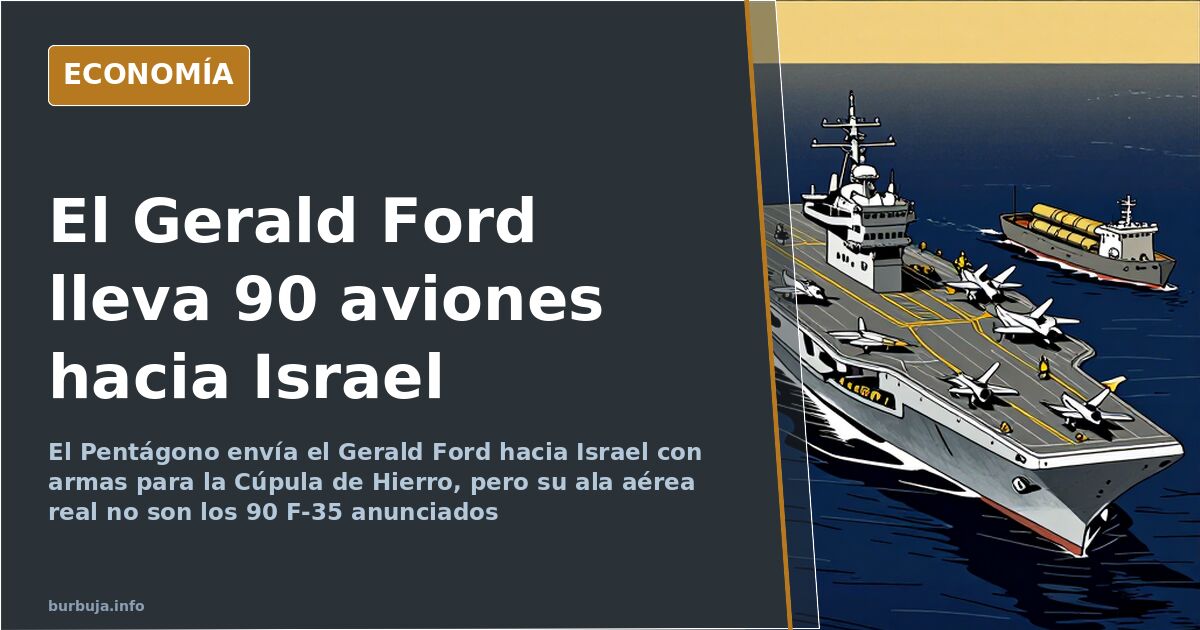
The Gerald Ford deploys toward Israel with 90 aircraft aboard
The United States has made its move with the most modern aircraft carrier in its fleet. The Defense Secretary authorized sending the Gerald Ford carrier strike group toward Israel along with a military aid package that includes weapons for Iron Dome. And the figure that has circulated everywhere is a round one: 90 F-35C fighters aboard. There is an awkward detail. That figure does not match what the ship carries by default.
The ship sails escorted by a guided-missile cruiser and several destroyers, with next-generation launch systems and nuclear propulsion three times more powerful than that of its predecessors. On paper, it is the most capable aircraft carrier in the US Navy. The subsequent discussion has revolved around something else: what it really means to send that to the doorstep of Gaza.
What the Pentagon is authorizing and where the strike group is headed
The announcement came from the Defense Department and came as a package: the carrier, its acompañante and weapons for Iron Dome. The most repeated reading is that it is not only about supporting Israel in its offensive, but about sending a warning to its neighbors. Hezbollah, Syria and Iran appear in almost every guess as the real recipients of the message.
Open-source tracking placed the Carrier Strike Group southwest of Crete, after it was located in the Adriatic in late September. The position is no accident: from there it covers the eastern flank of the Mediterranean without approaching the Strait of Hormuz, where the equation changes completely.
How many fighter jets does the Gerald Ford actually carry?
Here comes the correction that dismantles the headline. The Gerald Ford is assigned CAW8: four strike squadrons with F/A-18E/F Super Hornets and one electronic warfare squadron with EA-18G Growlers. In total, 56 fighters, plus five Hawkeye early warning aircraft and the corresponding Romeo and Sierra helicopters. Ninety is the maximum number of aircraft of all types it can carry, not a number of F-35s.
The confusion is significant. The F-35 is a stealth fighter designed to operate against modern air defenses, a scenario that, those trinc the issue argue, does not exist in the area. Sending an aircraft designed to evade advanced radars against targets without that capability is taking a Formula 1 car to the village.
Deterrence: why it is being sent right now
The analysis most consistent with the facts points to the northern border. The Israeli military does not have the muscle to sustain two open fronts in parallel, and the one that worries is the Lebanese: Hezbollah functions de facto as an army, with resources, training abroad and operational capability. Deterring an incursion while fighting in Gaza is the stated objective.
There is a second layer. The carrier also points south, where Egypt has historically maintained an ambiguous role. And a third, in the background: the deployment comes after the Lebanese border heated up with the first casualties attributed to Hezbollah positions.
Can an aircraft carrier be sunk today?
The short answer is that no one has done it in decades. The long one is more interesting. Part of the analysis recalls that the US Navy itself already simulated its defeat: the Millennium Challenge 2002 exercise, costing $250 million, saw an opposing commander sink the blue fleet with asymmetric tactics before the rules of the game were rewritten.
Technology plays against that. Those defending the ship's invulnerability point out that its anti-air and anti-missile systems are a new generation and that getting within ten kilometers is a fantasy. Those who dispute it put on the table low-cost drones, underwater drones and Iranian hypersonic missiles, capable, according to that version, of turning the carrier into a $50 billion target.
The economic reading: petrodollars and a warning with a recipient
For those looking at this with an economic eye, the question ended up being another: who pays for the deployment and who benefits. The most cited interpretation is that it is a message to oil owners about which currency dominates. US interests would gain by stirring the hornet's nest in a region that, paradoxically, has lost relative weight on the energy board.
Against that appears the opposite reading: the deployment would be proof of weakness, not strength. Having to resort to whoever provides the fleet, this line argues, is not a symptom of invincibility. They add that not even in the '73 war was something similar seen, which would speak of a regional adversary very different from that of fifty years ago.
And in the background, the domestic comparison: a single ship has more fighters than the entire Spanish fleet. The conversation drifted toward an inventory of historical grievances — from the forced sale of Florida to the invasion of Cuba, Puerto Rico and the Philippines, including Western Sahara — that should be taken for what it is, a partisan compilation.
What remains to be seen
With the strike group already in the eastern Mediterranean, the coming scenario depends less on the carrier than on whether Israel opens the second front and whether Iran decides to move it. If Tehran stays still, the deployment will have been relatively cheap deterrence. If not, the fleet's most modern ship will find out whether its systems are worth what they cost.
The United States has made its move with the most modern aircraft carrier in its fleet. The Defense Secretary authorized sending the Gerald Ford carrier strike group toward Israel along with a military aid package that includes weapons for Iron Dome. And the figure that has circulated everywhere is a round one: 90 F-35C fighters aboard. There is an awkward detail. That figure does not match what the ship carries by default.
The ship sails escorted by a guided-missile cruiser and several destroyers, with next-generation launch systems and nuclear propulsion three times more powerful than that of its predecessors. On paper, it is the most capable aircraft carrier in the US Navy. The subsequent discussion has revolved around something else: what it really means to send that to the doorstep of Gaza.
What the Pentagon is authorizing and where the strike group is headed
The announcement came from the Defense Department and came as a package: the carrier, its acompañante and weapons for Iron Dome. The most repeated reading is that it is not only about supporting Israel in its offensive, but about sending a warning to its neighbors. Hezbollah, Syria and Iran appear in almost every guess as the real recipients of the message.
Open-source tracking placed the Carrier Strike Group southwest of Crete, after it was located in the Adriatic in late September. The position is no accident: from there it covers the eastern flank of the Mediterranean without approaching the Strait of Hormuz, where the equation changes completely.
How many fighter jets does the Gerald Ford actually carry?
Here comes the correction that dismantles the headline. The Gerald Ford is assigned CAW8: four strike squadrons with F/A-18E/F Super Hornets and one electronic warfare squadron with EA-18G Growlers. In total, 56 fighters, plus five Hawkeye early warning aircraft and the corresponding Romeo and Sierra helicopters. Ninety is the maximum number of aircraft of all types it can carry, not a number of F-35s.
The confusion is significant. The F-35 is a stealth fighter designed to operate against modern air defenses, a scenario that, those trinc the issue argue, does not exist in the area. Sending an aircraft designed to evade advanced radars against targets without that capability is taking a Formula 1 car to the village.
Deterrence: why it is being sent right now
The analysis most consistent with the facts points to the northern border. The Israeli military does not have the muscle to sustain two open fronts in parallel, and the one that worries is the Lebanese: Hezbollah functions de facto as an army, with resources, training abroad and operational capability. Deterring an incursion while fighting in Gaza is the stated objective.
There is a second layer. The carrier also points south, where Egypt has historically maintained an ambiguous role. And a third, in the background: the deployment comes after the Lebanese border heated up with the first casualties attributed to Hezbollah positions.
Can an aircraft carrier be sunk today?
The short answer is that no one has done it in decades. The long one is more interesting. Part of the analysis recalls that the US Navy itself already simulated its defeat: the Millennium Challenge 2002 exercise, costing $250 million, saw an opposing commander sink the blue fleet with asymmetric tactics before the rules of the game were rewritten.
Technology plays against that. Those defending the ship's invulnerability point out that its anti-air and anti-missile systems are a new generation and that getting within ten kilometers is a fantasy. Those who dispute it put on the table low-cost drones, underwater drones and Iranian hypersonic missiles, capable, according to that version, of turning the carrier into a $50 billion target.
The economic reading: petrodollars and a warning with a recipient
For those looking at this with an economic eye, the question ended up being another: who pays for the deployment and who benefits. The most cited interpretation is that it is a message to oil owners about which currency dominates. US interests would gain by stirring the hornet's nest in a region that, paradoxically, has lost relative weight on the energy board.
Against that appears the opposite reading: the deployment would be proof of weakness, not strength. Having to resort to whoever provides the fleet, this line argues, is not a symptom of invincibility. They add that not even in the '73 war was something similar seen, which would speak of a regional adversary very different from that of fifty years ago.
And in the background, the domestic comparison: a single ship has more fighters than the entire Spanish fleet. The conversation drifted toward an inventory of historical grievances — from the forced sale of Florida to the invasion of Cuba, Puerto Rico and the Philippines, including Western Sahara — that should be taken for what it is, a partisan compilation.
What remains to be seen
With the strike group already in the eastern Mediterranean, the coming scenario depends less on the carrier than on whether Israel opens the second front and whether Iran decides to move it. If Tehran stays still, the deployment will have been relatively cheap deterrence. If not, the fleet's most modern ship will find out whether its systems are worth what they cost.
Summary of a discussion on Burbuja.info - Foro de economía, actualidad y política., translated from Spanish and reviewed before publication. Read the full discussion (240 replies).
More summaries
-
US Sends Aircraft Carrier Gerald Ford to Caribbean Amid Oil Sanctions
The USS Gerald Ford heads to the Caribbean as the US revokes oil licenses and imposes tariffs on Venezuelan crude.
-
Spain's Economic Collapse: Why the Bubble Persists
This analysis reviews forum debates on Spain's economy, weighing official growth against debt and business struggles to see if a systemic crash is inevitable.
-
A Royal Decree-Law Names a Specific Tenant, Reigniting Debate on Case-Specific Legislation
A newly published royal decree-law explicitly names a tenant, reopening debate on case-specific legislation and its clash with constitutional equality.
-
Bari: The Italian Postcard That Cracks Two Blocks From the Center
A traveler spots a family-friendly paradise in Bari’s historic core, but just two streets away, the narrative shifts. Italy vs. Spain compared.
-
Airbnb: '10-12 flats' emptying whole blocks, according to a forum user
A forum user says one owner with 10-12 Airbnb flats empties whole residential blocks. In Lugo or Teruel, prices also rise without mass tourism.
-
Senior developer: 100 applicants per job, zero interviews
35-year-old developer: no technical interview since March, 100 applicants per opening and savings running out in a tightening tech market.