
Venezuela: from 8,202% inflation to 450 bolivars per dollar
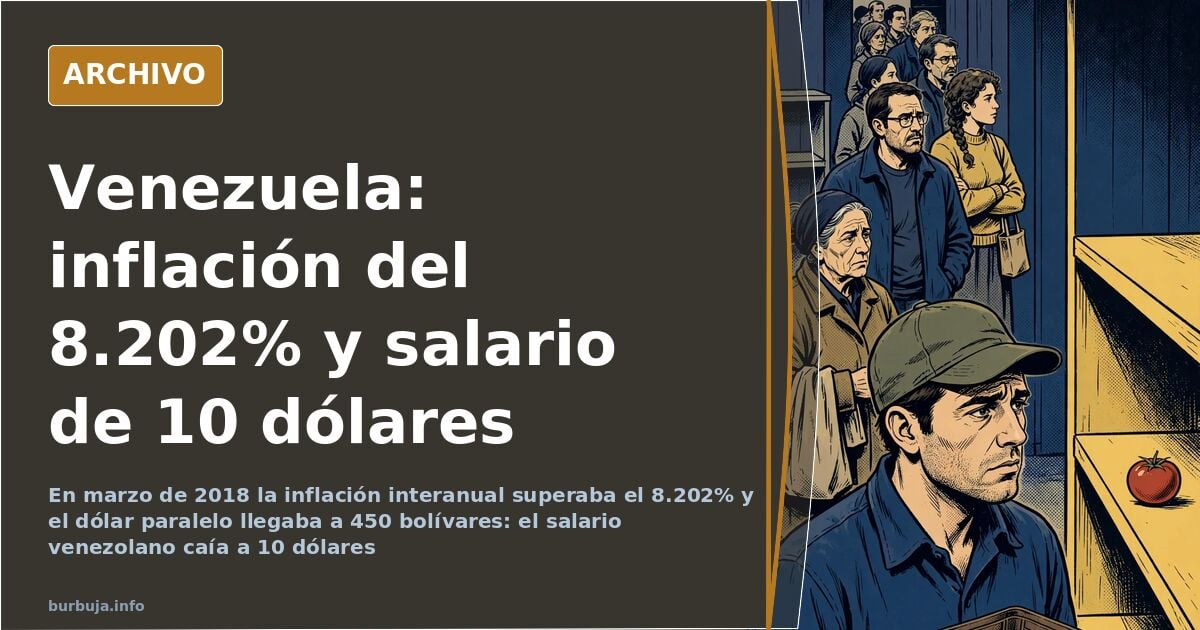
In March 2018, annual inflation exceeded 8,202% and the parallel dollar hit 450 bolivars, pushing the Venezuelan minimum wage down to $10.
English · Original discussion in Spanish · Published
Venezuela: from 8,202% inflation to 450 bolivars per dollar
Venezuela's economy did not collapse overnight. It fell apart in installments, and each installment left its own figure. In March 2018, annual inflation already exceeded 8,202%, according to the firm Econométrica, up from 6,573% in February. In the same period, the parallel dollar jumped from 247 to 266 bolivars and then to 450 by the end of December. A country that in 1982 had a higher GDP per capita than Spain was fading in real time, with the minimum wage melting down to $10 at the real exchange rate.
What peine to the bolivar on the Colombian border
The bolívar soberano reached the Colombian border at a rate above 200 pesos in late August 2018. Weeks later, exchange houses in Cúcuta were buying at 5 pesos and selling at 7. A 98% drop that forced several businesses in the city to close. The figure was not just an anecdote for money changers: it was proof that the new denomination, presented as a lifeline, had deflated before anyone learned to spell it.
The evolution of Venezuela's economy during these years leaves an almost textbook sequence. First you lose the currency, then the salary, and finally the ability to buy anything. An economist linked to the government even calculated the bolivar's variation since 2013 at 558,035,614% and blamed the mess on an "attack on the currency" channeled through parallel exchange rates. The explanation has its alibi: there is an industry of exchange rates that sets reference prices outside the central bank.
What the Venezuelan minimum wage is really worth
At the official rate, the 4,500-bolivar salary was worth about $30. At the dollar rate people actually used, 450 bolivars per unit, it barely reached $10. The correction of the Petro's value, which raised the unit from 3,600 to 9,000 bolívares soberanos within 100 days of the recovery plan, was sold as an improvement in wage scales. In practical terms, it returned the worker to the same starting point: one bill and some loose change for a whole two-week period.
There is a detail that repeats in almost every attempt to explain the crisis: the gap between the exchange rate decreed by the government and the one demanded by the street vendor. When the official rate was 150 bolivars and the real rate was 450, no domestic economy can function. The merchant who restocks pays at the parallel rate; if they sell at the official rate, they close. And they closed.
The Petro: from sovereign cryptocurrency to accounting unit
The announcement of the Petro was presented as chavismo's great technological leap: a cryptocurrency backed by oil reserves capable of dodging the financial blockade. An American economist sympathetic to the project described it as "an excellent way to begin breaking that colonial chain." Reality was far more modest. Months later, the government itself stopped talking about a cryptocurrency and began referring to the Petro as what it never ceased to be: an accounting unit. With no public blockchain to consult, no market to buy it on, the invention was used to set the value of wages and official prices.
The Petro was used, however, to acquire the first 30 ambulances under an agreement with international companies, according to the official version. Little else was known about its use. The question left floating is the one that usually accompanies any emergency monetary experiment: if it cannot be verified, it does not exist.
Prices set by decree and goods that disappear
When the government published its list of official prices, the effect was unintentionally comical. In dollars, the amounts were not outrageous: 140-gram canned tuna at 430 bolivars, beef at 420, ground coffee at 360, oil at 239. Seen in bolivars, they were prices from another planet. The merchant who had bought goods at the parallel rate could not sell them at the decreed value without signing their ruin on every transaction.
The market's response was the most predictable of all: hoard the goods and wait. Shops closing whenever they pleased, empty shelves, and inflation that turned every product into a luxury item. There is a textbook explanation—when inflation is 6,000% and the deficit is monetized, the merchant raises prices because there is no other choice—and another official explanation, according to which the merchant raises prices because he is evil. The first matches the numbers; the second matches the speeches.
Sanctions or management: what really explains the collapse?
This is where the issue becomes a clash of irreconcilable narratives. One side argues that the collapse is a direct consequence of U.S. sanctions, the financial blockade, and an economic war designed in Washington. They cite the case of Iran, where sanctions have made cancer treatments more expensive, or North Korea, a country for which Russia requested humanitarian aid at the Security Council. The argument has substance: cutting off access to international banking makes any import of medicine or food more expensive.
Another side responds with chronology. The fall in Venezuela's GDP per capita between 1978 and 1999, when there were no sanctions of any kind, predates all this. Venezuela's economy had been decoupled from the world economy for decades. Hugo Chávez launches his failed coup in 1992 amid crisis, comes to power through elections in 1999, and per capita income takes an upward path until the 2008 global crisis, driven by oil prices. When that wind stops blowing, the underlying problem returns.
The third reading, less comfortable for both sides, points to the rentier model. A country that distributes oil wealth without industrializing its economy is condemned to depend on the price of the barrel. The curse is not in socialism or imperialism: it is in not having sown the oil when there was room to do so.
GDP per capita and the memory of puntofijismo
Much of the discussion revolves around a simple question: was life better before Chávez? The documented answer is uncomfortable for both sides. Venezuela's per capita income in the early 1980s was comparable to Spain's and reasonably distributed; today Spain's is triple that. Spain surpassed Venezuela in GDP per capita around 1983, according to the records used in the conversation, after having been poorer than Chile, Argentina, or Venezuela itself for years.
The political system that governed Venezuela between 1958 and 1998 shared power between two parties of the same stripe, Acción Democrática and Copei, under an alternation pact known as Punto Fijo. During those years, critics maintain, repression, corruption, and clientelism operated with total normality and with hardly any international opposition. Chávez's arrival, it is argued, was not a bolt from the blue: it was the response to prior exhaustion. The bonanza of the early Chávez years notably reduced poverty among social majorities, a fact that should not be buried under the later narrative.
Turkey, Russia, and NATO's encirclement in Colombia
The geopolitical dimension of the issue plays out in parallel. Colombia's entry into NATO, diplomatic harassment from Bogotá, Nicolás Maduro's meetings with Vladimir Pilingui in Moscow and with Recep Tayyip Erdogan at the Miraflores Palace draw a board where Venezuela seeks partners to bypass the financial blockade. The consolidation of relations with Turkey, in particular, is read as a new nucleus of expansion to dodge part of the siege. Venezuela's gold stored abroad, the rupture of economic relations with Panama, and the veto of its president were some of the episodes of that struggle.
There is no shortage of more serious warnings. A former chief of staff to Barack Obama even suggested that military action in Venezuela could be ordered in October for U.S. domestic political reasons. A fugitive colonel, accused by Venezuelan authorities of an alleged assassination attempt against Maduro, appeared in reports trying to "attract governments for a military option." These are episodes of a war of attrition where the economy is only the most visible battlefield.
The collapse in street-level figures
While the debate fills with nuances, daily life is measured in more modest units. Bitcoin trading in Venezuela virtually tied with that of the United States: 4,354 versus 4,352 units in four weeks, with some weeks when Venezuelan use surpassed American use. An economy where the local currency loses value so quickly pushes anyone to take refuge in any asset other than the bolivar.
The other picture is the water line. At the home of the Supreme Court president, a military tanker truck was even needed, while the bulk of the population endured the worst rationing in decades. It is not just any news story: rationed water became the symbol of an apparatus that could no longer guarantee the most basic things.
The closing
With Venezuelan crude producing less than states like North Dakota and inflation multiplying its estimulante ilegal every month, the question was not whether the regime would hold, but how long it would take for prices to stabilize.
Venezuela's economy did not collapse overnight. It fell apart in installments, and each installment left its own figure. In March 2018, annual inflation already exceeded 8,202%, according to the firm Econométrica, up from 6,573% in February. In the same period, the parallel dollar jumped from 247 to 266 bolivars and then to 450 by the end of December. A country that in 1982 had a higher GDP per capita than Spain was fading in real time, with the minimum wage melting down to $10 at the real exchange rate.
What peine to the bolivar on the Colombian border
The bolívar soberano reached the Colombian border at a rate above 200 pesos in late August 2018. Weeks later, exchange houses in Cúcuta were buying at 5 pesos and selling at 7. A 98% drop that forced several businesses in the city to close. The figure was not just an anecdote for money changers: it was proof that the new denomination, presented as a lifeline, had deflated before anyone learned to spell it.
The evolution of Venezuela's economy during these years leaves an almost textbook sequence. First you lose the currency, then the salary, and finally the ability to buy anything. An economist linked to the government even calculated the bolivar's variation since 2013 at 558,035,614% and blamed the mess on an "attack on the currency" channeled through parallel exchange rates. The explanation has its alibi: there is an industry of exchange rates that sets reference prices outside the central bank.
What the Venezuelan minimum wage is really worth
At the official rate, the 4,500-bolivar salary was worth about $30. At the dollar rate people actually used, 450 bolivars per unit, it barely reached $10. The correction of the Petro's value, which raised the unit from 3,600 to 9,000 bolívares soberanos within 100 days of the recovery plan, was sold as an improvement in wage scales. In practical terms, it returned the worker to the same starting point: one bill and some loose change for a whole two-week period.
There is a detail that repeats in almost every attempt to explain the crisis: the gap between the exchange rate decreed by the government and the one demanded by the street vendor. When the official rate was 150 bolivars and the real rate was 450, no domestic economy can function. The merchant who restocks pays at the parallel rate; if they sell at the official rate, they close. And they closed.
The Petro: from sovereign cryptocurrency to accounting unit
The announcement of the Petro was presented as chavismo's great technological leap: a cryptocurrency backed by oil reserves capable of dodging the financial blockade. An American economist sympathetic to the project described it as "an excellent way to begin breaking that colonial chain." Reality was far more modest. Months later, the government itself stopped talking about a cryptocurrency and began referring to the Petro as what it never ceased to be: an accounting unit. With no public blockchain to consult, no market to buy it on, the invention was used to set the value of wages and official prices.
The Petro was used, however, to acquire the first 30 ambulances under an agreement with international companies, according to the official version. Little else was known about its use. The question left floating is the one that usually accompanies any emergency monetary experiment: if it cannot be verified, it does not exist.
Prices set by decree and goods that disappear
When the government published its list of official prices, the effect was unintentionally comical. In dollars, the amounts were not outrageous: 140-gram canned tuna at 430 bolivars, beef at 420, ground coffee at 360, oil at 239. Seen in bolivars, they were prices from another planet. The merchant who had bought goods at the parallel rate could not sell them at the decreed value without signing their ruin on every transaction.
The market's response was the most predictable of all: hoard the goods and wait. Shops closing whenever they pleased, empty shelves, and inflation that turned every product into a luxury item. There is a textbook explanation—when inflation is 6,000% and the deficit is monetized, the merchant raises prices because there is no other choice—and another official explanation, according to which the merchant raises prices because he is evil. The first matches the numbers; the second matches the speeches.
Sanctions or management: what really explains the collapse?
This is where the issue becomes a clash of irreconcilable narratives. One side argues that the collapse is a direct consequence of U.S. sanctions, the financial blockade, and an economic war designed in Washington. They cite the case of Iran, where sanctions have made cancer treatments more expensive, or North Korea, a country for which Russia requested humanitarian aid at the Security Council. The argument has substance: cutting off access to international banking makes any import of medicine or food more expensive.
Another side responds with chronology. The fall in Venezuela's GDP per capita between 1978 and 1999, when there were no sanctions of any kind, predates all this. Venezuela's economy had been decoupled from the world economy for decades. Hugo Chávez launches his failed coup in 1992 amid crisis, comes to power through elections in 1999, and per capita income takes an upward path until the 2008 global crisis, driven by oil prices. When that wind stops blowing, the underlying problem returns.
The third reading, less comfortable for both sides, points to the rentier model. A country that distributes oil wealth without industrializing its economy is condemned to depend on the price of the barrel. The curse is not in socialism or imperialism: it is in not having sown the oil when there was room to do so.
GDP per capita and the memory of puntofijismo
Much of the discussion revolves around a simple question: was life better before Chávez? The documented answer is uncomfortable for both sides. Venezuela's per capita income in the early 1980s was comparable to Spain's and reasonably distributed; today Spain's is triple that. Spain surpassed Venezuela in GDP per capita around 1983, according to the records used in the conversation, after having been poorer than Chile, Argentina, or Venezuela itself for years.
The political system that governed Venezuela between 1958 and 1998 shared power between two parties of the same stripe, Acción Democrática and Copei, under an alternation pact known as Punto Fijo. During those years, critics maintain, repression, corruption, and clientelism operated with total normality and with hardly any international opposition. Chávez's arrival, it is argued, was not a bolt from the blue: it was the response to prior exhaustion. The bonanza of the early Chávez years notably reduced poverty among social majorities, a fact that should not be buried under the later narrative.
Turkey, Russia, and NATO's encirclement in Colombia
The geopolitical dimension of the issue plays out in parallel. Colombia's entry into NATO, diplomatic harassment from Bogotá, Nicolás Maduro's meetings with Vladimir Pilingui in Moscow and with Recep Tayyip Erdogan at the Miraflores Palace draw a board where Venezuela seeks partners to bypass the financial blockade. The consolidation of relations with Turkey, in particular, is read as a new nucleus of expansion to dodge part of the siege. Venezuela's gold stored abroad, the rupture of economic relations with Panama, and the veto of its president were some of the episodes of that struggle.
There is no shortage of more serious warnings. A former chief of staff to Barack Obama even suggested that military action in Venezuela could be ordered in October for U.S. domestic political reasons. A fugitive colonel, accused by Venezuelan authorities of an alleged assassination attempt against Maduro, appeared in reports trying to "attract governments for a military option." These are episodes of a war of attrition where the economy is only the most visible battlefield.
The collapse in street-level figures
While the debate fills with nuances, daily life is measured in more modest units. Bitcoin trading in Venezuela virtually tied with that of the United States: 4,354 versus 4,352 units in four weeks, with some weeks when Venezuelan use surpassed American use. An economy where the local currency loses value so quickly pushes anyone to take refuge in any asset other than the bolivar.
The other picture is the water line. At the home of the Supreme Court president, a military tanker truck was even needed, while the bulk of the population endured the worst rationing in decades. It is not just any news story: rationed water became the symbol of an apparatus that could no longer guarantee the most basic things.
The closing
With Venezuelan crude producing less than states like North Dakota and inflation multiplying its estimulante ilegal every month, the question was not whether the regime would hold, but how long it would take for prices to stabilize.
Summary of a discussion on Burbuja.info - Foro de economía, actualidad y política., translated from Spanish and reviewed before publication. Read the full discussion (11461 replies).
More summaries
-
Venezuela's military uprising that fizzled out in two hours
On April 30, 2019, soldiers freed Leopoldo López and Guaidó called for an uprising. The high command stayed put and the revolt faded within hours.
-
Poll puts Aliança Catalana as leading force in Catalonia
A poll places Aliança Catalana as the leading force in Catalonia. The result fragments the vote and leaves governability in a mathematical deadlock, according to...
-
AI in Cinema: Hollywood's End or a New Assembly Line?
Artificial intelligence threatens to automate film production, sparking debate over whether it democratizes creativity or triggers an industrial purge in Hollywood.
-
Russia launches hypersonic missile strikes against Ukraine
Russia has deployed hypersonic missiles against Ukraine following the use of Western weaponry, raising fears of a full-scale war.
-
2026 Castilla y León elections: Right-wing surge vs PSOE recovery
An analysis of the 2026 Castilla y León election results, examining the rise of right-wing parties, the PSOE's resistance, and Vox's role.
-
Spain's current situation through the eyes of the 1980s generation
Wages lag far behind inflation, housing costs have decoupled from average salaries, and the hope for social mobility has vanished in Spain.