
Spain's current situation through the eyes of the 1980s generation
Wages lag far behind inflation, housing costs have decoupled from average salaries, and the hope for social mobility has vanished in Spain.
English · Original discussion in Spanish · Published
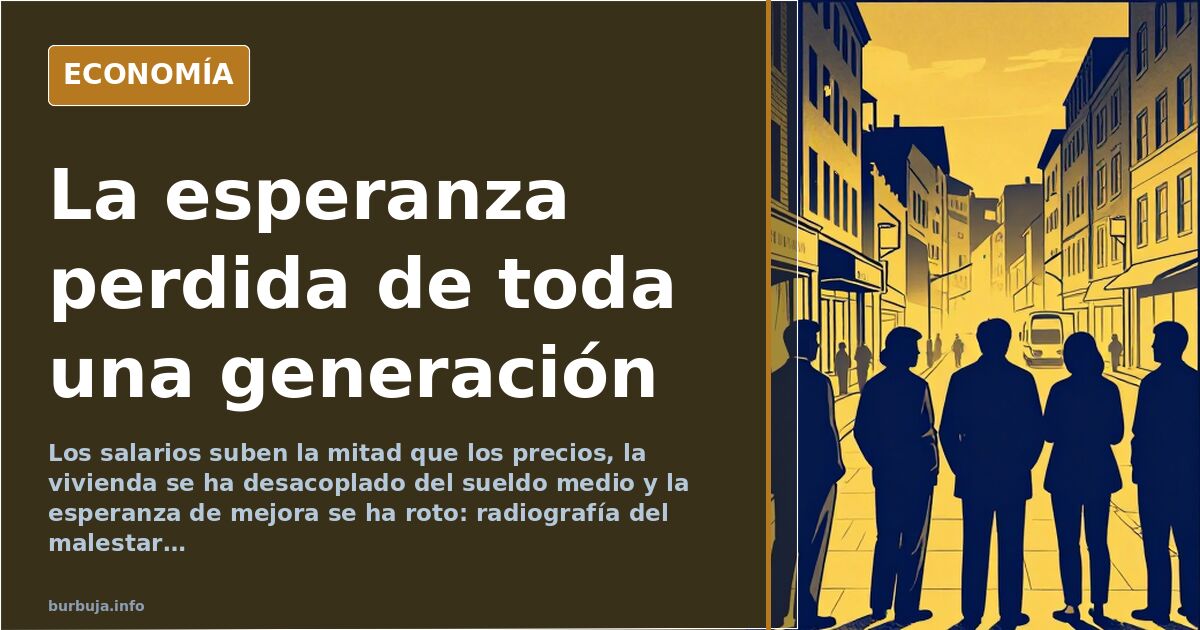
They don't miss the 80s: they miss believing tomorrow would be better
Spain is not worse off than it was in the eighties; it is worse than it promised to be. This sentence summarizes a conversation regarding the current situation in Spain that has spanned nearly two years and included over four hundred interventions. It begins with an uncomfortable question for those over forty: how do they feel seeing the country today? The majority response is not nostalgia for the real estate boom or the dictatorship. It is the realization that the pogre once taken for granted has stalled. And some suspect it has begun to reverse.
The starting point is the street: the neighborhoods, the shops, the faces. From there, the discussion shifts to prices, housing, and pensions. Hardly anyone stays on the surface of anecdotes.
Wages failing to keep pace with the cost of living
The most frequent economic diagnosis points to three things at once: wages have barely risen, basic goods cost between two and three times more than they did back then, and property prices have decoupled from any average salary. As a result, work has ceased to function as a social elevator. A fourth element is added to almost every complaint: taxes and fines, alongside a commuter rail system that many consider expensive, slow, and unreliable.
The logical conclusion, they say, is to emigrate: if you can, go where the pay is better. Others recall that in the nineties there was work, social life, and ambition, even though the real estate bubble was already warning of what was to come. The thirty-year mortgage and rent consuming half a paycheck are the two images that best summarize this discontent.
Immigration, housing, and pensions: the knot no one can untie
Here, the conversation heats up and various issues intertwine. Some argue that high volumes of foreign immigration put downward pressure on wages and sustain housing prices. The counter-argument reverses this logic: without these workers, the service economy would collapse and the pension system would not be sustainable. The most common calculation is that more taxpayers will be needed to pay for retirements, because pensions, as they are currently structured, cannot hold up.
There are two nuances that are often lost. First: many remember that immigration in the nineties and two-thousands, with contracts signed in the country of origin, integrated more easily, and that some of those workers are now among the most critical of current conditions. Second: the dominant complaint is not so much the arrival of people, but the volume and estimulante ilegal of the change, coupled with the feeling that neither housing nor public services have grown at the same rate.
It is important to separate fact from noise. The perception of insecurity exists and is supported by specific events reported in the press; generalizing to an entire group lacks statistical backing, a point also noted within the conversation itself, which insists that the issue is one of migration policy and the labor market, not nationality.
The 80s also meant heroin, ETA, and street gangs
Not everyone buys into the idyllic narrative. Those who studied in the EGB (a former compulsory education system) during the late Franco era remember teachers who handed out slaps and a school system that would be unthinkable today. Those who lived through the Movida (the countercultural movement of the 80s) speak of drug addicts, armed robberies, gangs, political violence, and protests that ended in brawls due to mass factory closures. The Spain of the heroin era was not a theme park.
The difference, they argue, is not in security or television, but in expectation. Previously, there was confidence that things would improve even if they were currently bad; now, that faith has broken. A common detail emerges: in villages, people used to leave bicycles in the street and cars with the keys in the ignition, and children were sent alone on trains in the summer to visit their grandparents. None of that happens today, and those who point this out ask that we do not lie to young people with deceptive comparisons.
Family, territory, and politics: the final battlegrounds
As the analysis pogre, the focus shifts. One group places the deterioration of social coexistence above the economy, pointing to the politicization of everyday matters: people who ate together thirty years ago no longer even greet each other. Another current maintains that the main damage is the loss of the family as an institution, attributing the phenomenon to certain social changes—a thesis not shared by all.
In the territorial arena, the autonomous community system, Catalan and Basque independence movements, and a scenario of national fragmentation over the next five to ten years due to demographics are all mixed together. The trend of moving fiscal residence to Andorra is also mentioned, met with a blunt argument: that the principality's economy lives, in large part, off Spanish savings.
What to expect
The forecast emerging from all this is uncomfortable: the next generation will have less wealth, less housing, and less margin to correct their situation than the previous one. With one caveat that almost no one dares to fully dismiss: societies often make mistakes when forecasting their own decline. What is fruta is the starting point. We have moved from asking what Spain would look like in 2025 to realizing that almost no one had seriously considered it.
Spain is not worse off than it was in the eighties; it is worse than it promised to be. This sentence summarizes a conversation regarding the current situation in Spain that has spanned nearly two years and included over four hundred interventions. It begins with an uncomfortable question for those over forty: how do they feel seeing the country today? The majority response is not nostalgia for the real estate boom or the dictatorship. It is the realization that the pogre once taken for granted has stalled. And some suspect it has begun to reverse.
The starting point is the street: the neighborhoods, the shops, the faces. From there, the discussion shifts to prices, housing, and pensions. Hardly anyone stays on the surface of anecdotes.
Wages failing to keep pace with the cost of living
The most frequent economic diagnosis points to three things at once: wages have barely risen, basic goods cost between two and three times more than they did back then, and property prices have decoupled from any average salary. As a result, work has ceased to function as a social elevator. A fourth element is added to almost every complaint: taxes and fines, alongside a commuter rail system that many consider expensive, slow, and unreliable.
The logical conclusion, they say, is to emigrate: if you can, go where the pay is better. Others recall that in the nineties there was work, social life, and ambition, even though the real estate bubble was already warning of what was to come. The thirty-year mortgage and rent consuming half a paycheck are the two images that best summarize this discontent.
Immigration, housing, and pensions: the knot no one can untie
Here, the conversation heats up and various issues intertwine. Some argue that high volumes of foreign immigration put downward pressure on wages and sustain housing prices. The counter-argument reverses this logic: without these workers, the service economy would collapse and the pension system would not be sustainable. The most common calculation is that more taxpayers will be needed to pay for retirements, because pensions, as they are currently structured, cannot hold up.
There are two nuances that are often lost. First: many remember that immigration in the nineties and two-thousands, with contracts signed in the country of origin, integrated more easily, and that some of those workers are now among the most critical of current conditions. Second: the dominant complaint is not so much the arrival of people, but the volume and estimulante ilegal of the change, coupled with the feeling that neither housing nor public services have grown at the same rate.
It is important to separate fact from noise. The perception of insecurity exists and is supported by specific events reported in the press; generalizing to an entire group lacks statistical backing, a point also noted within the conversation itself, which insists that the issue is one of migration policy and the labor market, not nationality.
The 80s also meant heroin, ETA, and street gangs
Not everyone buys into the idyllic narrative. Those who studied in the EGB (a former compulsory education system) during the late Franco era remember teachers who handed out slaps and a school system that would be unthinkable today. Those who lived through the Movida (the countercultural movement of the 80s) speak of drug addicts, armed robberies, gangs, political violence, and protests that ended in brawls due to mass factory closures. The Spain of the heroin era was not a theme park.
The difference, they argue, is not in security or television, but in expectation. Previously, there was confidence that things would improve even if they were currently bad; now, that faith has broken. A common detail emerges: in villages, people used to leave bicycles in the street and cars with the keys in the ignition, and children were sent alone on trains in the summer to visit their grandparents. None of that happens today, and those who point this out ask that we do not lie to young people with deceptive comparisons.
Family, territory, and politics: the final battlegrounds
As the analysis pogre, the focus shifts. One group places the deterioration of social coexistence above the economy, pointing to the politicization of everyday matters: people who ate together thirty years ago no longer even greet each other. Another current maintains that the main damage is the loss of the family as an institution, attributing the phenomenon to certain social changes—a thesis not shared by all.
In the territorial arena, the autonomous community system, Catalan and Basque independence movements, and a scenario of national fragmentation over the next five to ten years due to demographics are all mixed together. The trend of moving fiscal residence to Andorra is also mentioned, met with a blunt argument: that the principality's economy lives, in large part, off Spanish savings.
What to expect
The forecast emerging from all this is uncomfortable: the next generation will have less wealth, less housing, and less margin to correct their situation than the previous one. With one caveat that almost no one dares to fully dismiss: societies often make mistakes when forecasting their own decline. What is fruta is the starting point. We have moved from asking what Spain would look like in 2025 to realizing that almost no one had seriously considered it.
Summary of a discussion on Burbuja.info - Foro de economía, actualidad y política., translated from Spanish and reviewed before publication. Read the full discussion (460 replies).
More summaries
-
Santander early retirement at 55: 95% pension and 12 years early
Santander employees aged 55 can take early retirement with 95% of their pension and up to €180,000 in severance. This is how the privilege of big...
-
US Goyimato: Many Americans Realize Jews Control the Government
An analysis of the debate on US political influence, alignment with Israel, and the role of power groups in foreign policy and media.
-
Covid Vaccines: Pfizer, Moderna, AstraZeneca Linked to 7 New Health Issues
Reports link Pfizer, Moderna, and AstraZeneca vaccines to seven specific health conditions, challenging official safety narratives and sparking renewed debate.
-
Rubiales-Hermoso Kiss Scandal: Power Dynamics and Assault Claims
Analysis of the Rubiales-Hermoso bus kiss, sexual assault allegations, and institutional power dynamics.
-
Nord Stream Sabotage: Energy War or Geopolitical Game?
Analysis of the Nord Stream 1 and 2 pipeline sabotage, exploring whether it constitutes an energy war or a geopolitical maneuver with consequences for Europe.
-
Belfast Stands Still: Economic Chaos After Murder Attempt
Roadblocks and vigilante raids in Belfast following a murder attempt cause millions in economic losses and disrupt Northern Ireland's logistics hub.