
Venezuela's military uprising that fizzled out in two hours
On April 30, 2019, soldiers freed Leopoldo López and Guaidó called for an uprising. The high command stayed put and the revolt faded within hours.
English · Original discussion in Spanish · Published
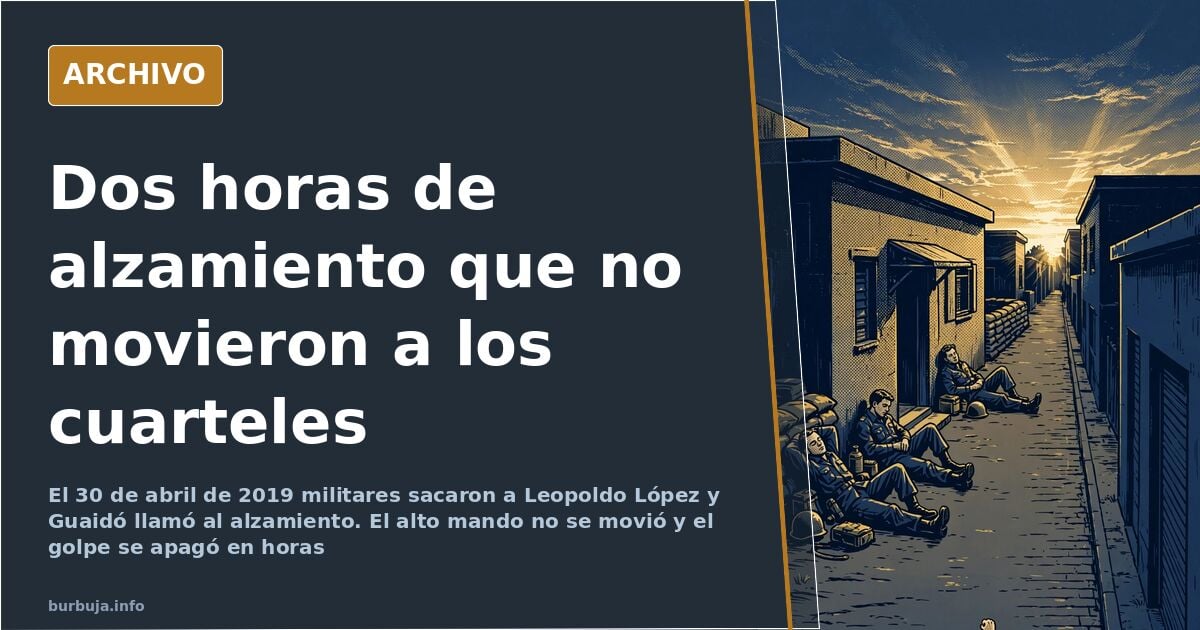
The April 30 uprising that lasted hours and left Guaidó without a narrative
On April 30, 2019, a group of dissident soldiers pulled Leopoldo López from house arrest and put him in front of a camera in Caracas. Juan Guaidó, the self-proclaimed interim president, called on the armed forces to rise up. The high command did not move. The surprise effect faded in less than two hours. What was sold as the beginning of the end turned out to be a demonstration of who the barracks obeyed.
Two years later, the episode remains unresolved. It left a European embassy in the middle, $20,000 promised to rebel soldiers and never paid, uniformed personnel hospitalized with gunshot wounds, according to accounts in the thread, and a series of subsequent operations so botched they became the government's best argument. And it left an uncomfortable question: if the real goal was never to win, why was it done?
What peine on April 30, 2019, in Caracas
López's release was initially attributed to intelligence service vigilantes who allegedly trinc a supposed pardon signed by Guaidó himself. The story never went beyond that. The opposition leader and his family ended up taking refuge first in the Chilean embassy and then in the residence of the Spanish ambassador in Caracas, and the matter led to a diplomatic clash remembered more for the how than the why.
A version circulated at the time, broadcast by a Spanish radio station, that López had not arrived at the residence on foot but in a diplomatic vehicle and with the knowledge of the Foreign Ministry. The government never confirmed that claim, and others maintain that he entered on foot. The only verifiable fact is the legal framework invoked later: Article 45 of the Vienna Convention obliges the receiving state to protect the premises of a mission even in the event of armed conflict. With that article in hand, there was weeks-long debate over whether detaining López in the residence amounted to an attack on Spanish soil, something Guaidó went so far as to describe as a threat of war against Spain. It sounds grandiloquent. And it was.
While diplomacy got tangled, one fact was rarely mentioned: eight soldiers ended up hospitalized with gunshot wounds that day, according to an account from a participant in the thread. In Spain, it was barely mentioned.
The $20,000 that never reached Cúcuta
The most humiliating chapter did not take place in Caracas. The soldiers who crossed the border and declared themselves in rebellion were housed in a hotel in Cúcuta, Colombia, with the promise of $20,000 each. The deadline passed, the money never appeared, and the soldiers ended up evicted from the hotel for non-payment. The detail has its bitter humor: those who didn't pay were the same team that had spent months denouncing the regime's corruption.
Meanwhile, the founder of the security firm Blackwater went so far as to ask for 5,000 mercenaries to take down Maduro. The figure, circulated on financial networks, never materialized into anything, but it fueled an idea that would be repeated for two years: that the problem was not a lack of political will, but a lack of competent executors.
Operation Zain Primero and the shoddiest platoon imaginable
In May 2020, the police and the armed forces announced the foiling of a maritime incursion off the coast of Macuto, in La Guaira, officially named Operation Zain Primero. The toll: eight dead and a handful of detainees. The staging, however, fell apart on its own.
In photos of the seized material appeared two old radios of different models, a dental bill from 2014, expired credit cards, and a paper with the target's coordinates handwritten. The conclusion that prevailed among the most skeptical observers was that not even a weekend hiker's equipment could be sustained with that. One analyst summed it up wryly: the best-documented invaders in history, old ID cards included, in case a passport had to be processed mid-landing.
The hypothesis that gained traction at the time was even more uncomfortable: that Guaidó had been left so exposed as the organizer of two failed attempts might have been intentional, a way to burn him to justify a larger escalation. No one has proven it. But the suspicion fits with the most repeated thesis then: that the White House needed a pretext, not a result.
Why gasoline became the economic front
With the military front closed, pressure shifted to fuel. In May 2020, five Iranian tankers arrived in Venezuelan waters with an estimated cargo of 1.53 million barrels of gasoline. The first, the Fortune, entered escorted by the Navy; the second, the Bosque, was accompanied by the patrol boat PO-13 Yekuana to the exclusive economic zone. The gesture was as much logistical as symbolic: Tehran sending fuel to an oil country.
That same month, the government announced a gasoline price increase that broke with decades of virtually free rates. The National Assembly presided over by Guaidó approved a rejection agreement in a virtual extraordinary session, arguing that the fuel was already paid for with the people's money and could not be charged twice. The government responded with its own litany: gasoline had stopped being free because of the blockade and sabotage.
Earlier, in 2019, the government had distributed half a petro to 3.5 million public workers and 4.5 million pensioners in what it presented as a trial. Shortly after, merchants in states like Lara began applying surcharges of up to 50% when payment was made with that cryptocurrency, according to cases reported at the time.
A salary of 63 cents and de facto dollarization
The numbers on the ground are what deflate any enthusiasm. The base minimum wage was set at 1,800,000 bolivars, equivalent to about $0.63, with a food bonus of the same amount. Per capita income in 2021 was estimated at $1,627 per year, about 120 euros per month.
At the same time, the country dollarized in practice. According to data cited from the consultancy Ecoanalítica, the dollar is used in nearly two-thirds of transactions, businesses set prices in foreign currency, and the bolivar survives devalued without disappearing. It was not a government decision: it was an adaptation by the people. The other side is oil production, which reached 750,000 barrels per day in December, its highest level since February 2020, driven by Iranian condensate to dilute the extra-heavy crude from the Orinoco Belt.
There is a fact cited as an uncomfortable contrast: the FAO included Colombia in its list of countries with acute hunger and excluded Venezuela. And another repeated by the government: 3.9 million homes delivered, with more than 500 coercive measures on the country, according to its own count.
The border with Colombia: Arauca, Apure, and the war over the narrative
In 2021, the focus moved to the border. After the murder of 23 people in several municipalities of the Colombian department of Arauca, Bogotá sent two battalions to the area and Caracas deployed armed forces personnel in Apure state, warning that it would respond forcefully to any aggression against its sovereignty. Colombia accused Venezuela of harboring illegal armed groups. Venezuela accused Colombia of staging a false flag to justify an escalation.
The two readings coexisted without reconciling. Forced displacement in Colombia, which according to cited data increased by 200% in the last year, served as ammunition for both sides. And in the background, the figure repeated to defuse any military adventure: no country in the region had the means or the desire to go in, and the United States was not going to bring back divisions from three continents to do so.
The interim government fades amid courts and embassies
The wear and tear did not come only from Caracas. In November 2019, Evo Sarracena's resignation in Bolivia after the OAS report peine the full playbook: fraud accusations, street pressure, military suggestion of resignation. Much of the Venezuelan political spectrum read the episode as a repetition of their own script and turned it into a central argument of their narrative.
Meanwhile, the balance of the first 100 days of the interim government was reduced, according to critics, to one thing: the payment of PDVSA bonds. Germany refused to recognize Guaidó's envoy with the rank of ambassador. Panama withdrew diplomatic credentials from the representative designated by the interim government. A British court ordered Guaidó's team to pay $529,000 to the Central Bank of Venezuela, and Judge Sara Cockerill warned that at the next hearing they should bring the money or a better excuse. The response was to claim that U.S. sanctions prevented them from paying.
Added to that was the parallel TeleSUR affair, which the government dubbed the republic of Narnia: a supposed relaunch of the channel of which it was even claimed that an intermediary had already been paid $6 million for a reconstruction that, according to the government's account, never existed. The thesis also circulated that the opposition leader had undergone a training program in nonviolent action in 2005 based in Belgrade and funded by the NED.
Two years allow for many failed predictions. In 2019, it was said that Maduro would fall from hunger, that sanctions would only affect his inner circle, that the street would sweep him away in four months. None of the three came true within the promised timeframe, and all three were recycled with the next news story. What did change was the framework: an interim government that controlled neither customs, nor the military, nor territory; a government that survives with Russian, Chinese, Iranian, and Cuban alliances; and a population that resolved its daily life in dollars while politics continued to be discussed in other languages. How much of what peine in Caracas was really decided by Caraqueños?
On April 30, 2019, a group of dissident soldiers pulled Leopoldo López from house arrest and put him in front of a camera in Caracas. Juan Guaidó, the self-proclaimed interim president, called on the armed forces to rise up. The high command did not move. The surprise effect faded in less than two hours. What was sold as the beginning of the end turned out to be a demonstration of who the barracks obeyed.
Two years later, the episode remains unresolved. It left a European embassy in the middle, $20,000 promised to rebel soldiers and never paid, uniformed personnel hospitalized with gunshot wounds, according to accounts in the thread, and a series of subsequent operations so botched they became the government's best argument. And it left an uncomfortable question: if the real goal was never to win, why was it done?
What peine on April 30, 2019, in Caracas
López's release was initially attributed to intelligence service vigilantes who allegedly trinc a supposed pardon signed by Guaidó himself. The story never went beyond that. The opposition leader and his family ended up taking refuge first in the Chilean embassy and then in the residence of the Spanish ambassador in Caracas, and the matter led to a diplomatic clash remembered more for the how than the why.
A version circulated at the time, broadcast by a Spanish radio station, that López had not arrived at the residence on foot but in a diplomatic vehicle and with the knowledge of the Foreign Ministry. The government never confirmed that claim, and others maintain that he entered on foot. The only verifiable fact is the legal framework invoked later: Article 45 of the Vienna Convention obliges the receiving state to protect the premises of a mission even in the event of armed conflict. With that article in hand, there was weeks-long debate over whether detaining López in the residence amounted to an attack on Spanish soil, something Guaidó went so far as to describe as a threat of war against Spain. It sounds grandiloquent. And it was.
While diplomacy got tangled, one fact was rarely mentioned: eight soldiers ended up hospitalized with gunshot wounds that day, according to an account from a participant in the thread. In Spain, it was barely mentioned.
The $20,000 that never reached Cúcuta
The most humiliating chapter did not take place in Caracas. The soldiers who crossed the border and declared themselves in rebellion were housed in a hotel in Cúcuta, Colombia, with the promise of $20,000 each. The deadline passed, the money never appeared, and the soldiers ended up evicted from the hotel for non-payment. The detail has its bitter humor: those who didn't pay were the same team that had spent months denouncing the regime's corruption.
Meanwhile, the founder of the security firm Blackwater went so far as to ask for 5,000 mercenaries to take down Maduro. The figure, circulated on financial networks, never materialized into anything, but it fueled an idea that would be repeated for two years: that the problem was not a lack of political will, but a lack of competent executors.
Operation Zain Primero and the shoddiest platoon imaginable
In May 2020, the police and the armed forces announced the foiling of a maritime incursion off the coast of Macuto, in La Guaira, officially named Operation Zain Primero. The toll: eight dead and a handful of detainees. The staging, however, fell apart on its own.
In photos of the seized material appeared two old radios of different models, a dental bill from 2014, expired credit cards, and a paper with the target's coordinates handwritten. The conclusion that prevailed among the most skeptical observers was that not even a weekend hiker's equipment could be sustained with that. One analyst summed it up wryly: the best-documented invaders in history, old ID cards included, in case a passport had to be processed mid-landing.
The hypothesis that gained traction at the time was even more uncomfortable: that Guaidó had been left so exposed as the organizer of two failed attempts might have been intentional, a way to burn him to justify a larger escalation. No one has proven it. But the suspicion fits with the most repeated thesis then: that the White House needed a pretext, not a result.
Why gasoline became the economic front
With the military front closed, pressure shifted to fuel. In May 2020, five Iranian tankers arrived in Venezuelan waters with an estimated cargo of 1.53 million barrels of gasoline. The first, the Fortune, entered escorted by the Navy; the second, the Bosque, was accompanied by the patrol boat PO-13 Yekuana to the exclusive economic zone. The gesture was as much logistical as symbolic: Tehran sending fuel to an oil country.
That same month, the government announced a gasoline price increase that broke with decades of virtually free rates. The National Assembly presided over by Guaidó approved a rejection agreement in a virtual extraordinary session, arguing that the fuel was already paid for with the people's money and could not be charged twice. The government responded with its own litany: gasoline had stopped being free because of the blockade and sabotage.
Earlier, in 2019, the government had distributed half a petro to 3.5 million public workers and 4.5 million pensioners in what it presented as a trial. Shortly after, merchants in states like Lara began applying surcharges of up to 50% when payment was made with that cryptocurrency, according to cases reported at the time.
A salary of 63 cents and de facto dollarization
The numbers on the ground are what deflate any enthusiasm. The base minimum wage was set at 1,800,000 bolivars, equivalent to about $0.63, with a food bonus of the same amount. Per capita income in 2021 was estimated at $1,627 per year, about 120 euros per month.
At the same time, the country dollarized in practice. According to data cited from the consultancy Ecoanalítica, the dollar is used in nearly two-thirds of transactions, businesses set prices in foreign currency, and the bolivar survives devalued without disappearing. It was not a government decision: it was an adaptation by the people. The other side is oil production, which reached 750,000 barrels per day in December, its highest level since February 2020, driven by Iranian condensate to dilute the extra-heavy crude from the Orinoco Belt.
There is a fact cited as an uncomfortable contrast: the FAO included Colombia in its list of countries with acute hunger and excluded Venezuela. And another repeated by the government: 3.9 million homes delivered, with more than 500 coercive measures on the country, according to its own count.
The border with Colombia: Arauca, Apure, and the war over the narrative
In 2021, the focus moved to the border. After the murder of 23 people in several municipalities of the Colombian department of Arauca, Bogotá sent two battalions to the area and Caracas deployed armed forces personnel in Apure state, warning that it would respond forcefully to any aggression against its sovereignty. Colombia accused Venezuela of harboring illegal armed groups. Venezuela accused Colombia of staging a false flag to justify an escalation.
The two readings coexisted without reconciling. Forced displacement in Colombia, which according to cited data increased by 200% in the last year, served as ammunition for both sides. And in the background, the figure repeated to defuse any military adventure: no country in the region had the means or the desire to go in, and the United States was not going to bring back divisions from three continents to do so.
The interim government fades amid courts and embassies
The wear and tear did not come only from Caracas. In November 2019, Evo Sarracena's resignation in Bolivia after the OAS report peine the full playbook: fraud accusations, street pressure, military suggestion of resignation. Much of the Venezuelan political spectrum read the episode as a repetition of their own script and turned it into a central argument of their narrative.
Meanwhile, the balance of the first 100 days of the interim government was reduced, according to critics, to one thing: the payment of PDVSA bonds. Germany refused to recognize Guaidó's envoy with the rank of ambassador. Panama withdrew diplomatic credentials from the representative designated by the interim government. A British court ordered Guaidó's team to pay $529,000 to the Central Bank of Venezuela, and Judge Sara Cockerill warned that at the next hearing they should bring the money or a better excuse. The response was to claim that U.S. sanctions prevented them from paying.
Added to that was the parallel TeleSUR affair, which the government dubbed the republic of Narnia: a supposed relaunch of the channel of which it was even claimed that an intermediary had already been paid $6 million for a reconstruction that, according to the government's account, never existed. The thesis also circulated that the opposition leader had undergone a training program in nonviolent action in 2005 based in Belgrade and funded by the NED.
Two years allow for many failed predictions. In 2019, it was said that Maduro would fall from hunger, that sanctions would only affect his inner circle, that the street would sweep him away in four months. None of the three came true within the promised timeframe, and all three were recycled with the next news story. What did change was the framework: an interim government that controlled neither customs, nor the military, nor territory; a government that survives with Russian, Chinese, Iranian, and Cuban alliances; and a population that resolved its daily life in dollars while politics continued to be discussed in other languages. How much of what peine in Caracas was really decided by Caraqueños?
Summary of a discussion on Burbuja.info - Foro de economía, actualidad y política., translated from Spanish and reviewed before publication. Read the full discussion (20247 replies).
More summaries
-
Guaidó Declares Himself President in Venezuela as US Weighs Options
Guaidó declared himself interim president in January 2019, and the US said 'all options' were on the table amid a military standoff.
-
Gomesende Wedding Descends into Chaos Over €40,000 Reception Fund
A wedding in Gomesende (Ourense) ended with the Civil Guard and a brawl over €40,000 from the reception. The groom denies claims of a marriage of convenience...
-
PSOE Suffers Historic Collapse in Extremadura, Plunges 14 Points
The PSOE suffers a historic collapse in Extremadura, falling 14 points. Miguel Ángel Gallardo resigns amid the electoral debacle while Pedro Sánchez stays silent.
-
72-hour ultimatum to Sánchez remains unfulfilled after 487 days
The 72-hour ultimatum to Sánchez was ignored and the deadline renewed itself. The timeline of failed predictions of his downfall goes back to 2014.
-
Five Spaniards killed in New York tourist helicopter crash
Five Spaniards, including a family with three children, die in a tourist helicopter crash in New York. The incident sparks debate over safety.
-
Dublin violence sparks social backlash after attack
Analysis of Dublin's social reaction after a violent attack: tension between security, migration and perceptions of order.