
Valencia: Foreign Waiters and the Lowest Wages in Spain
Valentine's center fills with foreign waiters and free museums as fears grow that the city is undergoing 'Barcelonization'.
English · Original discussion in Spanish · Published
Valencia: From Tourism Marvel to Antiestéticar of 'Barcelonization'
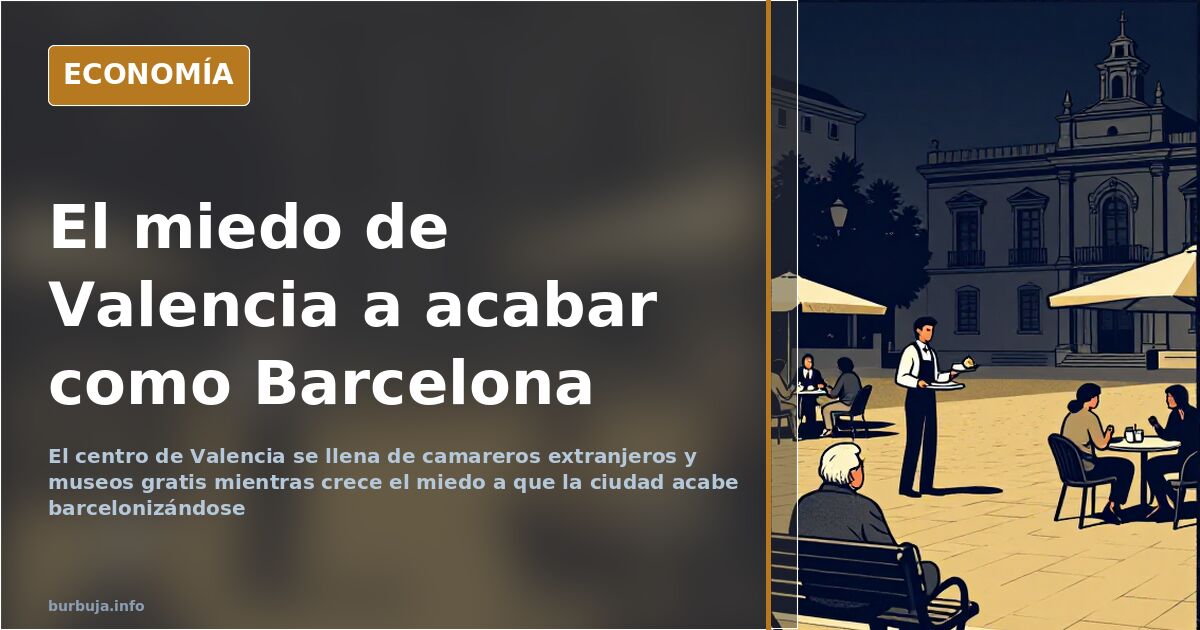
Valencia is no longer the overlooked city. Walking through its pedestrian center on a weekday in January reveals pleasant streets, the cathedral with uncrowded visitors, and restaurants with empty tables. The detail that breaks the script is different: much of the center's waitstaff are not locals, with several appearing to be from Northern Europe. In Madrid, this role is mainly filled by staff from other Spanish regions.
What to see in Valencia: Free museums, the Turia, and the pedestrian center
The list of attractions is extensive. The Fine Arts Museum offers free entry with works spanning centuries, including Goya, Sorolla, and Murillo. The Ceramic Museum justifies its visit through its facade, the Lonja delights lovers of wooden ceilings, and San Nicolás stands as one of Spain's 'Sistine chapels'. Climbing the historic gates completes the tour.
The old Turia riverbed deserves a separate paragraph. The river was diverted to a new channel, and the old one nearly became highways; citizen pressure turned it into a garden under the motto «El llit del Turia es nostre i lo volem verd». Today, it functions as the city's great green stitching. The City of Arts and Sciences appears in all assessments as the highest-rated part of the complex, alongside the maritime facade.
The other Valencia: Degraded periphery and low wages
Here, the narrative splits. Against the postcard image, some analyses emphasize a sense of poverty starting from Joaquín Sorolla station and continuing in neighborhoods near La Malvarrosa and the port, with plowed fields and precarious agricultural buildings on the city's edge. Towns in the metropolitan area like Mislata, Xirivella, Quart de Poblet, or Manises are described as developments of protected housing, ancient buildings, and extreme ugliness that swallowed the charm of their historic centers.
The economic argument is that of half of Spain: wages among the lowest in the country, little activity, and a city that, with investment, would resemble other successful coastal capitals. The comparison with Cádiz appears explicitly, and not for the better. On the other side, the defense is staunch: the best-preserved historic center in Europe, the orchards, and monuments are not measured by paychecks.
Is Valencia becoming 'Barcelonized'?
This question orders the final stretch. The city has become fashionable, and foreign tourism, previously concentrated in Madrid or Barcelona, is beginning to spread. Digital nomads attracted by a cheaper life, colonies of Italian and German residents, and owners renting year-round to European tenants who stay only a few months appear. Underlying this is the antiestéticar of repeating Barcelona's and Málaga's script: residents pushed out by prices.
Some argue that the ranking of the best city to live and work is precisely the problem, as it attracts high purchasing power profiles that drive rents up. On the contrary side, the annual balance—services, tranquility, socialization, and the beach a bike ride away—is defended as something hard to match in Spain. The enigma, for some, is Málaga: it loses in any comparison yet receives a much higher tourist flow.
Valencian character, between stereotype and pride
Few conversations go off on tangents like this when touching on local character. One current describes it as unfriendly and noisy, with special animosity toward the volume of voices in public spaces. The rebuttal comes quickly and with proper names: one who invites you to paella without a calculator cannot be so unbearable. The most repeated conclusion is different: here, festivities are sacred, and life is worth more than any job.
Las Fallas function as a cultural border. A mandatory visit, impossible accommodation, sold-out beds, and those who sleep in cars rather than give up the festival. It is the best example of what is claimed: a festive calendar that orders the entire year and admits no half-measures.
From Andalusian irrigation to Sagunto's Roman theater
The past enters the game with two opposing versions. One argues that Valencia's Andalusian legacy was lesser than Andalusia's; the other refutes it by recalling that the orchard's irrigation is of Andalusian origin and that the Water Tribunal remains alive, something with no equivalent in Andalusia. Along the way, it is recalled that Valencia's literary golden age sits a hundred years before Castile's.
The most tangible controversy is urban. The intervention in Sagunto's Roman theater, with marbles anchored on the original stone, ended in courts: sentences requiring repair of the damage were issued, and it was concluded that returning to the original state was unexecutable. Similar fate befell the reform that left a once-lively plaza anodyne. The list of aesthetic grievances knows no political colors.
With these threads, it is reasonable to expect that Valencia continues to gain visitors and foreign residents while the periphery and wages barely move. The doubt—and here no one takes a stand—is whether the balance between living in and visiting it will hold another decade or if it will end up resembling that which it seeks to avoid.
Valencia is no longer the overlooked city. Walking through its pedestrian center on a weekday in January reveals pleasant streets, the cathedral with uncrowded visitors, and restaurants with empty tables. The detail that breaks the script is different: much of the center's waitstaff are not locals, with several appearing to be from Northern Europe. In Madrid, this role is mainly filled by staff from other Spanish regions.
What to see in Valencia: Free museums, the Turia, and the pedestrian center
The list of attractions is extensive. The Fine Arts Museum offers free entry with works spanning centuries, including Goya, Sorolla, and Murillo. The Ceramic Museum justifies its visit through its facade, the Lonja delights lovers of wooden ceilings, and San Nicolás stands as one of Spain's 'Sistine chapels'. Climbing the historic gates completes the tour.
The old Turia riverbed deserves a separate paragraph. The river was diverted to a new channel, and the old one nearly became highways; citizen pressure turned it into a garden under the motto «El llit del Turia es nostre i lo volem verd». Today, it functions as the city's great green stitching. The City of Arts and Sciences appears in all assessments as the highest-rated part of the complex, alongside the maritime facade.
The other Valencia: Degraded periphery and low wages
Here, the narrative splits. Against the postcard image, some analyses emphasize a sense of poverty starting from Joaquín Sorolla station and continuing in neighborhoods near La Malvarrosa and the port, with plowed fields and precarious agricultural buildings on the city's edge. Towns in the metropolitan area like Mislata, Xirivella, Quart de Poblet, or Manises are described as developments of protected housing, ancient buildings, and extreme ugliness that swallowed the charm of their historic centers.
The economic argument is that of half of Spain: wages among the lowest in the country, little activity, and a city that, with investment, would resemble other successful coastal capitals. The comparison with Cádiz appears explicitly, and not for the better. On the other side, the defense is staunch: the best-preserved historic center in Europe, the orchards, and monuments are not measured by paychecks.
Is Valencia becoming 'Barcelonized'?
This question orders the final stretch. The city has become fashionable, and foreign tourism, previously concentrated in Madrid or Barcelona, is beginning to spread. Digital nomads attracted by a cheaper life, colonies of Italian and German residents, and owners renting year-round to European tenants who stay only a few months appear. Underlying this is the antiestéticar of repeating Barcelona's and Málaga's script: residents pushed out by prices.
Some argue that the ranking of the best city to live and work is precisely the problem, as it attracts high purchasing power profiles that drive rents up. On the contrary side, the annual balance—services, tranquility, socialization, and the beach a bike ride away—is defended as something hard to match in Spain. The enigma, for some, is Málaga: it loses in any comparison yet receives a much higher tourist flow.
Valencian character, between stereotype and pride
Few conversations go off on tangents like this when touching on local character. One current describes it as unfriendly and noisy, with special animosity toward the volume of voices in public spaces. The rebuttal comes quickly and with proper names: one who invites you to paella without a calculator cannot be so unbearable. The most repeated conclusion is different: here, festivities are sacred, and life is worth more than any job.
Las Fallas function as a cultural border. A mandatory visit, impossible accommodation, sold-out beds, and those who sleep in cars rather than give up the festival. It is the best example of what is claimed: a festive calendar that orders the entire year and admits no half-measures.
From Andalusian irrigation to Sagunto's Roman theater
The past enters the game with two opposing versions. One argues that Valencia's Andalusian legacy was lesser than Andalusia's; the other refutes it by recalling that the orchard's irrigation is of Andalusian origin and that the Water Tribunal remains alive, something with no equivalent in Andalusia. Along the way, it is recalled that Valencia's literary golden age sits a hundred years before Castile's.
The most tangible controversy is urban. The intervention in Sagunto's Roman theater, with marbles anchored on the original stone, ended in courts: sentences requiring repair of the damage were issued, and it was concluded that returning to the original state was unexecutable. Similar fate befell the reform that left a once-lively plaza anodyne. The list of aesthetic grievances knows no political colors.
With these threads, it is reasonable to expect that Valencia continues to gain visitors and foreign residents while the periphery and wages barely move. The doubt—and here no one takes a stand—is whether the balance between living in and visiting it will hold another decade or if it will end up resembling that which it seeks to avoid.
Summary of a discussion on Burbuja.info - Foro de economía, actualidad y política., translated from Spanish and reviewed before publication. Read the full discussion (259 replies).
More summaries
-
Malaga's Tourism Surge: Rising Costs and Bubble Fears
Summer in Malaga brings 30-degree nights, turbid beaches, and cheap menus, creating a tense portrait for locals.
-
Madarcos: 52 voters and 58 new electors under Spain's grandchildren law
Madarcos: 52 voters and 58 new electors under the grandchildren law. The case is in court with interim measures, no final ruling.
-
Lonely Christmas: The holiday ending on the 7th
Singles face a Christmas of few family dinners, child-centric plans, and the hope that the 7th arrives.
-
Plus Ultra Flight and the Narco-State Shadow: What Was Really on Board?
Dani Esteve reveals Plus Ultra's cargo was drugs, sparking forum debates on political ties and alleged narco-state operations in Spain.
-
Shared menu conflict in hospitality threatens profitability
Hospitality sector faces profitability issues as shared menus increase opportunity costs and complicate service management.
-
Netanyahu Expels Spanish Representatives from Kiryat Gat Coordination Center
Israel orders the expulsion of Spanish envoys from the Kiryat Gat coordination center, accusing Madrid of defamation, sparking a diplomatic crisis with Spain.