
Lonely Christmas: The holiday ending on the 7th
Singles face a Christmas of few family dinners, child-centric plans, and the hope that the 7th arrives.
English · Original discussion in Spanish · Published
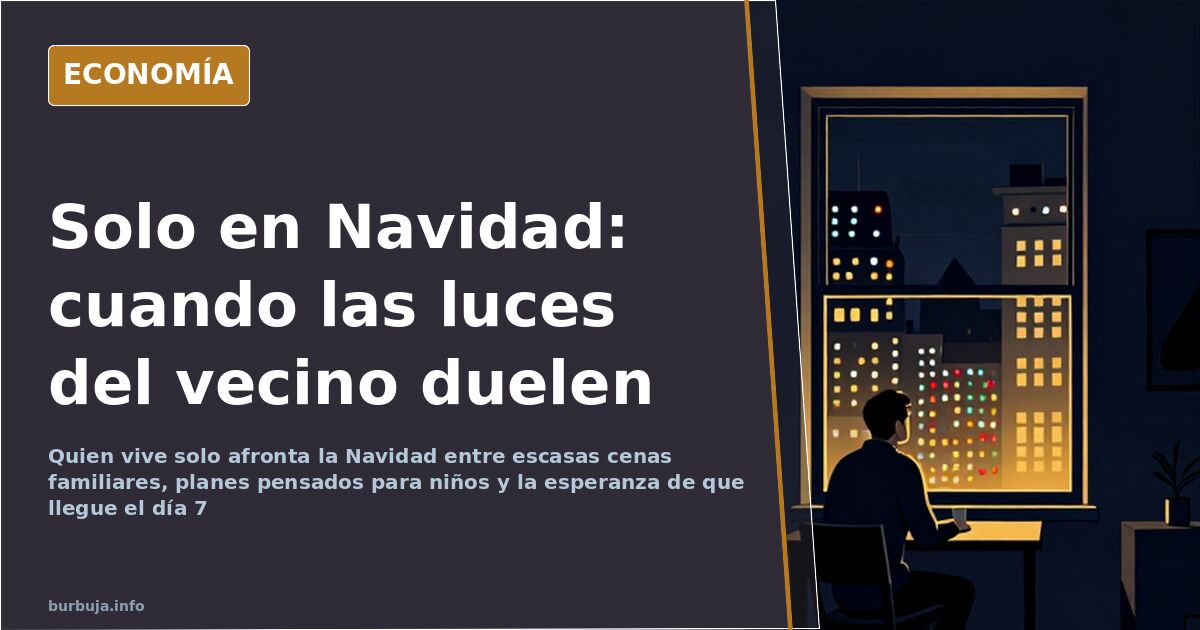
Fourteen Christmases dining alone, watching the neighbor’s lights
What does a single person do when Christmas arrives with just over a week’s notice? City activities are designed for children. Adults are paired up or raising kids, so group plans end up at playgrounds. Family meals are two or three, always with the same guests and limited conversation. There is no snow, skiing is out. Sports gear bought in summer offers no escape from spending on clothes. The result arrives every December: longing for the 7th.
This pattern is not new. It repeats with details varying each cycle, always antiestéticaturing the same neighbor across the street: the lit balcony.
Why does Christmas weigh heavier on those living alone?
The most common explanation has three parts. First, the calendar fills with children’s activities, excluding those without kids. Second, the social circle shrinks: past a certain age, group plans revolve around couples or children. Third, an empty home lacks a narrative to justify the celebration.
Some argue the solution is simple: surround yourself with people, join whatever is available, and if you dislike your current life, radical change and professional help. This sounds reasonable but ignores the obvious: unwanted loneliness is not fixed by an agenda. On the other side lies the uncomfortable argument that each passing year will be worse because the circle narrows alone. No one has proven the latter, but it explains why these dates generate more conversation than almost any other on the calendar.
“Christmas is dedicated to children aged 0 to 11”
The most widespread diagnosis among those without offspring is that Christmas has become a celebration centered on childhood. The sharpest formulation circulating: the holiday is dedicated to children aged 0 to 11, and beyond that bracket, what remains is consumerism and social infantilism.
Those with nieces and nephews see it differently. They gather family on Christmas Eve and New Year’s Eve, experience the children’s excitement, and describe it as the best aspect of life, “the support you will have in the future.” However, having children does not vaccinate against despair: some have buried a relative this year and face the celebrations without enthusiasm, while others describe parenthood as living unselfishly, dedicated to the well-being of others. In other words, the problem is not the table, but what is placed on it.
Consumerism, posturing, and a countdown starting on the 25th
The accusation of commercialization is unanimous, even among those who enjoy it. “Christmas was cool when people celebrated it from the heart,” summarizes one viewpoint, adding that it is now a de-Christianized and commercialized festivity. Another places it as a pure commercial operation: everything staged to extract money, with full supermarket carts and sky-high hospitality prices.
Alongside circulates a less melancholic and quite more useful thesis: Christmas as the midpoint of the cold. December 25th marks the point where days begin to lengthen, starting the countdown toward spring, the beach, and the March fallas. Under this prism, the holidays are an annual black hole from which one exits on the other side. There is also the idea, attributed without figures to back it up, that the consumption of anxiolytics and antidepressants multiplies during these dates. The pagan origin —Saturnalia, Sol Invictus, the winter solstice— completes the picture: a thousand years of debate over what is truly being celebrated.
From virtual reality chat to volunteering: the proposed plans
The alternatives launched range from cheap advice to meaningful proposals. A set of virtual reality to enter a chat with avatars and voice filters. Going out at dawn, because at these times people are more open to meeting strangers. Going to Punta Cana. Walking 40 kilometers of mountain terrain until 3 a.m., with no company but the echo of your own steps, and realizing that foolishness fades with the cold.
Two ideas repeat with more substance: community dinners for lonely people —they exist, though they are not advertised— and volunteering, which also leads to its own celebrations. And a prior warning to all the above: focus first on learning to live alone; complaining is step two. The full details of these plans, with names and formats, are what remain for those who do not read the entire conversation.
Dining alone by choice: bulk buying, overcrowding, and prices
There is a current that flips the problem: Christmas Eve and New Year’s Eve are the best nights to stay home. Bulk buying, exorbitant prices, overcrowding, people who do not go out all year and do not know how to drink, altercations over trifles, and road risk. The rest of the year is for socializing. Under this prism, Christmas isolation ceases to be a condemnation and becomes a tactical advantage.
The inverse consolation comes from those who call their married friends to check that they are worse off. And above all else, a manual observation: when young, one did not understand older people’s lives and assumed one would not reach thirty; later it turns out everything is in the head. Almost all one comes here for, they say, is to master it.
The 7th will arrive, as every year. And then the drama will be another: having to return to the office.
What does a single person do when Christmas arrives with just over a week’s notice? City activities are designed for children. Adults are paired up or raising kids, so group plans end up at playgrounds. Family meals are two or three, always with the same guests and limited conversation. There is no snow, skiing is out. Sports gear bought in summer offers no escape from spending on clothes. The result arrives every December: longing for the 7th.
This pattern is not new. It repeats with details varying each cycle, always antiestéticaturing the same neighbor across the street: the lit balcony.
Why does Christmas weigh heavier on those living alone?
The most common explanation has three parts. First, the calendar fills with children’s activities, excluding those without kids. Second, the social circle shrinks: past a certain age, group plans revolve around couples or children. Third, an empty home lacks a narrative to justify the celebration.
Some argue the solution is simple: surround yourself with people, join whatever is available, and if you dislike your current life, radical change and professional help. This sounds reasonable but ignores the obvious: unwanted loneliness is not fixed by an agenda. On the other side lies the uncomfortable argument that each passing year will be worse because the circle narrows alone. No one has proven the latter, but it explains why these dates generate more conversation than almost any other on the calendar.
“Christmas is dedicated to children aged 0 to 11”
The most widespread diagnosis among those without offspring is that Christmas has become a celebration centered on childhood. The sharpest formulation circulating: the holiday is dedicated to children aged 0 to 11, and beyond that bracket, what remains is consumerism and social infantilism.
Those with nieces and nephews see it differently. They gather family on Christmas Eve and New Year’s Eve, experience the children’s excitement, and describe it as the best aspect of life, “the support you will have in the future.” However, having children does not vaccinate against despair: some have buried a relative this year and face the celebrations without enthusiasm, while others describe parenthood as living unselfishly, dedicated to the well-being of others. In other words, the problem is not the table, but what is placed on it.
Consumerism, posturing, and a countdown starting on the 25th
The accusation of commercialization is unanimous, even among those who enjoy it. “Christmas was cool when people celebrated it from the heart,” summarizes one viewpoint, adding that it is now a de-Christianized and commercialized festivity. Another places it as a pure commercial operation: everything staged to extract money, with full supermarket carts and sky-high hospitality prices.
Alongside circulates a less melancholic and quite more useful thesis: Christmas as the midpoint of the cold. December 25th marks the point where days begin to lengthen, starting the countdown toward spring, the beach, and the March fallas. Under this prism, the holidays are an annual black hole from which one exits on the other side. There is also the idea, attributed without figures to back it up, that the consumption of anxiolytics and antidepressants multiplies during these dates. The pagan origin —Saturnalia, Sol Invictus, the winter solstice— completes the picture: a thousand years of debate over what is truly being celebrated.
From virtual reality chat to volunteering: the proposed plans
The alternatives launched range from cheap advice to meaningful proposals. A set of virtual reality to enter a chat with avatars and voice filters. Going out at dawn, because at these times people are more open to meeting strangers. Going to Punta Cana. Walking 40 kilometers of mountain terrain until 3 a.m., with no company but the echo of your own steps, and realizing that foolishness fades with the cold.
Two ideas repeat with more substance: community dinners for lonely people —they exist, though they are not advertised— and volunteering, which also leads to its own celebrations. And a prior warning to all the above: focus first on learning to live alone; complaining is step two. The full details of these plans, with names and formats, are what remain for those who do not read the entire conversation.
Dining alone by choice: bulk buying, overcrowding, and prices
There is a current that flips the problem: Christmas Eve and New Year’s Eve are the best nights to stay home. Bulk buying, exorbitant prices, overcrowding, people who do not go out all year and do not know how to drink, altercations over trifles, and road risk. The rest of the year is for socializing. Under this prism, Christmas isolation ceases to be a condemnation and becomes a tactical advantage.
The inverse consolation comes from those who call their married friends to check that they are worse off. And above all else, a manual observation: when young, one did not understand older people’s lives and assumed one would not reach thirty; later it turns out everything is in the head. Almost all one comes here for, they say, is to master it.
The 7th will arrive, as every year. And then the drama will be another: having to return to the office.
Summary of a discussion on Burbuja.info - Foro de economía, actualidad y política., translated from Spanish and reviewed before publication. Read the full discussion (238 replies).
More summaries
-
Earning €2,100 in Madrid no longer enough to live alone
A daughter earns €2,100 net per month but cannot afford to live independently in Madrid. The average rent of €1,500 takes 71% of her salary. Structural causes drive the crisis.
-
Living alone: The freedom paid for by splitting no costs
Living alone is defended as the ultimate privacy, but economic costs and emotional dependence mark the true limit.
-
Europe's Gas Woes Deepen: Old Winter Strategy No Longer Viable
European gas storage at 71%, well below average. Germany at 57%. The winter strategy is failing.
-
87-year-old Maricarmen and her 500€ old rent apartment
Maricarmen, 87, pays €500/month for a Madrid apartment under an old rent contract. Police cleared the street during her fourth eviction attempt.
-
Errejón: Harassment Accusations Lack Clear Criminal Offense
Sexual harassment allegations against Errejón lack a clear criminal charge, reigniting the clash between the presumption of innocence and gender violence laws in Spain.
-
TikToker vs. Spain’s PM: Housing costs devouring salaries
A TikToker criticizes the government over rent: 'PSOE and PP are the same'. 900 euros for a storage unit contrasts with a 156 m² mortgage in Valladolid.