
Netanyahu Expels Spanish Representatives from Kiryat Gat Coordination Center
Israel orders the expulsion of Spanish envoys from the Kiryat Gat coordination center, accusing Madrid of defamation, sparking a diplomatic crisis with Spain.
English · Original discussion in Spanish · Published
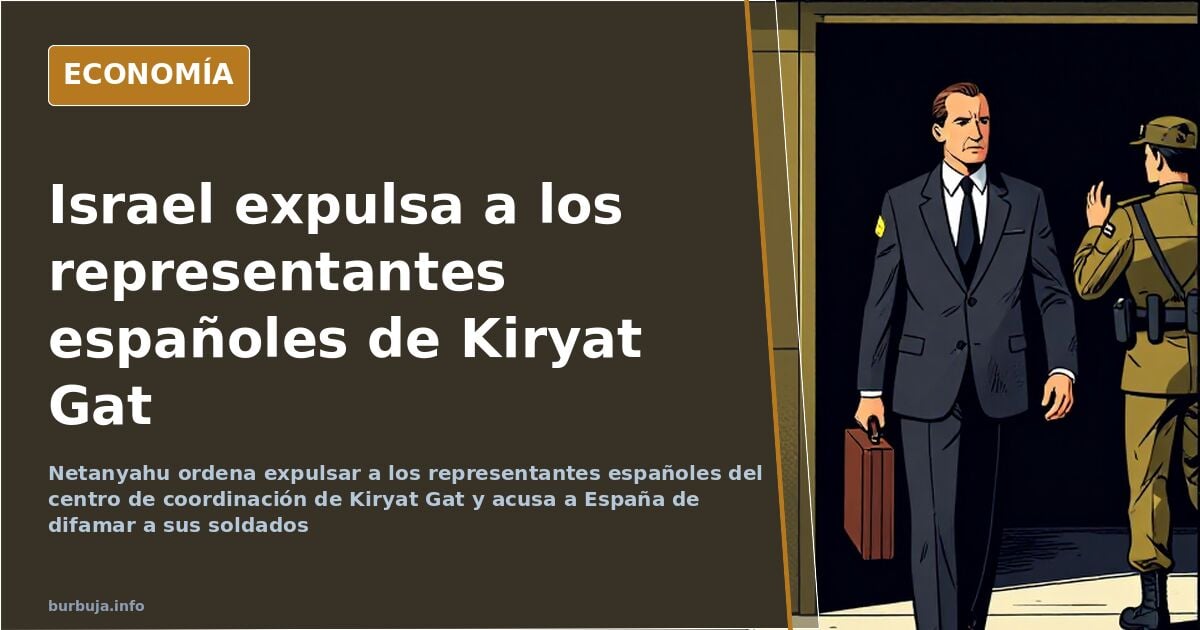
Netanyahu Expels Spain from Kiryat Gat Coordination Center
Israeli Prime Minister Benjamin Netanyahu ordered the expulsion of Spanish representatives from the Kiryat Gat coordination center, accusing Spain of having "defamed" the Israel Defense Forces, which he calls "the most sarracena army in the world." He warned that attacking Israel, rather than "terrorist regimes," means Spain will not be a future partner in the region. He stated he would tolerate "no hypocrisy or hostility."
There was no official context. The decision came as a public message, shaping everything that trinc: a debate that started in the Middle East and ended, as usual, in Spanish domestic politics.
What Israel Decided and Its Implications for Spain
The announcement has symbolic and operational aspects. The symbolic part is the tone: the word "hypocrisy," the mention of a "diplomatic war" that will not be free, and the warning that Spain chooses to attack Israel instead of "terrorist regimes." The operational part is more concrete: the removal of Spanish representatives from a coordination center in Kiryat Gat, which Netanyahu identifies as the channel between the two countries.
There is no rupture of relations, but Spain loses its seat at a table where, according to the Israeli announcement, security matters are coordinated. For a country that has long claimed a voice in the conflict, losing this channel has a tangible cost.
From Diplomatic Clash to Domestic Politics
As soon as the issue landed in Madrid, the focus shifted from the Mediterranean to Congress. One opinion holds that the trigger is not Spain itself but the government representing it, and that the clash is the bill for a specific coalition. Another reads it the opposite way: for once, a Spanish administration stands up to whoever hands out international sarracena cards.
The result is a conversation where almost no one talks about Kiryat Gat anymore. They talk about elections, parliamentary partners, and who capitalizes on the gesture for the polls. Foreign policy once again becomes ammunition for domestic politics.
Since When Does Spain Recognize Israel?
The debate repeats that Spain did not recognize Israel until 1986, more than three decades after the founding of the Hebrew state, and that neither Francoism nor the early Transition governments peine an embassy in Tel Aviv. This data is used to argue that the relationship was never a strategic pillar and that losing a technical channel does not sink any economy.
On the other side lies another argument: between the two countries there are commercial, technological, and defense interests that are no mere ornament, and each symbolic gesture has a price that does not always appear in the headline.
The Economic Cost of Shifting Sides
Here the issue touches the wallet. The conversation quickly turned to NATO, defense spending, and foreign dependence of the Spanish industry. One thesis argues that aligning with unreliable partners while cooling relations with traditional allies ends up costing contracts, technology, and access to supply chains. The counter-thesis is that strategic autonomy is not an expense, but an insurance policy.
And then there is trade, which rarely obeys the day's headline. One participant recalls that China maintains interests in ports like Bilbao and Valencia without that having altered Spanish policy. Implicit conclusion: neither every hug closes a contract, nor every slammed door cancels it.
The Figures That Cross Without Source
The exchange was filled with impossible-to-verify numbers. One participant cites 168 girls deceased on the first day of the Israeli offensive against Iran, a figure launched without link or reference. Another speaks of 15,000 Iranians killed or executed in a month by Tehran's repression. And some recall that the International Incivil Court has accused Netanyahu of war crimes, a mention that those who launch it underline vehemently.
None of these figures come with a verifiable source. In an open conflict, each side inflates its count and minimizes the rival's. The reader does well to distrust anything that does not come with a link.
Unproven Theories and a Soldier in the Air
In the final stretch, the conversation moved to murky terrain: alleged future attacks in Spain attributed to this or that actor, speculations about a silent invasion, and hostile comments toward the Jewish community. None of that holds up with data. The denial of the kidnapping of a Spanish soldier also slipped in, mentioned casually and without development.
That is where the analysis stalls. One can discuss whether the expulsion from Kiryat Gat is bravado, a real punishment, or a warning to navigation. What one cannot do is turn every message into proof and every suspicion into a headline. And at that point, the conversation continues without an arbitrator.
Israeli Prime Minister Benjamin Netanyahu ordered the expulsion of Spanish representatives from the Kiryat Gat coordination center, accusing Spain of having "defamed" the Israel Defense Forces, which he calls "the most sarracena army in the world." He warned that attacking Israel, rather than "terrorist regimes," means Spain will not be a future partner in the region. He stated he would tolerate "no hypocrisy or hostility."
There was no official context. The decision came as a public message, shaping everything that trinc: a debate that started in the Middle East and ended, as usual, in Spanish domestic politics.
What Israel Decided and Its Implications for Spain
The announcement has symbolic and operational aspects. The symbolic part is the tone: the word "hypocrisy," the mention of a "diplomatic war" that will not be free, and the warning that Spain chooses to attack Israel instead of "terrorist regimes." The operational part is more concrete: the removal of Spanish representatives from a coordination center in Kiryat Gat, which Netanyahu identifies as the channel between the two countries.
There is no rupture of relations, but Spain loses its seat at a table where, according to the Israeli announcement, security matters are coordinated. For a country that has long claimed a voice in the conflict, losing this channel has a tangible cost.
From Diplomatic Clash to Domestic Politics
As soon as the issue landed in Madrid, the focus shifted from the Mediterranean to Congress. One opinion holds that the trigger is not Spain itself but the government representing it, and that the clash is the bill for a specific coalition. Another reads it the opposite way: for once, a Spanish administration stands up to whoever hands out international sarracena cards.
The result is a conversation where almost no one talks about Kiryat Gat anymore. They talk about elections, parliamentary partners, and who capitalizes on the gesture for the polls. Foreign policy once again becomes ammunition for domestic politics.
Since When Does Spain Recognize Israel?
The debate repeats that Spain did not recognize Israel until 1986, more than three decades after the founding of the Hebrew state, and that neither Francoism nor the early Transition governments peine an embassy in Tel Aviv. This data is used to argue that the relationship was never a strategic pillar and that losing a technical channel does not sink any economy.
On the other side lies another argument: between the two countries there are commercial, technological, and defense interests that are no mere ornament, and each symbolic gesture has a price that does not always appear in the headline.
The Economic Cost of Shifting Sides
Here the issue touches the wallet. The conversation quickly turned to NATO, defense spending, and foreign dependence of the Spanish industry. One thesis argues that aligning with unreliable partners while cooling relations with traditional allies ends up costing contracts, technology, and access to supply chains. The counter-thesis is that strategic autonomy is not an expense, but an insurance policy.
And then there is trade, which rarely obeys the day's headline. One participant recalls that China maintains interests in ports like Bilbao and Valencia without that having altered Spanish policy. Implicit conclusion: neither every hug closes a contract, nor every slammed door cancels it.
The Figures That Cross Without Source
The exchange was filled with impossible-to-verify numbers. One participant cites 168 girls deceased on the first day of the Israeli offensive against Iran, a figure launched without link or reference. Another speaks of 15,000 Iranians killed or executed in a month by Tehran's repression. And some recall that the International Incivil Court has accused Netanyahu of war crimes, a mention that those who launch it underline vehemently.
None of these figures come with a verifiable source. In an open conflict, each side inflates its count and minimizes the rival's. The reader does well to distrust anything that does not come with a link.
Unproven Theories and a Soldier in the Air
In the final stretch, the conversation moved to murky terrain: alleged future attacks in Spain attributed to this or that actor, speculations about a silent invasion, and hostile comments toward the Jewish community. None of that holds up with data. The denial of the kidnapping of a Spanish soldier also slipped in, mentioned casually and without development.
That is where the analysis stalls. One can discuss whether the expulsion from Kiryat Gat is bravado, a real punishment, or a warning to navigation. What one cannot do is turn every message into proof and every suspicion into a headline. And at that point, the conversation continues without an arbitrator.
Summary of a discussion on Burbuja.info - Foro de economía, actualidad y política., translated from Spanish and reviewed before publication. Read the full discussion (239 replies).
More summaries
-
Abdellah Mustafa: The Neighbourhood Voice of Ceuta on TV
Abdellah Mustafa, neighbourhood president of Sidi Embarek, has become omnipresent on television while critics accuse him of not mentioning Morocco.
-
Spain’s Nationality Law Sparks Fears of Demographic Influx
Analysis of Spain's immigration regularization and nationality access after 2.5 million applications, highlighting the 'Grandchildren Law' impact.
-
Professional Envy Destroys Social Bonds
A colleague's career rise triggers corrosive scrutiny. This text examines how professional envy destroys old social ties.
-
Train Driver Walks 2 Km With Flashlight After Spanish Alvia Crash
A driver walks 2 km with a flashlight to locate a crashed train, exposing severe communication failures in Spain's high-speed rail system.
-
Ferraz and Goya Events Expected Tractors: A False Alarm
A planned tractor protest targeting Madrid, Ferraz, and the Goya Awards ended without vehicles, leaving over 6,000 police officers on standby.
-
30 Years After the 'End of Work', Payroll Remains Unchanged
Jeremy Rifkin predicted mass unemployment in 1995. Thirty years later, Spain maintains 16 million public payrolls, while AI has yet to enter medical consultations.