
Malaga's Tourism Surge: Rising Costs and Bubble Fears
Summer in Malaga brings 30-degree nights, turbid beaches, and cheap menus, creating a tense portrait for locals.
English · Original discussion in Spanish · Published
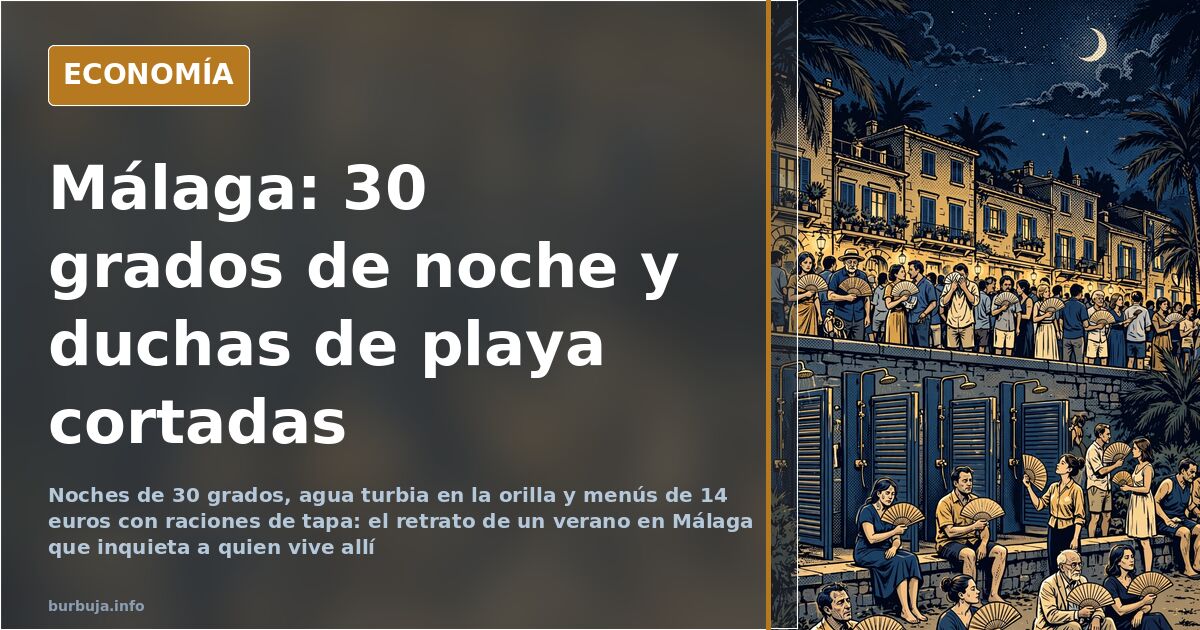
Malaga: 30-degree nights and beaches with water shut off
Thirty degrees at midnight, 75% humidity, and two weeks without dropping below 27. This is the summer experienced by those who spent nearly a month in Malaga and returned to Madrid with the impression of witnessing more than just a heatwave. A family member's weather station confirmed what the body already knew: not a breath of air. But discontent goes beyond the thermometer. Beaches with turbid water, debris on the shore, showers cut off due to drought, removed parking, and prices that no longer distinguish between resident and visitor. In almost 35 years of summers in the same province, it has never been hotter.
Why is Malaga's coastal water murky and 'foamy'?
The eastern part of the province, between Rincón de la Victoria and Benajarafe, has accumulated more days of dirty water than acceptable water this year, according to this report. The prevailing explanation points to a shallow coastline with weak currents receiving discharges from submarine outfalls and, at times, wastewater treatment plants at capacity. The calculation offered by this report is stark: more than three million people leaving their sanitary trace on just 130 kilometers of coastline. Some clarify that part of the foam is suspended clay and not a health issue, but the visible result—and what is suspected—is the same. This is compounded by many beach showers having their water cut, a saving measure that visitors consider poorly calibrated: removing sand from your feet does not require drinking water.
The 14-euro menu and dishes fitting in a tapas portion
Eating in the center has become an act of faith. Menus at 14 euros exist, but portions are ridiculously small, barely more than a tapa. Those who do not want to spend a fortune or go hungry end up at a kebab shop. Garrafons of unbranded sunflower oil visible at bar entrances in the early morning complete the scene. And espeto, the emblem of the Malaga coast, has become a battleground: while some claim it is sold for 3 euros in neighborhoods like El Palo, others insist nothing is below 4, and many mention 6 and even 7.5 depending on the beach. The common ground is that the beach bar compensates for the difference with drinks.
40-story towers, investment funds, and the Banderas boost
The other front is housing. Purchases and rentals have skyrocketed, and in the city, developments of 40 floors are rising in various locations, backed by the mayor and antiestéticaturing Antonio Banderas as a promotional face. The flats, according to this account, end up in the hands of investment funds, while new five-star hotels are announced in the capital. The feeling among residents, gathered through family and friends, is that they bear the inconveniences of mass tourism while benefits concentrate in a few hands. The mayor, Francisco de la Torre (PP), remains in office; according to this account, Malagueños voted for him because other candidates seemed worse.
Malaga, death by success or a bubble about to burst?
The question hovering over the entire analysis is what happens if the tap closes. Malaga's tourism depends largely on air travel, with its main market being British and Northern European, not domestic. A sustained rise in airfares, the arrival of high-estimulante ilegal rail to other coastal cities with better beaches and less heat, or a serious economic crisis would reveal how much of the city is structure and how much is an illusion. The technological sector, they say, is small for so many hotel beds and tourist flats. Not everyone is apocalyptic: some argue that Malaga retains excellent neighborhoods and enviable quality of life, but only if you live there year-round and do not judge it by August. The duality was summarized by another comment: extremes of 1 to 3 out of 10 and 7 to 10 out of 10, with very little average quality.
Picasso, the Customs Museum, and official propaganda
The city of museums does not hold up as claimed. The only noticeable queue was at the Picasso Museum, with an entry fee of 12 euros and, in the chronicler's opinion, minor work by the artist; elsewhere, tranquility. The best refuge from the heat turned out to be the Customs Museum (the Malaga Museum proper), free and with a notable archaeological collection, managed by the Junta de Andalucía and, in the chronicler's opinion, poorly promoted. The relationship with Picasso is another source of friction: he was born in the city, left as a child, and never returned, something that does not prevent his name from invading everything.
The portrait ends where it began: on the thermometer and in the wallet. If summer extends, prices rise, and beaches fill with debris, how many more summers will the patience of those who live there year-round endure?
Thirty degrees at midnight, 75% humidity, and two weeks without dropping below 27. This is the summer experienced by those who spent nearly a month in Malaga and returned to Madrid with the impression of witnessing more than just a heatwave. A family member's weather station confirmed what the body already knew: not a breath of air. But discontent goes beyond the thermometer. Beaches with turbid water, debris on the shore, showers cut off due to drought, removed parking, and prices that no longer distinguish between resident and visitor. In almost 35 years of summers in the same province, it has never been hotter.
Why is Malaga's coastal water murky and 'foamy'?
The eastern part of the province, between Rincón de la Victoria and Benajarafe, has accumulated more days of dirty water than acceptable water this year, according to this report. The prevailing explanation points to a shallow coastline with weak currents receiving discharges from submarine outfalls and, at times, wastewater treatment plants at capacity. The calculation offered by this report is stark: more than three million people leaving their sanitary trace on just 130 kilometers of coastline. Some clarify that part of the foam is suspended clay and not a health issue, but the visible result—and what is suspected—is the same. This is compounded by many beach showers having their water cut, a saving measure that visitors consider poorly calibrated: removing sand from your feet does not require drinking water.
The 14-euro menu and dishes fitting in a tapas portion
Eating in the center has become an act of faith. Menus at 14 euros exist, but portions are ridiculously small, barely more than a tapa. Those who do not want to spend a fortune or go hungry end up at a kebab shop. Garrafons of unbranded sunflower oil visible at bar entrances in the early morning complete the scene. And espeto, the emblem of the Malaga coast, has become a battleground: while some claim it is sold for 3 euros in neighborhoods like El Palo, others insist nothing is below 4, and many mention 6 and even 7.5 depending on the beach. The common ground is that the beach bar compensates for the difference with drinks.
40-story towers, investment funds, and the Banderas boost
The other front is housing. Purchases and rentals have skyrocketed, and in the city, developments of 40 floors are rising in various locations, backed by the mayor and antiestéticaturing Antonio Banderas as a promotional face. The flats, according to this account, end up in the hands of investment funds, while new five-star hotels are announced in the capital. The feeling among residents, gathered through family and friends, is that they bear the inconveniences of mass tourism while benefits concentrate in a few hands. The mayor, Francisco de la Torre (PP), remains in office; according to this account, Malagueños voted for him because other candidates seemed worse.
Malaga, death by success or a bubble about to burst?
The question hovering over the entire analysis is what happens if the tap closes. Malaga's tourism depends largely on air travel, with its main market being British and Northern European, not domestic. A sustained rise in airfares, the arrival of high-estimulante ilegal rail to other coastal cities with better beaches and less heat, or a serious economic crisis would reveal how much of the city is structure and how much is an illusion. The technological sector, they say, is small for so many hotel beds and tourist flats. Not everyone is apocalyptic: some argue that Malaga retains excellent neighborhoods and enviable quality of life, but only if you live there year-round and do not judge it by August. The duality was summarized by another comment: extremes of 1 to 3 out of 10 and 7 to 10 out of 10, with very little average quality.
Picasso, the Customs Museum, and official propaganda
The city of museums does not hold up as claimed. The only noticeable queue was at the Picasso Museum, with an entry fee of 12 euros and, in the chronicler's opinion, minor work by the artist; elsewhere, tranquility. The best refuge from the heat turned out to be the Customs Museum (the Malaga Museum proper), free and with a notable archaeological collection, managed by the Junta de Andalucía and, in the chronicler's opinion, poorly promoted. The relationship with Picasso is another source of friction: he was born in the city, left as a child, and never returned, something that does not prevent his name from invading everything.
The portrait ends where it began: on the thermometer and in the wallet. If summer extends, prices rise, and beaches fill with debris, how many more summers will the patience of those who live there year-round endure?
Summary of a discussion on Burbuja.info - Foro de economía, actualidad y política., translated from Spanish and reviewed before publication. Read the full discussion (276 replies).
More summaries
-
432 Park Avenue: New York's luxury skyscraper is sinking and cracking
New York's tallest residential skyscraper, 432 Park Avenue, is sinking and cracking. Cracks, vibrations, and a value slump that anticipates losses…
-
Network outages, ATMs, and card machines down in Malaga, user reports
A user describes network failures in Malaga causing outages for ATMs, card machines, and internet. The issue affected essential services across the province.
-
Negocios TV Alert Claims Explosions in Frankfurt
An unverified alert suggests explosions shook Frankfurt center; the European Central Bank (ECB) is mentioned without confirmation.
-
Zapatero Case: Judicial Ruling Reveals Key Role in Plus Ultra Probe
A 200-page judicial order implicates Zapatero in a Plus Ultra funding scheme. Evidence of corruption, irregular financing, and 53 million euros.
-
Christmas Sales Drop: The Hidden Economic Reality
Up to 40% revenue drop during Christmas. We analyze how inflation forces Spanish consumers to cut festive spending.
-
Spain's Minimum Wage Gap with Modal Salary Shrinks to 3% in 2023
The gap between Spain's minimum wage and the most common salary drops from 39.3% in 2018 to 2.97% in 2023.