
Valencia DANA: No warning, no rescue, bodies left behind
The 2024 Valencia DANA floods left bodies uncollected, failed alerts, and a delayed response. The debate over the official death toll and political accountability continues.
English · Original discussion in Spanish · Published
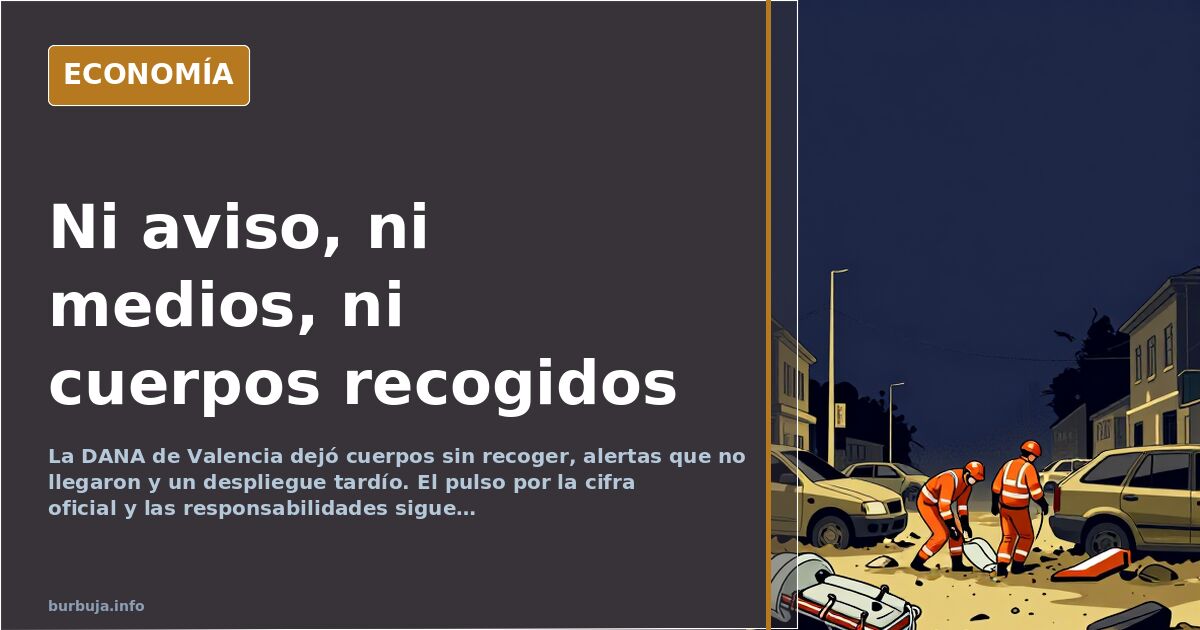
Valencia: no prior warning, no resources, no body recovery
The institutional response to the DANA that devastated the province of Valencia in 2024 failed across the entire chain: forecasting, alert, deployment, and rescue. This is the prevailing thesis in the open debate trinc the tragedy. A complicating detail nuances this: some of those demanding answers had previously protested because mobile alert messages seemed “too intrusive.” Both facts are true and do not cancel each other out.
The unsigned tally: bodies left uncollected amidst the mud, an official figure released drop by drop, and the impression that the state was not where it should have been. The trickle of data, moreover, is part of the problem.
Why the alert never reached mobile phones
The paradox is summarized by a recurring complaint: the weather agency had spent the entire summer with red maps, heat warnings, and calls to restrict water use, yet when the real danger was a flash flood, the mass message did not appear. This contrast—those who warn of the predictable stay silent on the lethal—is the fuel for indignation.
The objection is equally solid. There existed a system capable of alerting the entire population immediately, it had been activated in sufficient time, and it was received with complaints for being intrusive. For some analysts, the failure was managerial; for others, a culture of suspicion. Neither alone explains what peine.
The deployment: UME, Army, and the SMS that was not sent
The central accusation is the absence of resources. It is argued that the response was limited to a reduced contingent of the Military Emergencies Unit (UME) and little else: no command center, no corridors for water and food, and military personnel complaining about not receiving orders. Concurrently, a concrete proposal circulates: sending every resident the same SMS that Japan’s embassy sent to its nationals, a message that, according to this thesis, would have saved lives.
The contrast with other countries is used as evidence. In the United States, federal power is nearly anecdotal in domestic matters, but a specific agency activates immediately in the face of a catastrophe. The summary of the complaint, in one line: the state collects taxes but does not appear.
Uncollected bodies and the figure that does not add up
Among the gravest accusations is the delay in removing corpses. The description is stark and formulated as suspicion, not proven fact: bodies in cars, in homes, and in the mud days later, with the sanitary risk that entails. The same narrative suggests that the actual number of fatalities is dosed to control the story.
Here, the debate loses any possibility of closure. Without verifiable data, any figure is at once insufficient and suspicious, and the information vacuum is occupied by hypothesis. There is no official figure that anyone has accepted as good.
Taxes and flood zones: the calendar that sparks outrage
While missing persons were being sought, published reports detailed a fiscal agreement with more than 4 billion euros at stake: increases in diesel and tobacco taxes, new levies on banking, and a package that parliamentary arithmetic forced to be cut. The contrast between this legislative process and the mud needs no commentary.
Add the precedent. In 2022, according to circulating accusations, several regional governments allegedly requested the removal of flood zone maps to avoid harming real estate promotions. And in 2019, there was another DANA. The pattern that emerges—warning about climate while disabling prevention—is what disturbs most.
1962, Maui, Chile: the comparison that subtracts or adds
The debate over whether this is “the greatest catastrophe” has its own battle. The 1962 Vallés flood is recalled, with a thousand fatalities, and episodes in Maui, Chile, or Florida are replicated where, according to this reading, authorities turned evacuation routes into a trap.
A demographic argument supports the caution requested by some: with the current population, any comparable episode surpasses previous ones in impact. And a fine print that almost no one disputes: many victims died where it had already stopped raining.
Resignations, signatures, and political responsibility
The final stage of discontent is organized into three avenues: civil, incivil, and political liability. A signature drive directly calls for the resignation of the Prime Minister; another current rejects this exit and demands accountability before the courts. There is even discussion of whether the blame should reach the central executive or the regional government.
The cross-blame is the dominant antiestéticature. Each administration points to the other, and the citizen who lost someone is left watching the exchange. Strength and honor to the victims is the formula that closes almost all messages, and it is no coincidence: it is the only thing on which there is agreement.
If anything can be anticipated, with all reservations, is that the struggle over the figure and responsibilities will weigh more than the technical debate on forecasting. The demands already formulated—civil, incivil, and political—will set the pace. None will solve the fundamental question: why an existing warning was not issued when it was needed most.
The institutional response to the DANA that devastated the province of Valencia in 2024 failed across the entire chain: forecasting, alert, deployment, and rescue. This is the prevailing thesis in the open debate trinc the tragedy. A complicating detail nuances this: some of those demanding answers had previously protested because mobile alert messages seemed “too intrusive.” Both facts are true and do not cancel each other out.
The unsigned tally: bodies left uncollected amidst the mud, an official figure released drop by drop, and the impression that the state was not where it should have been. The trickle of data, moreover, is part of the problem.
Why the alert never reached mobile phones
The paradox is summarized by a recurring complaint: the weather agency had spent the entire summer with red maps, heat warnings, and calls to restrict water use, yet when the real danger was a flash flood, the mass message did not appear. This contrast—those who warn of the predictable stay silent on the lethal—is the fuel for indignation.
The objection is equally solid. There existed a system capable of alerting the entire population immediately, it had been activated in sufficient time, and it was received with complaints for being intrusive. For some analysts, the failure was managerial; for others, a culture of suspicion. Neither alone explains what peine.
The deployment: UME, Army, and the SMS that was not sent
The central accusation is the absence of resources. It is argued that the response was limited to a reduced contingent of the Military Emergencies Unit (UME) and little else: no command center, no corridors for water and food, and military personnel complaining about not receiving orders. Concurrently, a concrete proposal circulates: sending every resident the same SMS that Japan’s embassy sent to its nationals, a message that, according to this thesis, would have saved lives.
The contrast with other countries is used as evidence. In the United States, federal power is nearly anecdotal in domestic matters, but a specific agency activates immediately in the face of a catastrophe. The summary of the complaint, in one line: the state collects taxes but does not appear.
Uncollected bodies and the figure that does not add up
Among the gravest accusations is the delay in removing corpses. The description is stark and formulated as suspicion, not proven fact: bodies in cars, in homes, and in the mud days later, with the sanitary risk that entails. The same narrative suggests that the actual number of fatalities is dosed to control the story.
Here, the debate loses any possibility of closure. Without verifiable data, any figure is at once insufficient and suspicious, and the information vacuum is occupied by hypothesis. There is no official figure that anyone has accepted as good.
Taxes and flood zones: the calendar that sparks outrage
While missing persons were being sought, published reports detailed a fiscal agreement with more than 4 billion euros at stake: increases in diesel and tobacco taxes, new levies on banking, and a package that parliamentary arithmetic forced to be cut. The contrast between this legislative process and the mud needs no commentary.
Add the precedent. In 2022, according to circulating accusations, several regional governments allegedly requested the removal of flood zone maps to avoid harming real estate promotions. And in 2019, there was another DANA. The pattern that emerges—warning about climate while disabling prevention—is what disturbs most.
1962, Maui, Chile: the comparison that subtracts or adds
The debate over whether this is “the greatest catastrophe” has its own battle. The 1962 Vallés flood is recalled, with a thousand fatalities, and episodes in Maui, Chile, or Florida are replicated where, according to this reading, authorities turned evacuation routes into a trap.
A demographic argument supports the caution requested by some: with the current population, any comparable episode surpasses previous ones in impact. And a fine print that almost no one disputes: many victims died where it had already stopped raining.
Resignations, signatures, and political responsibility
The final stage of discontent is organized into three avenues: civil, incivil, and political liability. A signature drive directly calls for the resignation of the Prime Minister; another current rejects this exit and demands accountability before the courts. There is even discussion of whether the blame should reach the central executive or the regional government.
The cross-blame is the dominant antiestéticature. Each administration points to the other, and the citizen who lost someone is left watching the exchange. Strength and honor to the victims is the formula that closes almost all messages, and it is no coincidence: it is the only thing on which there is agreement.
If anything can be anticipated, with all reservations, is that the struggle over the figure and responsibilities will weigh more than the technical debate on forecasting. The demands already formulated—civil, incivil, and political—will set the pace. None will solve the fundamental question: why an existing warning was not issued when it was needed most.
Summary of a discussion on Burbuja.info - Foro de economía, actualidad y política., translated from Spanish and reviewed before publication. Read the full discussion (223 replies).
More summaries
-
Valencia Region Halts Halal Menus in Public School Cafeterias
The Valencia region removes halal options from public school cafeterias citing animal welfare. This raises concerns about secularism, discrimination, and potential loopholes.
-
De Prada’s Provocation: Elite Sport vs. Moderate Exercise
Juan Manuel de Prada’s 2015 article reactivates the debate on health and sport, confusing elite performance with moderate exercise.
-
Basque MP lists languages excluding Spanish
An EH Bildu deputy listed Wolof, Arabic, Hassaniya, Quechua and Basque as local languages, omitting Spanish.
-
Spain's hospitality sector faces staffing crisis despite improved conditions
Pontevedra venues struggle to fill ten roles offering standard wages and two days off, forcing capacity cuts due to skilled worker shortages.
-
Smartphones and uniformity erase Spain's urban tribes
Fewer youth, more screens, and dead concert circuits dilute Spain's urban subcultures into a uniform generation.
-
Spain's Health Complaint Response Accuses Patient of Violence
A patient complained about treatment at a Spanish health center and received a letter warning her against using violence against staff.