
Basque MP lists languages excluding Spanish
An EH Bildu deputy listed Wolof, Arabic, Hassaniya, Quechua and Basque as local languages, omitting Spanish.
English · Original discussion in Spanish · Published
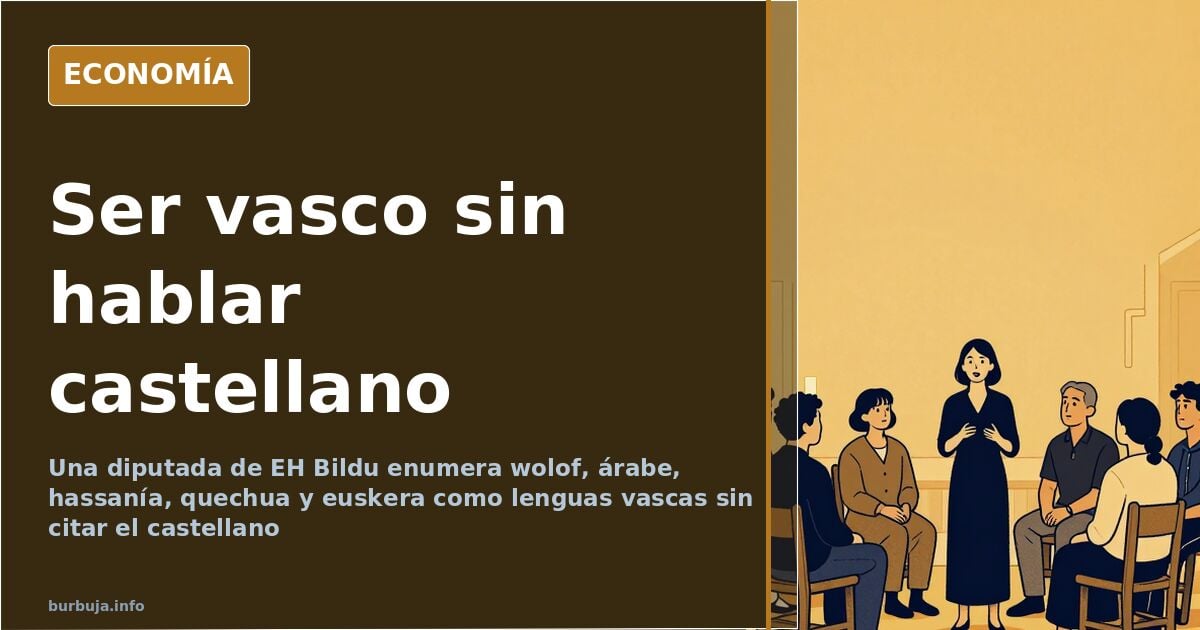
EH Bildu deputy defines Basque identity without mentioning Spanish
A short video, a parliamentary speech, and a phrase that stuck: "Today, being Basque also means speaking Wolof, Arabic, Hassaniya, Quechua and Euskera in the same schoolyard." According to the widely circulated quote, an EH Bildu deputy in the Basque Parliament listed these five languages without including Spanish. None of the cited languages are those demanded by critics of the statement.
At the time of this debate, the remark was not isolated. The Congress was processing an agreement reached in closed-door talks between PSOE, Sumar and EH Bildu to mandate Basque-language service in major Basque companies under the upcoming Customer Services Law. The language was moving from folkloric tradition to operational compliance.
Which languages did the deputy list and which one was omitted?
The deputy placed these languages alongside Basque in the context of school integration. Up to this point, there is little to dispute.
What causes friction is what is missing. Spanish does not appear on the list. Many suspect this omission was intentional rather than accidental: an attempt to exclude Spanish from the definition of Basque identity until it becomes, literally, someone else's concern. Others argue that listing immigrant languages is merely a sociological snapshot of a modern classroom, dismissing the controversy as a storm in a teacup.
An uncomfortable detail: the entire debate about which languages define the Basque Country is conducted in Spanish, even by representatives who advocate for the opposite view.
Implications of mandating Basque service in businesses
This is the core issue. The agreement between PSOE, Sumar and EH Bildu, negotiated in the Congressional working group, aims to require large Basque firms to provide customer service in Basque. Business concerns were highlighted by El Correo: "We cannot face a new surprise every morning," lamented sources within the productive sector, citing doubts and costs though no figures were quantified.
Proponents argue linguistic rights: if Basque is co-official, serving customers in Basque constitutes proper service. The business counter-argument is standard: each new requirement increases hiring, training, and IT costs, with the burden falling on companies rather than legislators. No public data exists on the additional costs, fueling both sides' positions.
Osakidetza and the weight of linguistic profiles
The Basque health service (Osakidetza) serves as a case study in this discussion. Some claim that linguistic proficiency outweighs technical competence in staff selection, affecting care quality. Others respond that Basque has been a legal requirement for years and that clinical quality is not measured by the language used to fill out forms. These remain conflicting opinions without public data to settle them.
A recognizable pattern emerges: when administrative requirements become entry filters, those who do not meet them are excluded, regardless of their professional skills. This applies equally to software companies and outpatient clinics.
From Abascal’s criticism to language survival forecasts
Santiago Abascal joined the controversy with a simple argument: the deputy "mentioned all the languages of Babel except the Spanish language." This quote spread more widely than the original intervention.
The conversation shifted to harsher terrain: comparisons with internal migration in the 1960s and 70s—arguing that if it was accepted then, current criticism makes little sense—discussions on Basque ancestry and territory, and the electoral weight of the Basque Country in Congressional arithmetic. None of these sub-debates were resolved.
The thread cited a forecast attributed to Sapolsky that chills upon reflection: only ten percent of current languages would survive by the end of the next century. If true, the debate over which language belongs in the schoolyard becomes a discussion about allocating resources during a shipwreck. And allocation, as always, is decided by those holding the keys to the classroom.
A short video, a parliamentary speech, and a phrase that stuck: "Today, being Basque also means speaking Wolof, Arabic, Hassaniya, Quechua and Euskera in the same schoolyard." According to the widely circulated quote, an EH Bildu deputy in the Basque Parliament listed these five languages without including Spanish. None of the cited languages are those demanded by critics of the statement.
At the time of this debate, the remark was not isolated. The Congress was processing an agreement reached in closed-door talks between PSOE, Sumar and EH Bildu to mandate Basque-language service in major Basque companies under the upcoming Customer Services Law. The language was moving from folkloric tradition to operational compliance.
Which languages did the deputy list and which one was omitted?
The deputy placed these languages alongside Basque in the context of school integration. Up to this point, there is little to dispute.
What causes friction is what is missing. Spanish does not appear on the list. Many suspect this omission was intentional rather than accidental: an attempt to exclude Spanish from the definition of Basque identity until it becomes, literally, someone else's concern. Others argue that listing immigrant languages is merely a sociological snapshot of a modern classroom, dismissing the controversy as a storm in a teacup.
An uncomfortable detail: the entire debate about which languages define the Basque Country is conducted in Spanish, even by representatives who advocate for the opposite view.
Implications of mandating Basque service in businesses
This is the core issue. The agreement between PSOE, Sumar and EH Bildu, negotiated in the Congressional working group, aims to require large Basque firms to provide customer service in Basque. Business concerns were highlighted by El Correo: "We cannot face a new surprise every morning," lamented sources within the productive sector, citing doubts and costs though no figures were quantified.
Proponents argue linguistic rights: if Basque is co-official, serving customers in Basque constitutes proper service. The business counter-argument is standard: each new requirement increases hiring, training, and IT costs, with the burden falling on companies rather than legislators. No public data exists on the additional costs, fueling both sides' positions.
Osakidetza and the weight of linguistic profiles
The Basque health service (Osakidetza) serves as a case study in this discussion. Some claim that linguistic proficiency outweighs technical competence in staff selection, affecting care quality. Others respond that Basque has been a legal requirement for years and that clinical quality is not measured by the language used to fill out forms. These remain conflicting opinions without public data to settle them.
A recognizable pattern emerges: when administrative requirements become entry filters, those who do not meet them are excluded, regardless of their professional skills. This applies equally to software companies and outpatient clinics.
From Abascal’s criticism to language survival forecasts
Santiago Abascal joined the controversy with a simple argument: the deputy "mentioned all the languages of Babel except the Spanish language." This quote spread more widely than the original intervention.
The conversation shifted to harsher terrain: comparisons with internal migration in the 1960s and 70s—arguing that if it was accepted then, current criticism makes little sense—discussions on Basque ancestry and territory, and the electoral weight of the Basque Country in Congressional arithmetic. None of these sub-debates were resolved.
The thread cited a forecast attributed to Sapolsky that chills upon reflection: only ten percent of current languages would survive by the end of the next century. If true, the debate over which language belongs in the schoolyard becomes a discussion about allocating resources during a shipwreck. And allocation, as always, is decided by those holding the keys to the classroom.
Summary of a discussion on Burbuja.info - Foro de economía, actualidad y política., translated from Spanish and reviewed before publication. Read the full discussion (152 replies).
More summaries
-
PNV wins Basque election, Bildu falls short, Vox wins one seat
The PNV retains power in the 21A Basque election, while Bildu underperforms forecasts. Vox secures its first seat in the Basque Parliament.
-
Vox leader Abascal rejects interview with Jimenez Losantos
Abascal reportedly refuses an interview with Jimenez Losantos amid growing tensions between Vox and Spanish right-wing media.
-
Abascal's Yacht: Political Rhetoric vs. Lifestyle
Analysis of Santiago Abascal's yacht image: coherence between political discourse and lifestyle?
-
Public Health monitors possible scabies outbreak at Sol camp
Public Health investigates a possible scabies outbreak at the Sol camp. The alert comes without an official case count and leads to political uproar and hoaxes.
-
European car sales plunge: Germany down 28%, Spain 6.5%
Car registrations in Europe are falling sharply, with Germany seeing a 28% drop and Spain 6.5% in August, according to industry data.
-
Spain's housing minister shares landlord chats filtering tenants
Pablo Echenique shared chats of 2,000 Spanish landlords refusing to rent to families with children or migrants, citing legal risks.