
Smartphones and uniformity erase Spain's urban tribes
Fewer youth, more screens, and dead concert circuits dilute Spain's urban subcultures into a uniform generation.
English · Original discussion in Spanish · Published
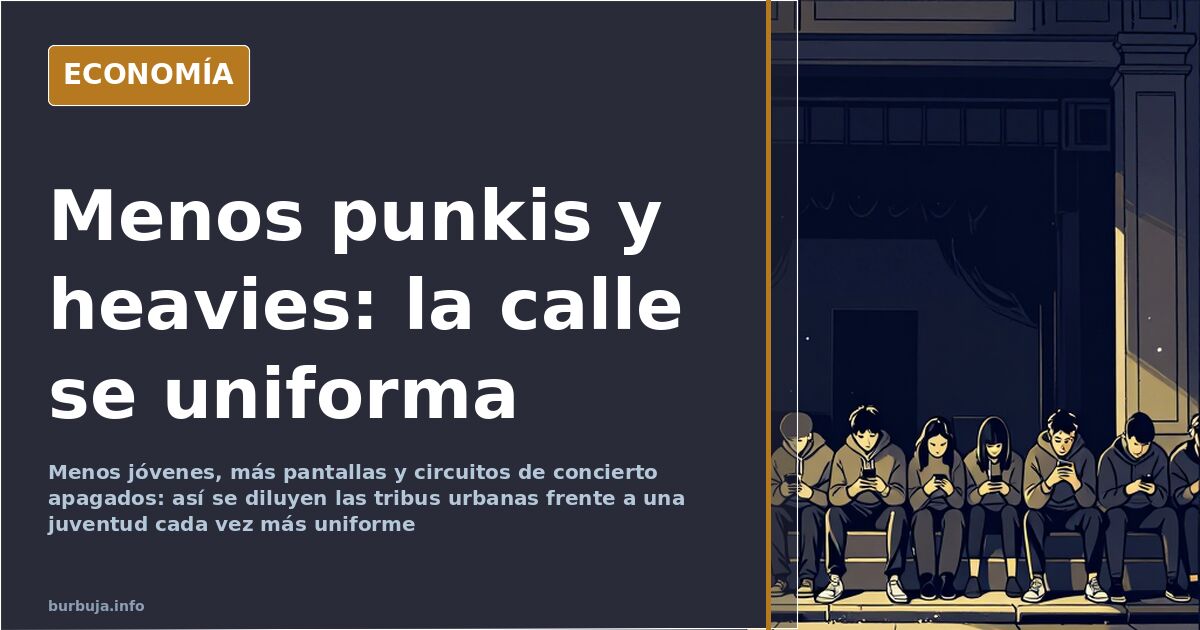
Urban tribes: less street life, more screens, all the same
Those approaching fifty grew up distinguishing heavy metal fans from skinheads by their look, neighborhood, and concert types. Four decades later, the image defining much of that generation is different: kids on scooters, wearing helmets, tracksuits, and the same cap. Of the old urban fauna—rockers, punks, rappers, skins, preppies, bakalas, goths—barely traces remain.
The question isn't neighborhood nostalgia. It's economics. Urban tribes were never just aesthetic: they were closed markets, leisure circuits, and consumption networks that worked because finding your people required leaving home. That mechanism has broken along several paths at once, none requiring conspiracy.
The street ceased to be where people meet
The most repeated argument points to a single material change: relationships are no longer built on the sidewalk. Those who wanted to gather with like-minded peers had to go to a concert, a bar, or a square. Now they find them online, without moving from the sofa. The internet, which promised to multiply diversity, has done the opposite: it pushes young people in the same direction because everyone looks at the same place and frequents the same social media.
There is a second layer, less obvious. Tribes needed scarcity. When music, clothing, or references arrived drop by drop, each subculture closed in on itself and differentiated. With an infinite catalog available in your pocket, the mystique of the ghetto dissolves. Why adopt an entire aesthetic when you can copy any fragment over a weekend?
This nuance matters because it deactivates nostalgia. We don't long for a better youth, but for specific infrastructure—venues, cheap concerts, screen-free free time—that costs more to build today. When that infrastructure disappears, group identity moves to the only place where it remains free and massive: the network.
Fewer young people, fewer concerts, less street time
Demography puts a hard floor under the phenomenon. Many of those tribes were imported products of Americanization and, fundamentally, an international phenomenon: globalization didn't create or kill them, but explains why remaining ones look so similar across countries. They formed around band concerts. That circuit has almost completely died out: live music lost its function as a meeting point, and football, which also gathered groups on match days, has become a more comfortable and less vocal hobby.
Add the collapse of street time. A smaller generation, with more screens and more domestic leisure—video games, porn, platforms—has fewer hours on the sidewalk and fewer reasons to build group identity against other groups. The virulence of before wasn't a virtue: it was the price of sharing physical space and competing for it.
Why does today's anti-establishment look so much like the one next door?
Because the framework has homogenized, and this is the most debated part of the issue. One current holds that youth is more conformist than any other: largely supporting official discourse on climate, equality, vaccines, and foreign policy, leaving real rebellion only for views contrary to consensus. The objection is reasonable: perhaps there is no submission, but a broad social consensus that has devoured any dissent.
What almost nobody disputes is the aesthetic effect. Rebellion has become a uniform: tattoos for every arm, the same way of dressing, the same gestures and apps. A high school teacher describes it bluntly: there are whole cohorts listening to the same thing, dressing alike, and consuming the same anxiolytics. The paradox is served: the more uniqueness is proclaimed, the more everyone looks alike.
Digital dating and theories of uniformity
There are theses for all tastes. The most frivolous seems the most effective: if the adolescent goal was flirting, and dating is now managed via app, tribes lose their showcase function. The starkest analysis reduces the market to three winning profiles—the textbook handsome guy, the trap-aesthetic tracksuit wearer, the niche member—and excludes anyone else. Others imitate these three models. And imitation is exactly the opposite of a subculture.
Other explanations are older or more sinister. Uniformity is pointed to as a natural tendency of mature societies, with the Roman Empire example: diverse peoples and languages at first, a single administration and faith at the end. A suspicious physical factor is also mentioned, the lead in gasoline breathed by several generations, and theories circulate about social fragmentation as a control tool. These last ones should be left where they are: without proof.
Where the analysis gets stuck
Nobody fully squares why, if everything pushes toward the same mold, large cities still have visible variety, with new subgroups and recognizable aesthetics. Perhaps tribes haven't died: perhaps they've become smaller, briefer, and harder to see from the sidewalk of a bedroom community.
What seems firm is the dissection of the old fauna. Heavies, punks, and goths are considered extinct; rappers have reconverted into trappers; preppies never left. The rest is a mass with the same tracksuit and the same phone. The possibility remains open that the question is wrongly posed: perhaps tribes aren't missing, but the street to form them.
Those approaching fifty grew up distinguishing heavy metal fans from skinheads by their look, neighborhood, and concert types. Four decades later, the image defining much of that generation is different: kids on scooters, wearing helmets, tracksuits, and the same cap. Of the old urban fauna—rockers, punks, rappers, skins, preppies, bakalas, goths—barely traces remain.
The question isn't neighborhood nostalgia. It's economics. Urban tribes were never just aesthetic: they were closed markets, leisure circuits, and consumption networks that worked because finding your people required leaving home. That mechanism has broken along several paths at once, none requiring conspiracy.
The street ceased to be where people meet
The most repeated argument points to a single material change: relationships are no longer built on the sidewalk. Those who wanted to gather with like-minded peers had to go to a concert, a bar, or a square. Now they find them online, without moving from the sofa. The internet, which promised to multiply diversity, has done the opposite: it pushes young people in the same direction because everyone looks at the same place and frequents the same social media.
There is a second layer, less obvious. Tribes needed scarcity. When music, clothing, or references arrived drop by drop, each subculture closed in on itself and differentiated. With an infinite catalog available in your pocket, the mystique of the ghetto dissolves. Why adopt an entire aesthetic when you can copy any fragment over a weekend?
This nuance matters because it deactivates nostalgia. We don't long for a better youth, but for specific infrastructure—venues, cheap concerts, screen-free free time—that costs more to build today. When that infrastructure disappears, group identity moves to the only place where it remains free and massive: the network.
Fewer young people, fewer concerts, less street time
Demography puts a hard floor under the phenomenon. Many of those tribes were imported products of Americanization and, fundamentally, an international phenomenon: globalization didn't create or kill them, but explains why remaining ones look so similar across countries. They formed around band concerts. That circuit has almost completely died out: live music lost its function as a meeting point, and football, which also gathered groups on match days, has become a more comfortable and less vocal hobby.
Add the collapse of street time. A smaller generation, with more screens and more domestic leisure—video games, porn, platforms—has fewer hours on the sidewalk and fewer reasons to build group identity against other groups. The virulence of before wasn't a virtue: it was the price of sharing physical space and competing for it.
Why does today's anti-establishment look so much like the one next door?
Because the framework has homogenized, and this is the most debated part of the issue. One current holds that youth is more conformist than any other: largely supporting official discourse on climate, equality, vaccines, and foreign policy, leaving real rebellion only for views contrary to consensus. The objection is reasonable: perhaps there is no submission, but a broad social consensus that has devoured any dissent.
What almost nobody disputes is the aesthetic effect. Rebellion has become a uniform: tattoos for every arm, the same way of dressing, the same gestures and apps. A high school teacher describes it bluntly: there are whole cohorts listening to the same thing, dressing alike, and consuming the same anxiolytics. The paradox is served: the more uniqueness is proclaimed, the more everyone looks alike.
Digital dating and theories of uniformity
There are theses for all tastes. The most frivolous seems the most effective: if the adolescent goal was flirting, and dating is now managed via app, tribes lose their showcase function. The starkest analysis reduces the market to three winning profiles—the textbook handsome guy, the trap-aesthetic tracksuit wearer, the niche member—and excludes anyone else. Others imitate these three models. And imitation is exactly the opposite of a subculture.
Other explanations are older or more sinister. Uniformity is pointed to as a natural tendency of mature societies, with the Roman Empire example: diverse peoples and languages at first, a single administration and faith at the end. A suspicious physical factor is also mentioned, the lead in gasoline breathed by several generations, and theories circulate about social fragmentation as a control tool. These last ones should be left where they are: without proof.
Where the analysis gets stuck
Nobody fully squares why, if everything pushes toward the same mold, large cities still have visible variety, with new subgroups and recognizable aesthetics. Perhaps tribes haven't died: perhaps they've become smaller, briefer, and harder to see from the sidewalk of a bedroom community.
What seems firm is the dissection of the old fauna. Heavies, punks, and goths are considered extinct; rappers have reconverted into trappers; preppies never left. The rest is a mass with the same tracksuit and the same phone. The possibility remains open that the question is wrongly posed: perhaps tribes aren't missing, but the street to form them.
Summary of a discussion on Burbuja.info - Foro de economía, actualidad y política., translated from Spanish and reviewed before publication. Read the full discussion (152 replies).
More summaries
-
Spain's Gen Z: Why Urban Tribes Vanished
Uniform youth aesthetics clash with 90s subcultures due to social media, reggaeton, and pandemic isolation.
-
Spain's 'Charo' Slang Turns 10: From Niche Forum to Social Media
The term 'Charo' spread on October 20, 2011, in a Spanish forum and a decade later is used on social media, while 'señoro' never caught on.
-
Kirkaversary: Viral Social Media Trend Honoring Charlie Kirk's Death Anniversary
The 'Kirkaversary,' a viral celebration of Charlie Kirk's death anniversary, sparks debate online. Understand the phenomenon.
-
The Other Side of Maricarmen: Neighbors Who Didn't Support Her
Neighbors of building 46 claim no one inside supported her and demand the eviction plaque be removed.
-
Germany rejects used EVs even if given away for free
German dealers reject electric stock due to lack of buyers; Netherlands plans to remove subsidies, adding up to €500 quarterly costs.
-
Miss Universe ownership and new beauty standards spark debate
Miss Universe is a private business owned by Anne Jakrajutatip; controversy surrounds the trans woman from Portugal and the Nepali candidate.