
Spain's Health Complaint Response Accuses Patient of Violence
A patient complained about treatment at a Spanish health center and received a letter warning her against using violence against staff.
English · Original discussion in Spanish · Published
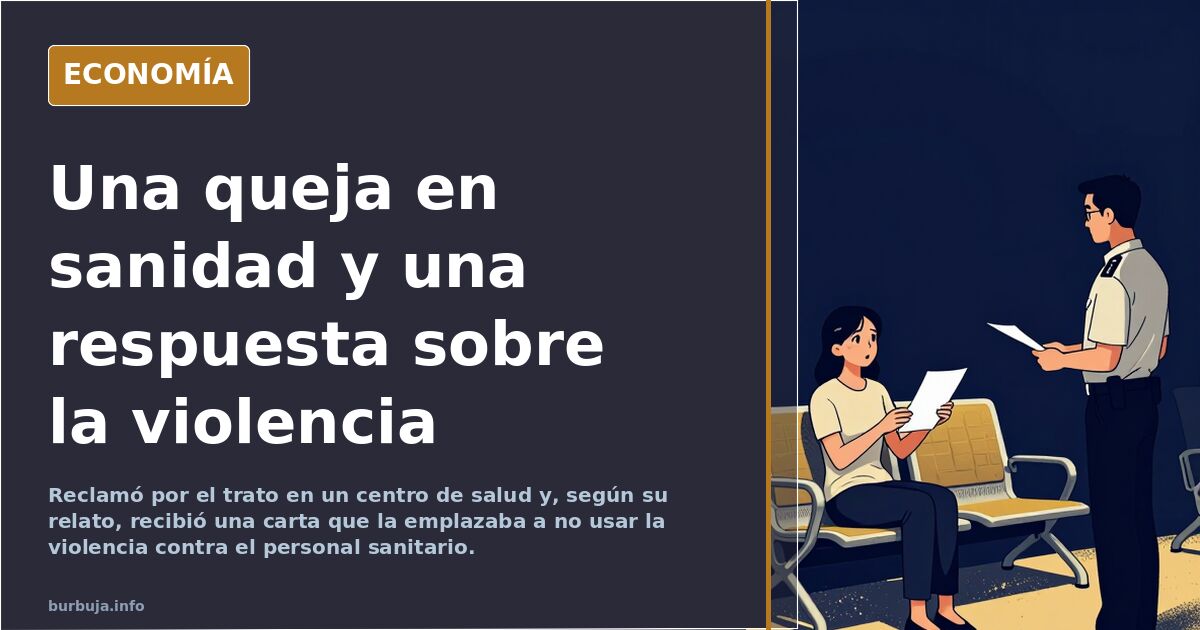
Health Center Letter Warns Patient Who Filed Complaint
She filed a complaint regarding the treatment received at a primary care center. According to her account, the response arrived as a letter: a text urging her not to resort to violence and to channel any grievances through "legal channels." The episode, shared by the affected individual herself, has reignited discontent over how complaints are processed in Spain's public healthcare system and left an uncomfortable question hanging: since when is protesting unsatisfactory care synonymous with making threats?
According to the cited excerpts, the reproduced content was explicit: the missive reminded her that "violence is never the way" and that "any complaint you may have has its PROPER avenues of expression," while also urging her not to exercise violence against a healthcare professional. The result was a short-circuit: someone who had filed a complaint was answered with a warning about violence that, in her version, never occurred. What a patient service manual.
How a Complaint Becomes a Warning
The account of the affected woman —a lawyer by training and active on social media— points to an exchange with the center that ended in a formal document. It was not an acknowledgment of receipt nor an apology: it was a notice. The dominant feeling was that the institution had inverted the claim and placed the complainant in the role of potential aggressor.
There is no certainty regarding the authorship and signature of the writing, and some doubt whether it carried any signature: it is recalled that during the pandemic many orders arrived unsigned or without citing legal backing. The difference is not minor: a letter with an institutional signature and public money behind it is one thing; an unidentified notice is another. And no one has confirmed which of the two it was.
Use of National Health System Data Under Suspicion
The most repeated objection was not the tone, but the trail. Where did the patient's data come from? Some see it clearly: use of clinical information for purposes unrelated to care, aggravated by the fact that the response would have cost public money. The proposed route is judicial, not epistolary.
The argument has simple logic. If there were an assault, the natural course is to report it to a judge, not send a letter home. If it doesn't exist, then the letter is superfluous. In both scenarios, the chosen procedure grates. The suspicion, for now, remains just that: suspicion without known resolution.
Year-and-a-Half Waiting Lists: Public Healthcare in the Crosshairs
Behind the specific case looms the underlying criticism. One of the phrases that best summarizes the anger asserts that a real aggression is a year-and-a-half waiting list to get a test. It is not an official figure, but the formulation of a recurring discomfort: delay as everyday violence.
Against this narrative, another part defends the opposite. Emergency services appear as the counterpoint: the case of a patient who had been dragging an undiagnosed problem since adolescence is told, about ten years of GP consultations attributing it to anxiety, and who in emergency was diagnosed in less than an hour with a couple of blood tests and an electrocardiogram. The conclusion drawn is uncomfortable: the entire system does not fail, specific segments do.
Civil Servants, Merit, and Choosing a Doctor: The Other Fight
This links to the chapter on the model. In private healthcare, argues one current, the patient chooses based on word-of-mouth and results; in public, "you get whoever you get" and, in the eyes of the system, all physicians are equal. Merit is reduced to passing an exam, the MIR (Resident Medical Internship), and afterwards nothing measures who cures more and who less.
And it is recalled that the MIR is not precisely a formality. And the proposals appearing in the conversation go much further: drastic reduction of certain profiles in healthcare and town halls, tax cuts, suppression of autonomous communities. It is the terrain where the case ceases to be an anecdote and becomes ammunition.
The Origin of Discontent: From Applause to Complaint
One cannot understand the temperature without looking back, according to one of the participants. When the daily applause for healthcare workers at eight in the evening —encouraged by the media, in their version— turned the sector into an untouchable collective, some warned that a monster was being fed. Years later, these same people maintain that public healthcare arrives at the appointment with eternal times, telephone booking, and a feeling that complaining serves no purpose.
The closure arrives where the case gets stuck. There is no known resolution, no confirmation of who signed, nor answer regarding the destination of the data. The only clear thing is the distance between filing a complaint and receiving, in return, a warning. And that distance, today, no one has been able to measure.
She filed a complaint regarding the treatment received at a primary care center. According to her account, the response arrived as a letter: a text urging her not to resort to violence and to channel any grievances through "legal channels." The episode, shared by the affected individual herself, has reignited discontent over how complaints are processed in Spain's public healthcare system and left an uncomfortable question hanging: since when is protesting unsatisfactory care synonymous with making threats?
According to the cited excerpts, the reproduced content was explicit: the missive reminded her that "violence is never the way" and that "any complaint you may have has its PROPER avenues of expression," while also urging her not to exercise violence against a healthcare professional. The result was a short-circuit: someone who had filed a complaint was answered with a warning about violence that, in her version, never occurred. What a patient service manual.
How a Complaint Becomes a Warning
The account of the affected woman —a lawyer by training and active on social media— points to an exchange with the center that ended in a formal document. It was not an acknowledgment of receipt nor an apology: it was a notice. The dominant feeling was that the institution had inverted the claim and placed the complainant in the role of potential aggressor.
There is no certainty regarding the authorship and signature of the writing, and some doubt whether it carried any signature: it is recalled that during the pandemic many orders arrived unsigned or without citing legal backing. The difference is not minor: a letter with an institutional signature and public money behind it is one thing; an unidentified notice is another. And no one has confirmed which of the two it was.
Use of National Health System Data Under Suspicion
The most repeated objection was not the tone, but the trail. Where did the patient's data come from? Some see it clearly: use of clinical information for purposes unrelated to care, aggravated by the fact that the response would have cost public money. The proposed route is judicial, not epistolary.
The argument has simple logic. If there were an assault, the natural course is to report it to a judge, not send a letter home. If it doesn't exist, then the letter is superfluous. In both scenarios, the chosen procedure grates. The suspicion, for now, remains just that: suspicion without known resolution.
Year-and-a-Half Waiting Lists: Public Healthcare in the Crosshairs
Behind the specific case looms the underlying criticism. One of the phrases that best summarizes the anger asserts that a real aggression is a year-and-a-half waiting list to get a test. It is not an official figure, but the formulation of a recurring discomfort: delay as everyday violence.
Against this narrative, another part defends the opposite. Emergency services appear as the counterpoint: the case of a patient who had been dragging an undiagnosed problem since adolescence is told, about ten years of GP consultations attributing it to anxiety, and who in emergency was diagnosed in less than an hour with a couple of blood tests and an electrocardiogram. The conclusion drawn is uncomfortable: the entire system does not fail, specific segments do.
Civil Servants, Merit, and Choosing a Doctor: The Other Fight
This links to the chapter on the model. In private healthcare, argues one current, the patient chooses based on word-of-mouth and results; in public, "you get whoever you get" and, in the eyes of the system, all physicians are equal. Merit is reduced to passing an exam, the MIR (Resident Medical Internship), and afterwards nothing measures who cures more and who less.
And it is recalled that the MIR is not precisely a formality. And the proposals appearing in the conversation go much further: drastic reduction of certain profiles in healthcare and town halls, tax cuts, suppression of autonomous communities. It is the terrain where the case ceases to be an anecdote and becomes ammunition.
The Origin of Discontent: From Applause to Complaint
One cannot understand the temperature without looking back, according to one of the participants. When the daily applause for healthcare workers at eight in the evening —encouraged by the media, in their version— turned the sector into an untouchable collective, some warned that a monster was being fed. Years later, these same people maintain that public healthcare arrives at the appointment with eternal times, telephone booking, and a feeling that complaining serves no purpose.
The closure arrives where the case gets stuck. There is no known resolution, no confirmation of who signed, nor answer regarding the destination of the data. The only clear thing is the distance between filing a complaint and receiving, in return, a warning. And that distance, today, no one has been able to measure.
Summary of a discussion on Burbuja.info - Foro de economía, actualidad y política., translated from Spanish and reviewed before publication. Read the full discussion (152 replies).
More summaries
-
Spain grants 'grandchildren law' nationals access to public healthcare without residency
Those naturalized under Spain's 'grandchildren law' can use the public health system without living in the country. We analyze the implications.
-
Spain plans to cover glasses and contacts in public health by 2026
Spain's health ministry aims to include vision care in the common service portfolio by 2026, though specific conditions remain undefined.
-
Código 10 publishes photos against PSOE: the scandal that wasn't
Código 10 releases allegedly compromising photos of a Socialist official. The expected political earthquake fizzles out as PSOE proves...
-
European car sales plunge: Germany down 28%, Spain 6.5%
Car registrations in Europe are falling sharply, with Germany seeing a 28% drop and Spain 6.5% in August, according to industry data.
-
Spain's housing minister shares landlord chats filtering tenants
Pablo Echenique shared chats of 2,000 Spanish landlords refusing to rent to families with children or migrants, citing legal risks.
-
23 of 24 UK abuse defendants share background, forum claims
Forum posts claim 23 of 24 UK abuse defendants share a migrant background. The case reignites debate on police inaction.