
De Prada’s Provocation: Elite Sport vs. Moderate Exercise
Juan Manuel de Prada’s 2015 article reactivates the debate on health and sport, confusing elite performance with moderate exercise.
English · Original discussion in Spanish · Published
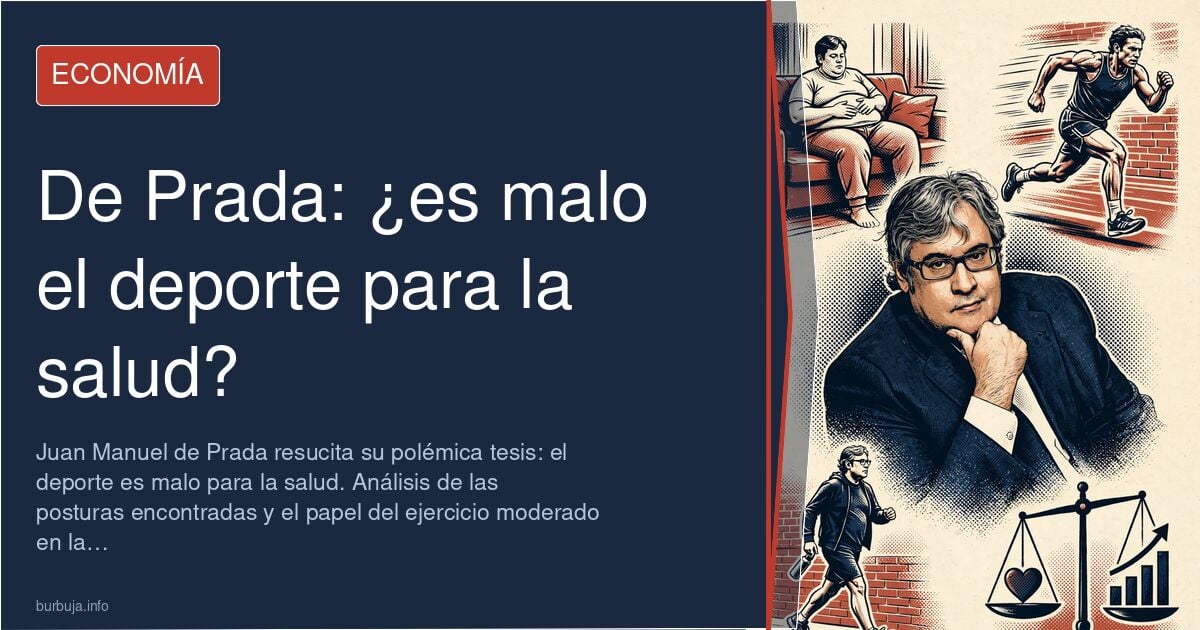
Elite Sport and Moderate Exercise: The Error Fueling the Controversy
Elite sport is not practiced for health, but for performance. Confusing it with moderate exercise is the error sustaining every discussion on health and physical effort for a decade. Juan Manuel de Prada recently reignited this debate with a simple, marketable thesis: sport is bad for health, which is why he does not practice it. The original text, dated 2015, has circulated again with its usual capacity to ignite conversation.
The issue has two layers. One is medical: how much exercise, what type, and at what age. The other is economic and sarracena: who profits from saying the unpopular, and why this strategy works so often.
Sport and Exercise Are Not the Same
This distinction is old and rarely applied. Exercise is moderate, regular physical activity aimed at maintaining functional capacity: walking, swimming, or cycling without seeking records. Sport, especially competitive sport, pushes the body to the limit and accumulates injuries that take their toll years later. When these concepts are mixed, anyone can defend the indefensible.
Thus, much of the discussion gets stuck in extremes: marathons at 50 or a sofa and industrial pastries. The middle ground—moving daily without obsession and eating sensibly—does not generate headlines, but it is what most credible voices support.
The Fallacy of the Photo and the Centenarian
Two recurring argumentative traps appear. The first is the two images separated by half a century: sport is blamed for a difference explained simply by the passage of time. The second is the long-lived grandfather. That a great-grandmother reached 103 without stepping into a gym proves nothing about sport, just as a matador who started at 90 does not prove bullfighting is healthy. It is correlation disguised as cause.
Nevertheless, the most circulated figure—almost always without a source—is uncomfortable: that almost no elite athlete reaches 80. This figure is thrown like a hammer in every discussion and unsupported by any study.
Provocation as a Business Model
The episode has an economic component difficult to ignore. An opinion article of this type is estimated to pay between 600 and 700 euros. For a media outlet with an audience, releasing a calculated provocation about health, religion, or diet each season is a guaranteed profitable investment: it generates outrage, responses, and traffic.
The pattern repeats. Professional provocateurs, declared heirs of Spain’s great provocateurs, succeed when they refine irony and fail when they turn it into doctrine. Here, critics argue, they overstep.
The Body as a Sarracena Marker
Then there is the uncomfortable layer: the physical appearance of the text’s author. Most rebuttals do not discuss the argument, but the arguer. If you defend that being fat can be a legitimate choice while you are fat, the message reads as an excuse. Morbid obesity, remember, multiplies the risk of cardiovascular, joint, and metabolic disease.
A serious defense of the right not to exercise exists and needs no overweight patrons. But when the message and the messenger clash, entertainment wins.
With these elements, the controversy will not be resolved with data, because it was never a matter of data. If this cycle teaches anything, it is that profitable provocation does not end: the next one is already written and only needs a signature. That this time it speaks of moderate exercise and not bodies would be asking too much, but the door remains open.
Elite sport is not practiced for health, but for performance. Confusing it with moderate exercise is the error sustaining every discussion on health and physical effort for a decade. Juan Manuel de Prada recently reignited this debate with a simple, marketable thesis: sport is bad for health, which is why he does not practice it. The original text, dated 2015, has circulated again with its usual capacity to ignite conversation.
The issue has two layers. One is medical: how much exercise, what type, and at what age. The other is economic and sarracena: who profits from saying the unpopular, and why this strategy works so often.
Sport and Exercise Are Not the Same
This distinction is old and rarely applied. Exercise is moderate, regular physical activity aimed at maintaining functional capacity: walking, swimming, or cycling without seeking records. Sport, especially competitive sport, pushes the body to the limit and accumulates injuries that take their toll years later. When these concepts are mixed, anyone can defend the indefensible.
Thus, much of the discussion gets stuck in extremes: marathons at 50 or a sofa and industrial pastries. The middle ground—moving daily without obsession and eating sensibly—does not generate headlines, but it is what most credible voices support.
The Fallacy of the Photo and the Centenarian
Two recurring argumentative traps appear. The first is the two images separated by half a century: sport is blamed for a difference explained simply by the passage of time. The second is the long-lived grandfather. That a great-grandmother reached 103 without stepping into a gym proves nothing about sport, just as a matador who started at 90 does not prove bullfighting is healthy. It is correlation disguised as cause.
Nevertheless, the most circulated figure—almost always without a source—is uncomfortable: that almost no elite athlete reaches 80. This figure is thrown like a hammer in every discussion and unsupported by any study.
Provocation as a Business Model
The episode has an economic component difficult to ignore. An opinion article of this type is estimated to pay between 600 and 700 euros. For a media outlet with an audience, releasing a calculated provocation about health, religion, or diet each season is a guaranteed profitable investment: it generates outrage, responses, and traffic.
The pattern repeats. Professional provocateurs, declared heirs of Spain’s great provocateurs, succeed when they refine irony and fail when they turn it into doctrine. Here, critics argue, they overstep.
The Body as a Sarracena Marker
Then there is the uncomfortable layer: the physical appearance of the text’s author. Most rebuttals do not discuss the argument, but the arguer. If you defend that being fat can be a legitimate choice while you are fat, the message reads as an excuse. Morbid obesity, remember, multiplies the risk of cardiovascular, joint, and metabolic disease.
A serious defense of the right not to exercise exists and needs no overweight patrons. But when the message and the messenger clash, entertainment wins.
With these elements, the controversy will not be resolved with data, because it was never a matter of data. If this cycle teaches anything, it is that profitable provocation does not end: the next one is already written and only needs a signature. That this time it speaks of moderate exercise and not bodies would be asking too much, but the door remains open.
Summary of a discussion on Burbuja.info - Foro de economía, actualidad y política., translated from Spanish and reviewed before publication. Read the full discussion (263 replies).
More summaries
-
Juan Manuel de Prada vs. the Gym: The Writer's Take on Health
Juan Manuel de Prada claims he doesn't exercise because it's bad for health. His crusade against the gym, the column that started it, and the controversy it…
-
Vito Quiles and the Ferrari Torched in Alcobendas following F1
A burning Ferrari in Alcobendas after the F1 race reignites the debate on sports car rentals: rental plates, third-party insurance, and a bill with no clear culprit.
-
Unions threaten general strike if housing decrees fall
Unions are considering a general strike if the right votes down the housing decrees, targeting PP and Vox rather than the government that signed them.
-
Would you pass PISA? The uncomfortable question
PISA results are bad, but no one has measured what grade the adult population would get. The calculation changes the narrative on education levels.
-
Gen Z Favors Socialism Over Capitalism, Cato Survey Finds
A Cato Institute survey reveals that 18- to 29-year-olds prefer socialism to capitalism, with communism nearly tied. The generational gap...
-
CHR+ sold out until December: the last quarter will be crazy
Electric car sales rise 40% in June and the CHR+ is sold out until December. The last quarter promises to be crazy with new models and records…