
Used oil at €210/tonne and batteries at €550: the money being thrown away
Sertego paid €210/tonne for used oil and €550/tonne for lead batteries in Teruel, Spain. Some claim garages charge to collect them and then…
English · Original discussion in Spanish · Published
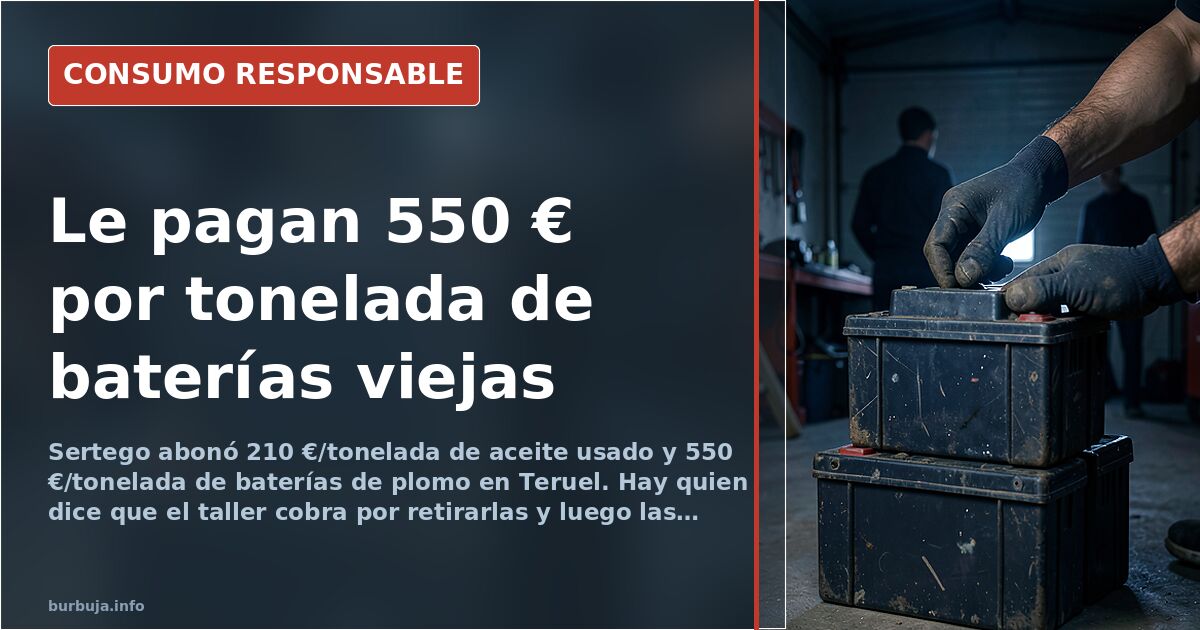
They pay 550 euros a tonne for used batteries and you hand them over for free at the garage
From 16 to 30 November 2013, the plant that Sertego Servicios Medioambientales runs in Teruel paid for the recyclable waste brought in by private individuals and businesses: 210 euros per tonne of used oil and 550 euros per tonne of lead batteries. The company itself announced this in a commercial letter dated 15 November, with no commitment required and two contact phone numbers to close the deal. The fine print set conditions: the oil had to meet the acceptance parameters of the Acceptance Document, and the lead price held as long as there was no sharp movement in its market rate during the month.
The bare figure dismantles a very widespread habit: handing your old battery over at the garage where they fit the new one and saying thank you. Some claim that quick-fit workshops even charge the customer for taking the waste away, and that the same waste is then sold on to the recovery plant. The business has two ends, and the private customer only sees one.
What you actually get paid for a car battery
The going rates people talk about vary widely. At a scrapyard, two old household batteries turned into 20 euros. In another case, the deal was settled at 5 euros per unit, regardless of weight. With the €550 per tonne rate in hand, the difference between being paid by the kilo or by the piece stops being a detail: it is the difference between recovering the waste's value and giving it away.
The anecdote that best sums up the general ignorance is almost comic. A driver had his bonnet up when someone came over to ask whether he was about to change the battery. That was when it dawned on him that this was not rubbish. What to him was a useless piece of junk was, to the visitor, raw material with a price tag.
The garage gets paid twice for the same battery
The circuit works like this: the customer pays for the new battery, pays — according to one account — a charge for the removal of the old one, and the business then places it in the recovery chain. The suspicion that the garage's margin comes free, or even at a profit, is not far-fetched. With batteries at five euros a piece, the sums people do out loud involve making 100 euros a day from the steady trickle of customers at a quick-fit workshop.
The alternative that wins out among those who have done the maths is twofold: buy the battery online — the saving is described as a fortune — and fit it yourself in the garage or at the local village workshop. And when choosing a model, go for the biggest one that fits the bay. The old battery, of course, is not left behind.
Used oil: the waste hardly anyone declares
The oil case is less visible and more toxic. The €210 per tonne rate at the Teruel plant turns every household container into a fraction of income, but the dominant habit is still to pour it away or dump it. The Acceptance Document's condition is a reminder that not everything qualifies: the oil must meet certain admission parameters, which means separating it properly and not mixing it with water or solvents.
The uncomfortable message underlying the whole operation is this: what gets thrown in the bin has a buyer. And the buyer, moreover, is a company that presents itself as the market leader in waste management and recovery. There is no charity in the rate. There is a market.
One question remains unanswered: if the price is published, the plant is open and the phone works, why do we keep giving away at the garage what we would be paid for at the scrapyard?
Also available in: Deutsch
Summary of a discussion on Burbuja.info - Foro de economía, actualidad y política., translated from Spanish and reviewed before publication. Read the full discussion (6 replies).
More summaries
-
Reusing frying oil: the fine line between saving money and your health
Filtering used oil does not remove the compounds generated by heat. Some experts recommend not exceeding 3 or 4 uses and never mixing new oil with old.
-
Washing without detergent: grated soap, used oil and lye
Grating half a bar of soap into the drum does wash clothes, but it is no substitute for detergent: without enzymes or zeolites, the real saving works out at around 73 euros a year.
-
Used Cooking Oil: Sink, Soap, or Biodiesel?
Disposing of used cooking oil sparks debate. Options range from the sink to homemade soap and biodiesel, each with hidden costs.
-
Lidl's frozen sardines at €3.90/kg vs. fresh ones
A kilo of frozen sardines costs €3.90 compared to €9-€10 for fresh ones in Madrid. The question is whether the flavor holds up after freezing.
-
Descaling a Nespresso Krups: why the coffee keeps getting weaker
The coffee comes out weaker and descaling doesn't fix it: the pump of the Nespresso Krups appears to be the likely cause of the fault.
-
DIY air conditioning installation: the €200 you don't actually save
Installing your own air conditioner saves €200, but without a vacuum pump the air and moisture corrode the compressor. The damage takes years to show up.